10 Things You Need to Know about Fall Protection
by Jonathan McGaha | 28 September 2011 12:00 am
Falls from heights are one of the leading causes of serious injury and death for workers in the construction industry. For a safe work environment, successful fall protection must be addressed and implemented at job sites. The following information can tell you how to do that.
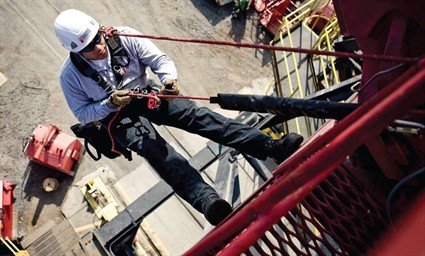
1. Falls happen.
Nearly 6.5 million people work at approximately 252,000 construction sites across the nation on any given day. According to the U.S. Occupational Safety and Health Administration, the fatal injury rate for the construction industry is higher than the national average in this category for all industries. Each year, falls consistently account for the highest number of fatalities in the construction industry. On average, between 150 and 200 workers are killed and more than 100,000 are injured as a result of falls at construction sites, each year. A number of factors are often involved in falls, including unstable working surfaces, misuse of or failure to use fall protection equipment, and human error.
2. Plan for it.
Fall protection must be planned for ahead of time; it cannot be done at the last minute. “Planning for safe work at heights should follow a hierarchy of control,” says John Giovengo, fall protection product engineering manager at MSA, Cranberry Township, Pa. “Each choice has a place and time. The first choice is engineering to eliminate the fall hazard. The second choice is fall prevention equipment, like platforms and railings, lifts, scaffolding and fall restraints. The final choice is personal fall protection. A complete fall protection program must also include an emergency rescue plan. Workers must be rescued in a minimum amount of time. Define the plan during the hazard and risk assessment.”
3. Use lifesaving equipment.
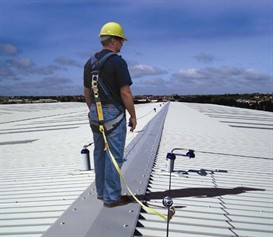
There are four key equipment components to a fall protection system: anchorage, body support, connectors and descent/rescue. The anchorage is the secure point of attachment for the fall arrest systems. Anchorages vary by industries, the job being performed, the installation type and the structure available. It must be able to withstand fall arrest forces. The full-body support harness provides the necessary body support with straps that fasten around the user and distribute fall arrest forces over the upper thighs, pelvis, chest and shoulders. A connector, such as a shock absorbing lanyard or self-retracting lifeline, is a device that links the user’s full-body harness to an anchorage. When used with a fall-restraint system, the connector must be short enough so that the worker cannot reach a fall hazard. Personal fall arrest systems must be inspected prior to each use for wear damage and other deterioration. Descent and rescue devices are an essential part of the fall protection program, and can retrieve or lower a fallen worker to the ground.
4. Select correct equipment.
While the four devices mentioned above are fall protection key components, there are literally thousands of products available to keep a worker safe from falling from heights. “Modern fall protection solutions include comfortable and easy-to-use harnesses, ladder climbing systems, twin leg lanyards or vertical lifelines with rope grabbing fall limiters; retractable devices that allow worker movement while staying tied off; and for anchorages there are tie-back lanyards and portable counterweight anchors,” Giovengo says. Finding an acceptable anchorage is a challenge for many employers. The best harness with the best lanyard or lifeline cannot arrest a fall if unsuitable anchorages are selected. An anchorage must support 5,000 pounds for a single tie-off point for one individual. The free fall should be limited to 6 feet or less. “In the past few years there have been many creative, and more importantly, functional, anchorage devices developed,” says Kevin Denis, training manager, Gravitec Systems Inc., Bainbridge Island, Wash. “There are anchorage connectors that attach to the seam of metal roofs, anchorages that pin or bolt through holes in structural steel, non-penetrating anchorages that use water, weights or even vacuum pressure to secure a worker to the structure. There are an equal number of permanent, fixed single anchorages and horizontal lifeline systems. Not every anchor works for every application. If a proper hazard assessment is conducted, equipment selection is relatively simple.”
5. New technologies.
The fall protection industry is very competitive and companies are constantly developing products to keep workers safe from fall hazards. “Recent innovation in the market has primarily focused on ease of use, comfort and added functionality,” Giovengo says. “For example, use of radio frequency identification makes it faster and easier to perform product inspections to ensure the product is in working order.” OSHA is acknowledging new technologies. “The WHALEN-JACK is the only non-ground based OSHA acknowledged scaffold/fall protection system that can be used in principle work steps providing an OSHA compliant safety platform while doing framing, shear walls, roof trusses, fascia, roof sheeting, windows, soffit and siding,” says Del Kitching, owner/partner of JD Systems LLC, Richmond, Calif., maker of the WHALEN-JACK.
6. Get trained.
Train all employees in all safety procedures and equipment. Post written instructions that are clear and written in different languages so all employees can read them. Use a competent and qualified trainer. “Be sure your training program is comprehensive and well documented,” says Brad Foster, director of field sales-Western U.S., Capital Safety, Red Wing, Minn. “If you utilize an external source for training, be sure to fully understand the value of what you are paying for. Often times, courses with the same name vary greatly in terms of quality and content.” There are many training options available to employers. “Computer based training, video and correspondence models, traditional classroom methods and on-the-job training are all commonly used training methods,” says Denis. “The use of fall protection equipment is a skill; therefore, whichever training method is employed should involve physical
‘observations of performance’ specific to the equipment and work practices expected of the employee. To withstand the test of litigation, it is difficult to defend a fall protection training program in which the employer never demonstrated how to use the equipment.”
7. Liability and enforcement.
Enforcing worker safety is important to the project owner, general contractor and subcontractor because all are liable when an accident occurs and proper fall protection is not being used. “To really address the ‘liability’ of a fall hazard, Gravitec Systems often recommends that an employer address fall protection from a ‘hazard assessment’ point of view rather than minimum compliance,” says Denis. “If an employer addresses fall hazards based upon the severity of an accident, feasibility of protection and basic risk management steps, rather than compliance, they will always have the best protection for that task, reducing their liability. They can defend their position, rather than state that minimum compliance was met. There are many holes in current regulations that allow workers to work under alternate procedures, fall protection plans and other systems that don’t offer a positive, secondary means of protection. Although compliant, an employer may not have a citation to deal with, they will still be dealing with an injured employee, lost time, compensation costs, increased insurance premiums, increased industry rates and increased liability. There are thousands of items of fall protection equipment and advancements in the way that buildings are designed, fabricated and constructed. If a fall occurs, even if the policy and work practices were ‘compliant,’ it is difficult to state that protection couldn’t be provided.” Occupational safety rule development and enforcement may be done by OSHA or by a state occupational safety and health agency with authority over the state in which the project is located. CalOSHA and Washington State’s Department of Labor and Industries are two examples. Compliance with rules in effect at a project location may vary from state to state- this is especially true with fall protection rules. For example, “Federal OSHA imposes a duty on construction employers to provide fall protection for workers when they are exposed to a fall hazard of 6 feet or greater,” says Harry Dietz, director of risk management, National Roofing Contractors Association, Rosemont, Ill. “Under CalOSHA rules, however, many roofing operations require employers to provide fall protection when workers are exposed to falls of 20 feet or greater. It’s important to note that state and federal requirements set minimum standards for worker protection-compliance with those standards allows a contractor to avoid fines from those agencies. Many contractors exceed those minimum standards for a variety of reasons: broader civil liability exposure avoidance; management commitment to a stronger safety culture; and requirements set by general contractors or building owners who control projects, to name a few.”
8. Violations.
OSHA citations for violations of its standards can be classified as “serious,” “other than serious,” “willful,” or “repeat.” Penalties vary according to the severity of the violation-serious violations are those where death or serious physical harm could result. “Fall protection violations invariably will be classified as serious by the agency and carry a maximum fine of $7,000,” Dietz says. “Willful violations are those where the employer shows an intentional or reckless disregard or plain indifference to the safety of workers. Willful violations have a maximum fine of $70,000. Repeat violations are assessed when an employer has been cited for a violation of the same or substantially similar standard within the past five years. Penalties for repeat violations are two times the original penalty for the first repeat violation, five for the second and 10 for the third with a maximum of $70,000.”
9. New regulations.
On Dec. 16, 2010, OSHA published a new compliance instruction for residential construction work. With an average of 40 workers per year being killed as a result of falling from a residential roof, action was taken to provide a safer workplace for construction workers. The new instruction cancels the original interim instruction issued in 1995 and 1999. The new requirements took effect on June 16, 2011 and require employers to follow the original fall protection guidelines from 1995, known as subpart M (Reference OSHA 1926.500-503). As stated in OSHA 1926.501, employees performing residential construction work who can fall 6 feet or more shall be protected by one or more forms of fall protection. Workers on low-sloped roofs (defined as having less than or equal to a 4:12 pitch) are no longer allowed to use slide guards as the only form of fall protection. Acceptable fall protection for low-sloped roofs includes guardrails, nets or personal fall arrest systems. Other combinations of protection are also acceptable (warning line and guardrail, warning line and personal fall arrest system). In some cases, a safety monitor is an acceptable form of fall protection according to OSHA.
10. Monitor your fall protection.
Monitoring is one of the best ways to deal with fall protection, liability, violations and regulations. Inspect your employees’ use of safety equipment and safety procedures to see if they are working safely. If they are not, instruct them on correct procedures. Watch out for employees who neglect safety procedures. Use corrective action. “It is a never ending process, you cannot be too strict, every accident affects other contractors as well as your company,” stresses Doss Briggs, manager, BRB Roofing in Muskogee, Okla. One resource available to employers to monitor safety is the ANSI/ASSE Fall Protection Code. It is a compilation of fall protection equipment and program management standards, specific to fall protection that can assist employers address fall protection at their site.
Ask the contractors
Metal Construction News asked two contractors
to describe in their own words how they
protect their workers from falls.
In most cases, our work crews perform their elevated
work from scissor lifts or from rolling scaffolds.
In both cases the means of fall protection is through
the use of guardrails. In some cases, neither of these
methods is practical to gain the reach to work areas
for various reasons. In these cases other traditional
means of fall protection need to be planned into the
work process. This planning requires a close look at
the specifics of the work location, height of work,
anchorage point options, etc., as there are many combinations
of fall protection equipment that can address
the various conditions that workers will encounter. The
only common denominators are a full-body harness as
the anchorage point, an anchorage connector, and the
type of lanyard that is selected based on the conditions
of the specific work area. There are constantly
changing conditions and every work area presents
you with different scenarios, which makes the planning
of fall protection very important to ensure the
correct combination of fall protection components are
selected for a given area of work. Training of both supervisors
and workers is essential so that the correct
combinations of equipment are used in different applications,
equipment is worn and inspected properly,
and if a fall event were to occur the equipment would
do the job that it is designed to do. In addition to
workers and supervisors being appropriately trained,
there is a designated fall protection competent person
involved with the planning and execution of work as it
relates to fall protection. Joel Becks, safety professional,
DPR Construction, Redwood City, Calif.
We always take a serious approach on our safety
program. We train on the first day of employment
and have weekly toolbox meetings at the beginning
of each new project and an intensive safety update
training is required by every crew member twice a
year. We also, of course, follow all OSHA guidelines
and training requirements. Our strategy is based on
education, education and education. We provide
our crews with the tools and equipment to keep
them safe from falls and training that makes them
competent to use the equipment properly. We train
on a regular basis and we have a NO tolerance policy.
Safety is serious and we take no exceptions to that.
Although the ultimate goal is to prevent any type of
fall from the roof, our crews are trained on rescue
and retrieval. In the event of a fall, our crews are also
highly trained and regularly updated on rescue and
retrieval procedures. A prompt rescue plan should
always be in place based on the type of equipment
being used. If you plan for a fall, plan for a rescue.
Tom Weihmuller, general superintendent/safety,
AARA Construction Inc., Phoenix
Source URL: https://www.metalconstructionnews.com/articles/10-things-you-need-to-know-about-fall-protection/