Jazz It Up
by Jonathan McGaha | 6 December 2011 12:00 am
The Bertram and Judith Kohl Building at the Oberlin Conservatory of Music in Oberlin, Ohio, houses a 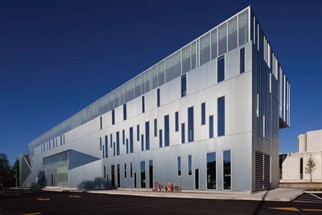 jazz studies program. The building creates a visual that brushes up against a historic Oberlin neighborhood and right into the Oberlin Conservatory’s Tappan Square. Nestled within a campus filled with buildings designed by the famous architect Minoru Yamasaki in the 1960s, the building also houses a recording studio, performance spaces, practice rooms and the largest jazz recording archive in the United States. Practice rooms and spaces with acoustical requirements are found on the lower levels while faculty offices can be found on the upper level. From the interior spaces, the building’s occupants are treated to a wide range of visuals. Windows of differing sizes look out to multiple views of the campus and the surrounding community.
The three-story, 37,000-square-foot facility was designed to meet LEED Gold standards. The designers chose to clad the building in 25,000 square feet of Eastman, Ga.-based Alcoa Architectural Products’ 4-mm Reynobond aluminum composite material panels with a PE core in a custom Pre-weathered Zinc Durabrite finish over brushed aluminum for the exterior walls, and 3,000 square feet of 4-mm Reynobond ACM with a PE core in an Anodic Clear finish for the soffits of the building. Additionally, metal fabricator and installer Riverside Group, Windsor, Ontario, Canada, supplied its R4-300 dry joint pressure equalized rainscreen system which was custom designed to suit actual built conditions.
“From the beginning, we planned to clad the exterior in aluminum,” explains Jonathan Kurtz, AIA, of Westlake Reed Leskosky, Cleveland. “It was a natural choice because Charles Martin Hall, an Oberlin alumni and one of the founders of Alcoa, donated the Tappan Square property to the college.”
Kurtz notes that meeting LEED certification requirements presented a challenge as the music building, housing a large number of instruments, must maintain constant humidity levels so as not to damage the instruments. Specifically a green roof system and stormwater run-off and filtration systems help the building meet specific targets for LEED accreditation.
While working on the project, the architects wanted to tie the building to the rest of campus.. The Yamasaki buildings contain precast concrete with an opalescent sheen, which appears to transform under different lights. To replicate the design aesthetic of the Yamasaki buildings, the Riverside Group worked with Alcoa to create a custom finish that mimics the effects of the precast concrete. The end result is a vibrant visual created by the sheen of the aluminum that fits the creative atmosphere of the campus
The Bertram and Judith Kohl Building at the Oberlin Conservatory of Music, Oberlin, Ohio
Completed: April 2010
Total Square Feet: 37,000 square feet
Building Owner: Oberlin Conservatory of Music, Oberlin
Architect: Westlake Reed Leskosky, Cleveland, www.wrldesign.com[1]
General Contractor: The Krill Co., Cleveland, www.krill.com[2]
Metal Panel Fabricator and Installer: Riverside Group, Windsor, Ontario, Canada, www.riversidegroup.net[3]
Metal Wall Panels: Alcoa Architectural Products, Eastman, Ga., www.alcoaarchitecturalproducts.com[4]
- www.wrldesign.com: http://www.wrldesign.com
- www.krill.com: http://www.krill.com
- www.riversidegroup.net: http://www.riversidegroup.net
- www.alcoaarchitecturalproducts.com: http://www.alcoaarchitecturalproducts.com
Source URL: https://www.metalconstructionnews.com/articles/2011-mcn-awards-honorable-mention-1/