A Modernized Rural Structure
by Marcy Marro | 2 November 2020 12:00 am
Campus flagship building serves as an educational tool
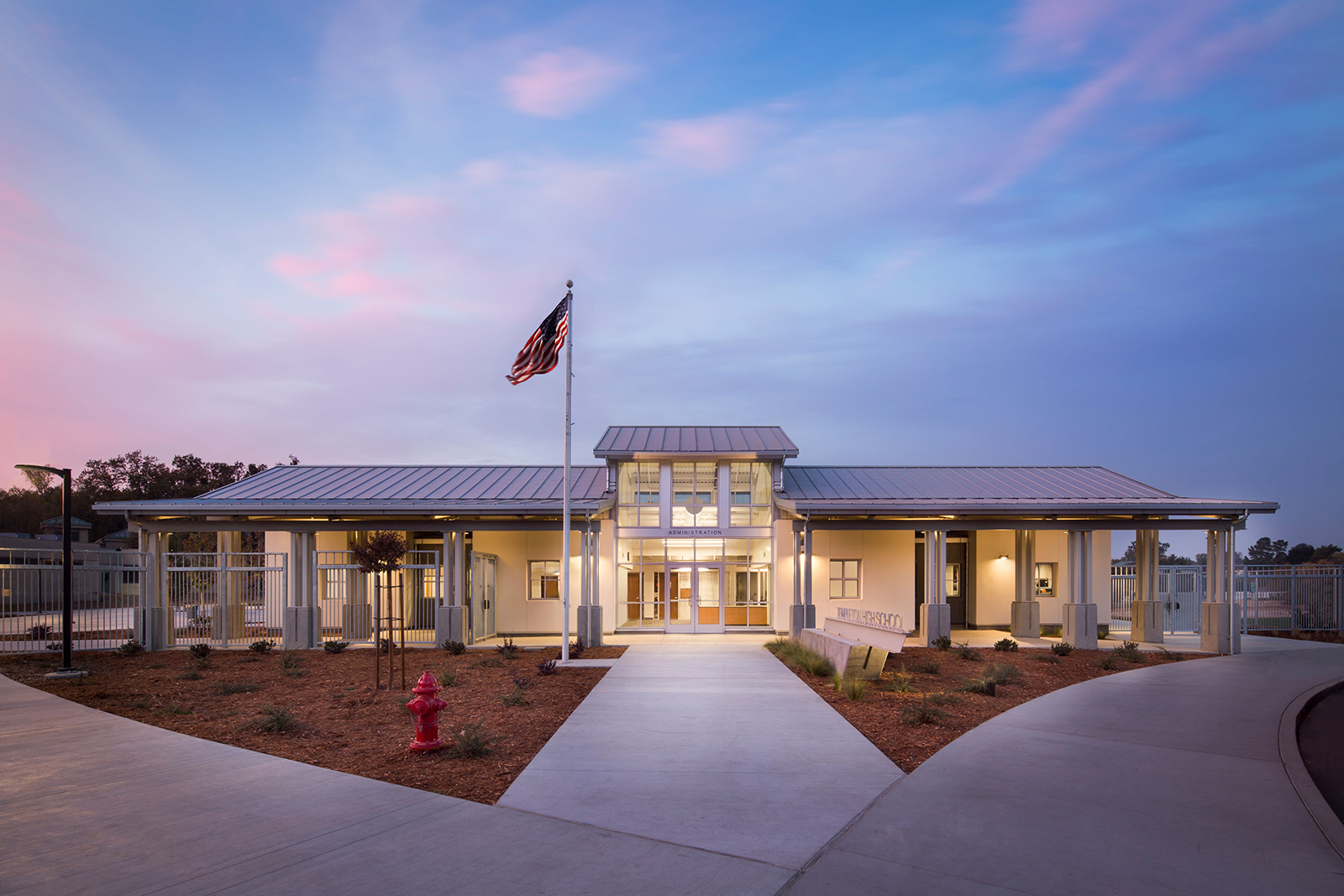
Photo: Jason Rick, Jason Rick Photography
The 8,500-square-foot building has five science classrooms and 2,600 square feet of administration space. A centralized lecture space provides an open volume with plenty of balanced light along with exposed structural and mechanical systems. Additionally, outboard lab spaces are designed for collaborative group work with low ceilings and more controlled lighting. Designed as a modern rural structure, the STEM/Admin building has asymmetrical gable end standing seam roofs that delineate the classroom teaching space, as well as board and batten siding that serves as a nod to local history, and metal panel siding and smooth plaster that articulates its internal functions.
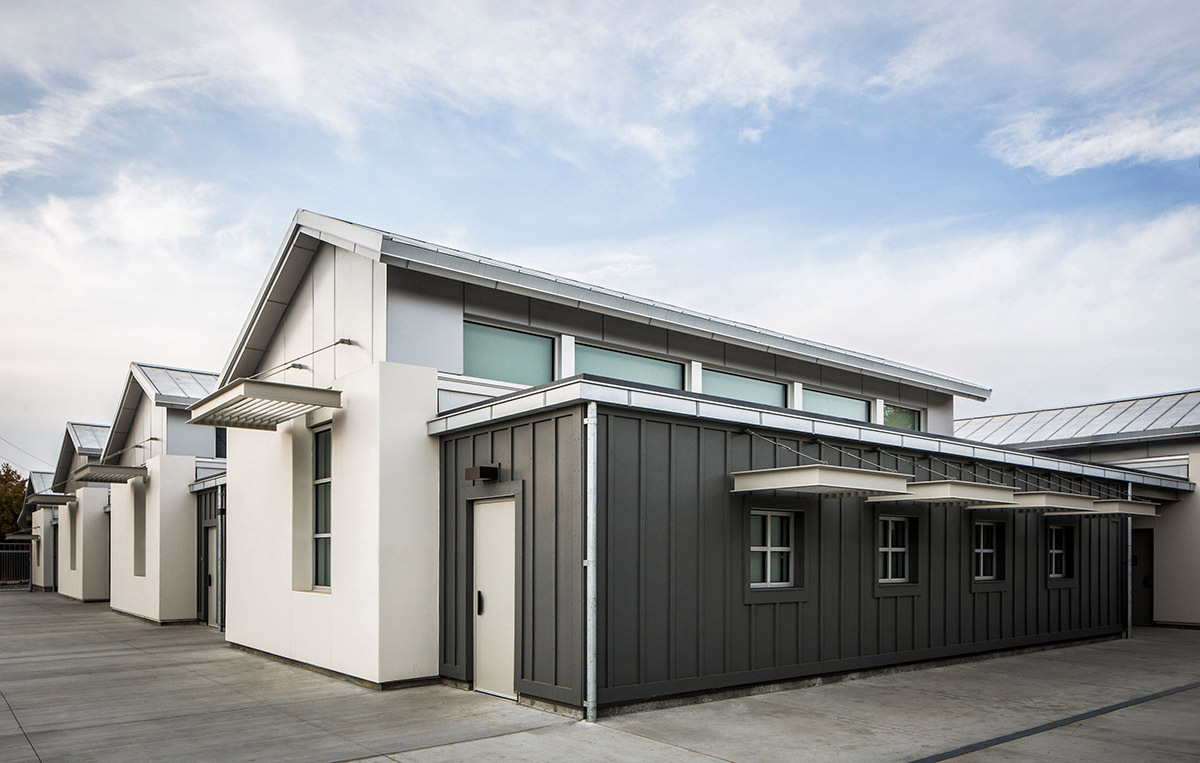
Photo: Jason Rick, Jason Rick Photography
Campus Dynamics
Located on a public high school campus in a rural part of California’s Central Coast, simple forms and materials derived from the surrounding rural community define the building. Mat Gradias, AIA, principal architect at Santa Barbara, Calif.-based Kruger Bensen Ziemer Architects Inc.[1], says it was important to provide a contemporary architectural solution that fits within the surrounding rural context. “Building forms and building materials were an integral part of achieving a solution that was both an upgrade to the campus architecture while remaining authentic to the region,” he explains. “Working from the existing campus layout, we located the new building in a manner that provided for a new central arrival point that also serves as a central courtyard.”
Introducing a new building design into the campus was a challenge. “Apart from a few buildings, most of the campus was built in the late ‘70s and late ‘90s,” Gradias explains. “A lot of code changes, building systems and construction methods have changed since that time, so trying to minimize the impact those changes have for the user groups was an important challenge. Creating a new campus entry and flagship building within budget was also a challenge.”
With its primary function to teach STEM education, the designers looked at exposing its building systems as an educational tool. The building incorporates a steel brace frame structural system with metal stud framing, which when exposed became a central design aesthetic for the building. “As the design evolved, this idea of exposing the building systems seemed like a logical next step in the design,” Gradias says. “It helped that our metal decking also had acoustic properties, so we didn’t need to supplement the exposed metal deck with additional materials.”
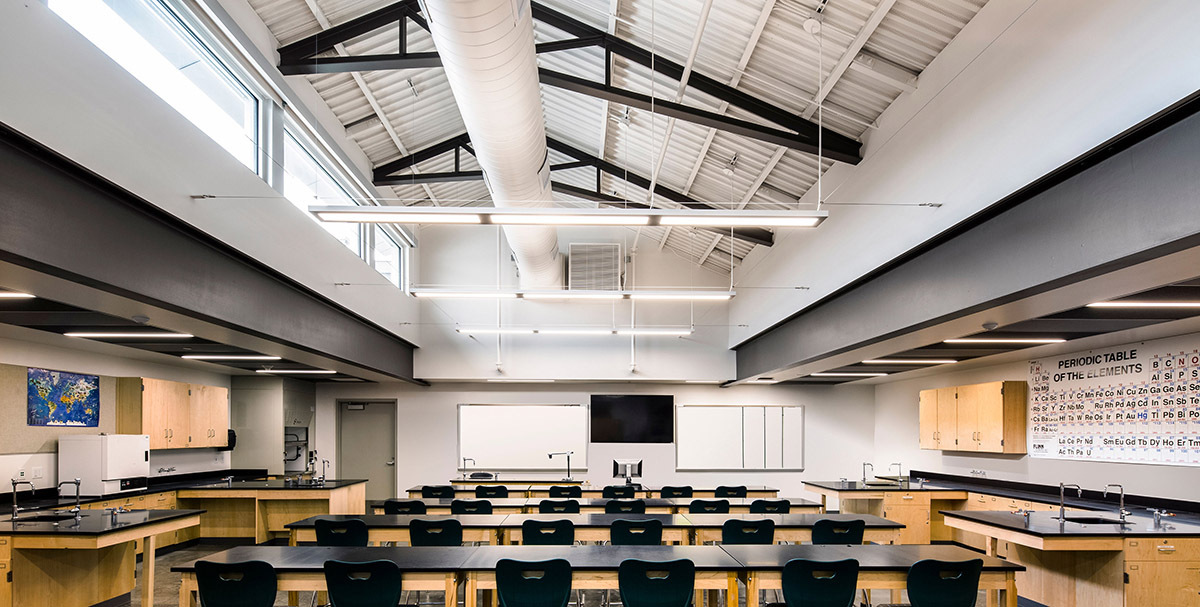
Photo: Jason Rick, Jason Rick Photography
Material Palette
The designers developed a palette for the project from the historic buildings in the community, as well as from materials that work well in that climate zone. “Because durability was also important,” Gradias says, “we selected materials that are durable and weather gracefully.”
Gradias says metal became an immediate solution for the project because it comes in a variety of forms and finishes and has a historic use as a building finish. “In this specific purpose, the material provides a durable, long-lasting solution while also providing a nod toward the historic rural structures within the community,” he says.
For the roof, the designers used 10,700 square feet of West Sacramento, Calif.-based AEP Span[2]’s 22-gauge, 22 1/4-inch-wide Select Seam Narrow Batten panels in Zincalume Plus. “Touring the community, it was apparent that a variation of a metal standing seam gable end roof would offer a durable contemporary solution that was rooted to regional architecture,” Gradias says. “To achieve a well-worn look when completed, the standing seam roof was left unprotected during construction, allowing the Zincalume Plus finish to patina over the course of construction.”
Additionally, the project features 1,500 square feet of Envelope 2000 system metal wall panels in Champagne Metallic from Citadel Architectural Products[3], Indianapolis. While the building forms and finishes reference traditional structures of the region, Gradias says it is the consistent surface appearance of the aluminum panels that provide a contemporary visual break between the soft plaster walls and the patina of the standing seam roof. “The [Champagne Metallic] finish was selected to warmly reflect the surrounding context in a chameleon-like manner,” he says, “mimicking the immediate surroundings.”
There are also 11 custom-made louvers on the building for sun protection, which were developed using BIM models in conjunction with computer-based sun studies.
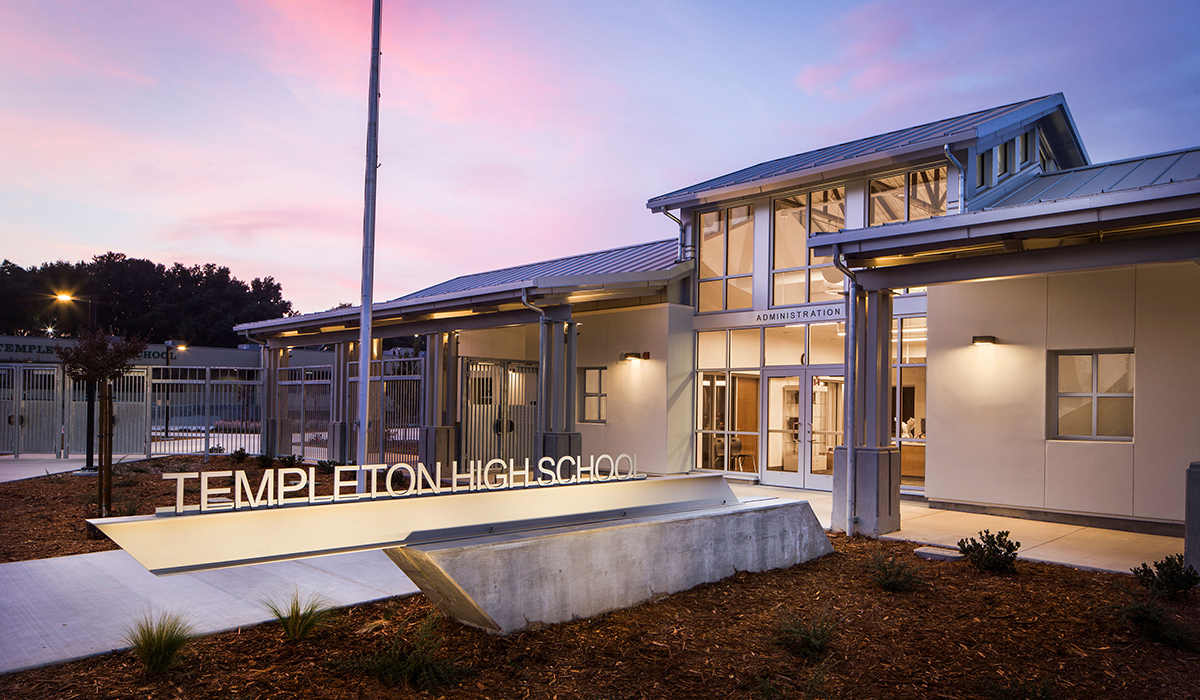
Photo: Jason Rick, Jason Rick Photography
High-Performance Building Envelope
The project, which was awarded a 2019 Honor Award from AIA Santa Barbara, reflects a site-specific integrated approach to design. Due to its location, there was a tremendous amount of focus on the building envelope, which resulted in using a high-performance continuous insulation rainscreen wall system. The Dow-Knight CI System from DuPont Performance Building Solutions[4], Wilmington, Del., and Knight Wall Systems[5], Deer Park, Wash., provided an integrated solution from studs to substrate.
“In the summer, the temperature can range from 50 degrees in the morning to over 90 degrees in the afternoon,” Gradias says. “It was important for us to address this large swing in temperature without relying solely on the mechanical system. Using the rainscreen with a continuous insulation system provides a great buffer against these temperature swings. In simple terms, the building acts as thermos bottle.”
During construction, and prior to the HVAC system being operational, Gradias notes the temperature inside the building varied by 8 to 10 degrees, while the outside temperature swung 30 to 40 degrees, which he says is a testament to the system.
- Kruger Bensen Ziemer Architects Inc.: http://www.kbzarch.com/
- AEP Span: https://www.aepspan.com/
- Citadel Architectural Products: https://www.citadelap.com/
- DuPont Performance Building Solutions: https://www.dupont.com/building.html
- Knight Wall Systems: https://knightwallsystems.com/
- www.kbzarch.com : https://www.kbzarch.com
- www.rshconstructioninc.com : https://www.rshconstructioninc.com
- www.teamtopnotch.com : https://www.teamtopnotch.com
- www.dupont.com/building.html : https://www.dupont.com/building.html
- www.aepspan.com : https://www.aepspan.com
- www.citadelap.com : https://www.citadelap.com
- www.knightwallsystems.com : https://www.knightwallsystems.com
Source URL: https://www.metalconstructionnews.com/articles/a-modernized-rural-structure/