Aluminum Composite Material Panels and their Installation
by Paul Deffenbaugh | 1 May 2023 12:00 am
An appealing material for exterior cladding systems with many options

With the combination of the flat, protective outer aluminum layer and the strong inner core, ACM panels provide excellent rigidity, strength and durability. ACM panels are non-absorbent, water-resistant and easy to maintain—making them an ideal choice for exterior building applications.
Endless Options
ACM panels have become increasingly popular over the last few decades due to their adaptability, ease of installation and reliability. ACM panels come in an array of cores, various thicknesses, sheet sizes, and double- or single-sided sheets. The panels will not swell, corrode, rot, wick water or delaminate even under harsh conditions.
ACM panels are available in a wide-variety of long-lasting colors and an assortment of high-quality finishes, including smooth, stucco-embossed, matte, anodized, metallic, brushed, rusted, PVDF/Kynar 500, polyester and more.
Also, finish options that resemble natural materials, including metal (zinc, copper, steel, silver, etc.) and stone (slate, granite, marble, limestone, etc.), as well as wood types (oak, maple, walnut, bamboo, etc.) and various wood grains (circular, straight, wavy, etc.) have become more desirable throughout the years. Choosing to use ACM panels can be a more cost-effective solution than sheets of metal with similar thicknesses … all while maintaining an eye-catching appearance.
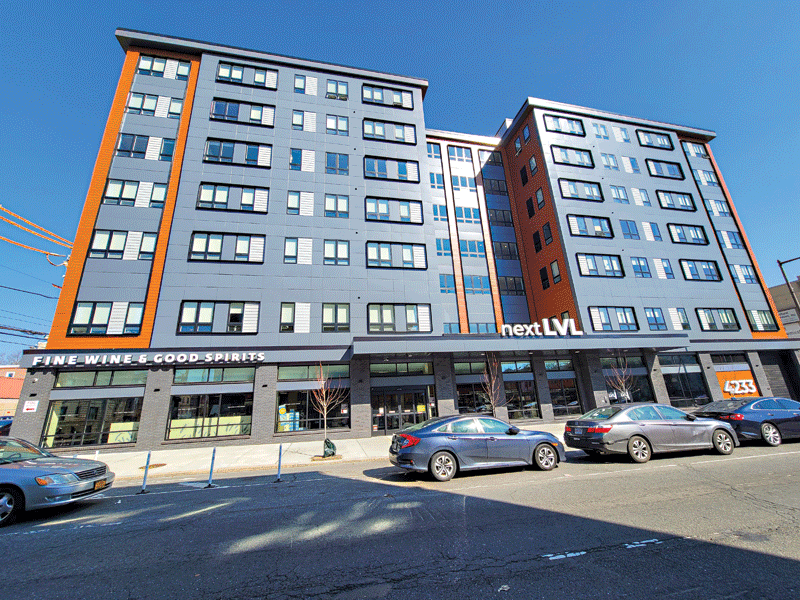
ACM Panel Installation Systems
Once the type of ACM product is selected, the installation system is typically the next consideration. The exterior wall envelope plays a multifunctional role in the performance of the overall building envelope. The International Building Code (IBC) has established performance requirements for water management, thermal performance and fire resistance for exterior wall envelopes.
There are various types of systems. Field-fabricated and shop-fabricated, which can produce different aesthetics at differing price points.
Field-fabricated installation systems can be assembled by the installer while on the job site. The installer will order the panels and system components and perform all the needed cuts in the field. The most common field-fabricated systems are 1-piece moldings, 2-piece moldings, clip and caulk, and face fastened.
Shop-fabricated refers to systems in which the panels are typically routed, bent and fabricated in an off-site shop environment. The most common shop-fabricated systems are rout-and-return wet seal [utilizes sealants] and rout-and-return dry seal [utilizes extrusions]. Both shop-fabricated systems are considered rainscreen systems; however, some are also available as a pressure-equalized system, meaning the pressure outside the wall and behind the panel system can equalize rapidly so negative pressure does not pull bulk moisture into the wall cavity.
Regardless of the installation system, ACM panels can be easily cut, routed, fabricated, mounted and installed using standard carpentry tools. Furthermore, to save on time and installation costs, some manufacturers can custom cut and fabricate panels to your exact specifications.
Let’s Compare Systems
A major benefit to field-fabricated installation systems is that they can be fully fabricated at the jobsite, leading to faster install times and greater flexibility for adjustments during construction to the as-built conditions. Often, projects are not built 100% to plan, which requires on-site modifications making these systems faster solutions because material is on-site to accommodate the change.
Shop-fabricated installation systems often utilize a third-party fabricator or the panel manufacturer to fabricate the panels, instead of the installer. This typically adds time and cost to the project. In addition, if there were unforeseen changes implemented during construction, the installer must rely on the fabricator to remake the panel module at the shop facility.
Shawn Crouthamel, CSI, CDT, is the architectural national sales manager at Laminators Inc., Hatfield, Pa. To learn more, call (800) 523-2347, email shawn.crouthamel@laminatorsinc.com[1] or visit www.laminatorsinc.com[2].
- shawn.crouthamel@laminatorsinc.com: mailto:shawn.crouthamel@laminatorsinc.com
- www.laminatorsinc.com: http://www.laminatorsinc.com
Source URL: https://www.metalconstructionnews.com/articles/aluminum-composite-material-panels-and-their-installation/