Aluminum sunshade systems: Balancing aesthetics, performance, and sustainability
by anthony_capkun_2 | 23 June 2026 10:37 am
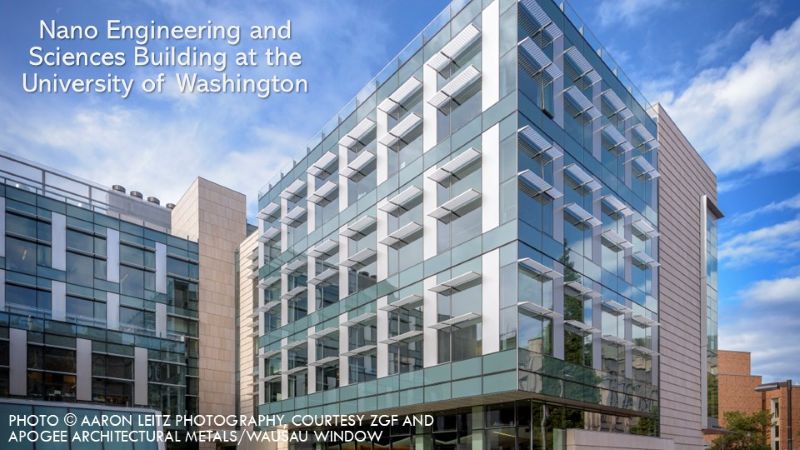 [1]
[1]Sunshades present a recognizable and functional feature for commercial buildings, and their role is growing.
Once associated primarily with warm-climate construction, exterior shading and solar control systems are now installed on buildings across every U.S. climate zone, appearing on educational campuses, healthcare facilities, corporate offices, and government centers alike.
As building teams face rising expectations for energy performance, occupant comfort, and sustainable material use, aluminum sunshades have emerged as a versatile and reliable tool to address these challenges. These architectural products offer both functional performance and architectural expression.
Material advantages of extruded aluminum
Aluminum’s combination of properties makes it especially well-suited for exterior shading applications. It can be extruded into a range of blade profiles, including tubular, rectilinear, trapezoidal, Z-shaped, airfoil forms, and custom designs.
Complementing the overall facade composition, blade shapes may be paired with different fascia styles. For example, a bullnose fascia may be specified with an airfoil blade, while a square fascia pairs naturally with a Z-shaped profile. Precision-cut end caps and snap covers can conceal fasteners for a clean, finished appearance.
Color choice is nearly unlimited for sunshades. Aluminum components can be finished using high-performance architectural coatings to match fenestration framing for a unified look or specified in a contrasting color for visual impact.
Whatever the aesthetic intent, finish durability is essential given sunshades’ continuous exposure to weather. Painted coatings should meet AAMA 2605, Voluntary Specification, Performance Requirements and Test Procedures for Superior Performing Organic Coatings on Aluminum Extrusions and Panels (with Coil Coating Appendix), and anodize finishes should conform to AAMA 611, Specification for Anodized Architectural Aluminum, to ensure long-term color stability and resistance to corrosion and UV degradation with minimal maintenance. AAMA 2605 and AAMA 611 are Fenestration and Glazing Industry Alliance (FGIA) documents.
Sustainability credentials are increasingly important in material and product selection, and aluminum performs well on this front. The metal is lightweight, which simplifies shipping logistics while reducing installation time and labor. It also is highly durable, requiring minimal upkeep over a long service life.
At the end of its long life on a building, aluminum is fully recyclable. Many manufacturers offer sunshade products that incorporate recycled content and are finished with low- or no-VOC painted or anodized coatings. Some also provide Environmental Product Declarations (EPDs) and Declare Labels, giving project teams the documentation needed to support LEED and other green building certification efforts.
Functional solar control drives performance
Effective solar shading begins with site analysis of a building’s latitude, orientation, and surrounding context. This analysis includes neighboring structures, trees, and reflective surfaces, all of which influence how much solar radiation reaches each elevation and at what times of day.
In North America, southern elevations receive the most direct solar exposure throughout the year. At higher latitudes, the sun’s lower angle in winter can cause early morning and evening glare from the north-facing east and west exposures. No single sunshade configuration is universally appropriate; each project requires specific analysis.
Using the project’s location, orientation, and surroundings, daylight building simulations can assist teams with this analysis. Several software and digital tool options are now available to architects, building envelope consultants, and sunshade and fenestration system manufacturers.
The most common configuration is a horizontal, multi-blade outrigger system that cantilevers from above the glazing daylight opening. These systems should be engineered to work with curtain wall, window wall, storefront, and other fenestration assemblies. Sunshades also may be installed as vertical fins. The two orientations serve different shading functions—horizontal shades block high-angle sun, while vertical fins are more effective at managing low-angle east and west exposure. The two are not interchangeable and must be specified in coordination with the fenestration system.
The depth and placement of sunshades are driven primarily by performance requirements, though appearance is also a factor. Some multi-blade aluminum systems can span up to 142 in. (360 cm) and project as far as 44 in. (112 cm) from the facade. For larger spans and projections, structural review is necessary to confirm that the assembly can appropriately handle dead loads, wind loads, and snow or ice loads.
When properly designed and installed, exterior sunshades can reduce annual cooling energy costs by up to 15 percent, making a meaningful contribution to overall building energy performance. Unlike interior blinds and shades, which block occupant views and impede natural ventilation without preventing solar heat gain from entering the building, exterior sunshades intercept solar radiation at the building envelope.
This distinction matters both for energy performance and occupant experience: exterior shading preserves views to the outdoors and access to daylight, supporting the connection to nature that green building programs recognize as a contributor to human health and well-being.
For projects seeking maximum daylight optimization, sunshades can be combined with interior light shelves. While the exterior shades manage heat gain and glare, the interior light shelf—often finished in white or clear anodize to maximize reflectance—redirects daylight upward and deeper into the building’s interior.
Diffused, indirect daylight reduces glare on screens and reflective surfaces, improving occupant comfort and productivity. Studies link excessive glare to eye strain, headaches, and other stress-related conditions, making thoughtful daylight management a genuine contributor to occupant health.
Fixed-blade sunshades represent the most common and cost-effective approach for exterior solar control, with blades set at a predetermined angle calibrated to the sun’s seasonal path. Motorized, articulating blade systems are also available and can be connected to light sensors or preprogrammed to adjust throughout the day. Daylight modeling and snow load analysis can help the building team compare the long-term energy savings of a responsive system against the lower initial cost and simpler maintenance profile of a fixed system.
Loading considerations: snow, ice, and structural requirements
The expanding use of exterior sunshades in cold-weather climates has prompted legitimate questions about snow and ice accumulation on horizontal shading surfaces. Ice build-up can occur in every U.S. climate zone and on any exterior building surface, regardless of slope or orientation.
When ice or snow is dislodged, it can affect adjacent surfaces, equipment, and people below. Building teams should consider sunshades as both potential sources and potential targets of falling ice and snow.
AAMA 514, Standard Test Method for Static Loading and Impact on Exterior Shading Devices, an FGIA document, provides a laboratory procedure for evaluating both downward static ice and snow loads and falling ice impact loads on horizontal exterior shading systems. Specifying systems tested to this standard helps ensure realistic performance expectations for projects in all climate conditions.
For large-scale installations, reinforcing stays may be required depending on system size, weight, and load demands. Sunshades at building corners can present challenges, where intersecting planes must be resolved to maintain both performance and appearance. These conditions warrant early coordination with the sunshade manufacturer.
Installation and facade integration
Sunshades are anchored either directly to the building structure or to the facade system’s mullions, jambs, or designated framing members. Because shading systems typically are manufactured to project-specific dimensions and blade counts, careful coordination between the sunshade manufacturer and the fenestration supplier is key, particularly when the sunshade is integral to the facade assembly.
Most sunshade systems are assembled in the field rather than arriving preassembled. Installers follow the manufacturer’s instructions and attachment guidelines to ensure proper alignment and load transfer.
One evolving approach uses detachable mounting brackets that fasten to the pressure plate area of the curtain wall, window wall, or storefront system. The brackets connect to sunshade outriggers via screw-spline connections and can be detached in individual sections to accommodate future reglazing. Along with easier installation, this serves a practical function for long-term building management and maintenance access.
Thermal performance of the connection should also be considered. When sunshades are integral to the facade, thermally improved attachments help minimize thermal bridging at the connection point, preserving the overall thermal performance of the building envelope. Attention to insulation and sealing at these connections supports the comprehensive whole-building performance approach that an effective facade requires.
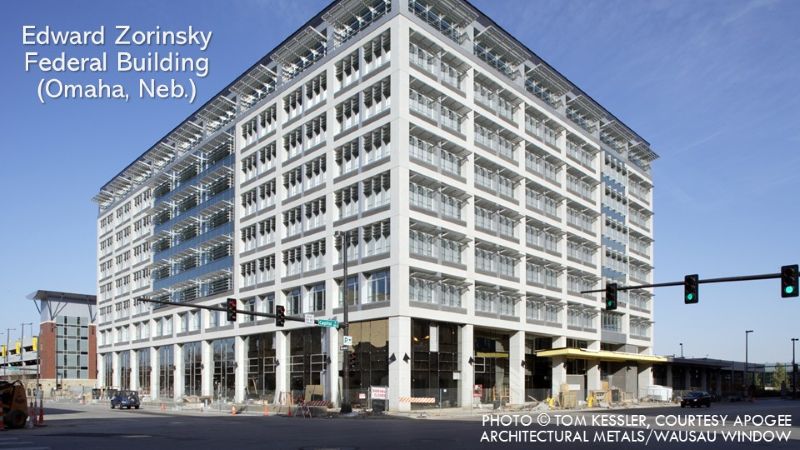 [2]
[2]The aluminum components of a sunshade system are finished in a single batch to ensure color consistency across the installation. On projects where the shading system spans multiple floors or a significant facade area, this batch-finishing process is an important quality control measure. All components should be inspected upon delivery and prior to installation to confirm that finish quality meets project specifications.
Common mistakes with aluminum sunshades
Skipping site-specific solar analysis. Assuming a single sunshade configuration will work across all orientations is a critical error. Each project requires an analysis of latitude, building orientation, neighboring structures, and other contextual factors.
Confusing horizontal shades with vertical fins. Each serves a distinct function, and while both may be used on the same building, they are not interchangeable. Horizontal blades block high-angle sun while vertical fins manage low-angle east and west exposures. Specifying the wrong orientation undermines the system’s solar control performance.
Underestimating structural and load requirements. Snow, ice, and wind loads must be accounted for in every climate zone, not just warm ones. Large spans and projections require formal structural review, and systems should be tested to AAMA 514 to ensure realistic performance under real-world load conditions.
Neglecting coordination between sunshade and fenestration suppliers. Because sunshades are typically manufactured to project-specific dimensions, coordination between the shading system manufacturer and the fenestration supplier is essential to ensure alignment, proper load transfer, and integration.
Assuming anchorage and attachments can be modified. When sunshades are designed as part of an integrated fenestration system, their attachments also are a key part of the system’s integrity. Sunshade and fenestration system manufacturers do not verify or calculate anchorage to materials provided by others. Third-party engineers should determine anchorage methods and coordinate with the manufacturers and installers. Failures can occur if any substitutions or changes are made to these attachments or their surrounding framing materials.
Overlooking thermal bridging at attachment points. When sunshades are integral to the facade, failing to use thermally improved attachments at connection points can compromise the overall thermal performance of the building envelope and may undermine the energy benefits the sunshades are meant to provide.
Well-positioned for high-performance buildings
Aluminum sunshade systems offer an appealing combination of aesthetic flexibility, measurable energy performance, and long-term durability to support both building owner objectives and occupant quality of life. Successful applications involve careful analysis of site conditions, climate, and orientation; coordination with the fenestration system; structural evaluation for load conditions; and attention to finish quality and installation details.
As climate performance expectations continue to rise and interest in healthy, daylit interior environments grows, exterior aluminum sunshades are well-positioned to remain a standard feature of high-performance commercial building design, across all climate zones and building types.
Brian Tobias serves as a senior product marketing analyst for Tubelite, a brand of Apogee Architectural Metals[3]. He draws from nearly 40 years of construction industry experience and is well-versed in the USGBC’s Leadership in Energy and Environmental Design (LEED) Green Building Rating System. He can be reached at btobias@apog.com[4].
This feature—along with numerous other “Projects for Inspiration”—originally appeared in the June 2026 edition of Metal Construction News, which you can find in our Digital Edition Archive.
- [Image]: https://www.metalconstructionnews.com/wp-content/uploads/2026/06/Aluminum-Sunshades-MCNJune2026-01-800.jpg
- [Image]: https://www.metalconstructionnews.com/wp-content/uploads/2026/06/Aluminum-Sunshades-MCNJune2026-02-800.jpg
- Apogee Architectural Metals: https://apogeearchmetals.com/
- btobias@apog.com: mailto:btobias@apog.com
Source URL: https://www.metalconstructionnews.com/articles/aluminum-sunshade-systems-balancing-aesthetics-performance-and-sustainability/