Better Access to Your Roof Accessories
by Jonathan McGaha | 31 July 2015 12:00 am
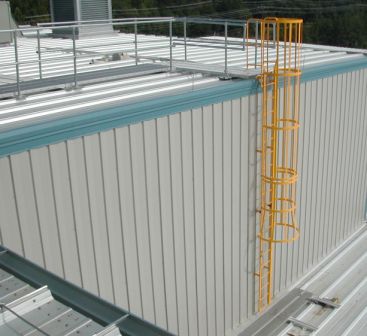
Gaining safe access to service your roof accessories is important
 |
| Photo courtesy of Design Components Inc. |
Metal roof accessories are important. But gaining safe roof access to service your roof accessories might be even more important and should not be overlooked. Fall hazards are present at most worksites and many workers are exposed to these hazards on a daily basis. A fall hazard is anything at your worksite that could cause you to lose your balance or lose bodily support and result in a fall. Any walking or working surface can be a potential fall hazard. OSHA generally requires fall protection when working over a height of 6 feet.
In 2009, the Bureau of Labor statistics (BLS) reported over one-third of all construction workers deaths were from falls and many times falls from ladders are the source. In fact falls from ladders were responsible for 16 percent of all workplace fatalities. Annually more than 20,000 people are injured from falls from ladders resulting in over 100 deaths a year. When breaking down the numbers further, 40 percent of accidents are because the ladder moved, 24 percent because of foot slip/miss and 18 percent because of losing balance. The importance of fall protection cannot be stressed enough.
When using portable ladders, you risk falling when the ladder is not positioned safely each time. While you’re on the ladder it may move or slip from its supports. You can also lose your balance while getting on or off an unsteady portable ladder. Falls from ladders can result in severe sprains or even death, as noted by the BLS statistics above. Frequently cited OSHA ladder violations include not having a portable ladder extend at least three feet above the roofline. While portable ladders are frequently used while the building is under construction, once the shell of the building is complete many contractors are installing permanent OSHA-rated roof access ladders. Also, architects are specifying these types of fixed-steel, OSHA-rated ladder systems more and more on the buildings they design.
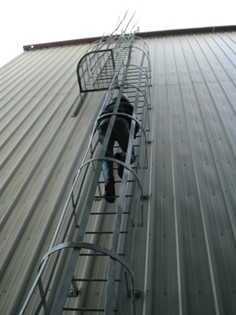
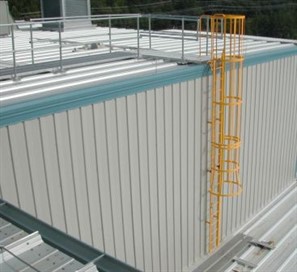
Fixed-rated ladders that are permanently installed to buildings should meet OSHA 1910.27 and 1926.1053 construction standards. For exterior ladders, they should have 42-inch-high, walk-thru handrails that extend above the roof surface for safe handhold egress. Any single ladder climb in excess of 20 feet must have an OHSA safety cage, however it is highly recommended to include the cages even on shorter ladder heights. For climbs in excess of 30 feet-0 inches high, OSHA dictates that the
 |
| Photo courtesy of Design Components Inc. |
climb must be split into two runs with a mid-point landing with safety handrails. Other OSHA fixed ladder requirements include maintaining at least a 7-inch clearance from the wall, starting the first rung of the ladder no more than 14 inches above grade, having 16-inch-wide rungs on 12-inch centers and starting the OSHA cage between 84 and 96 inches above grade as well. All of these requirements make for a stable and safe climbing environment. Lockable security gates at ground level can be added so as to restrict unauthorized roof access and hot-dip galvanized finishes can be added for highly caustic environments or locations along the coast.
Anytime you are on a roof or at a roofs edge there is an inherent danger present. Installing an OSHA-rated fixed ladder to your building along with roof edge guardrails can greatly reduce these risks and allow you to confidently gain roof access. Not only is this important during the construction process, but perhaps more importantly moving forward for the life of the building as roof accessories need to be maintained for years to come.
Nathan Plaxco is the sales and marketing manager at Design Components Inc., Fayetteville, Ga. To learn more, visit www.designcomponents.com[1].
- www.designcomponents.com: http://www.designcomponents.com
Source URL: https://www.metalconstructionnews.com/articles/better-access-to-your-roof-accessories/