Choose the Right Plasma Tool for the Job
by Mark Robins | 3 December 2018 12:00 am
Important answers to questions about plasma tool systems

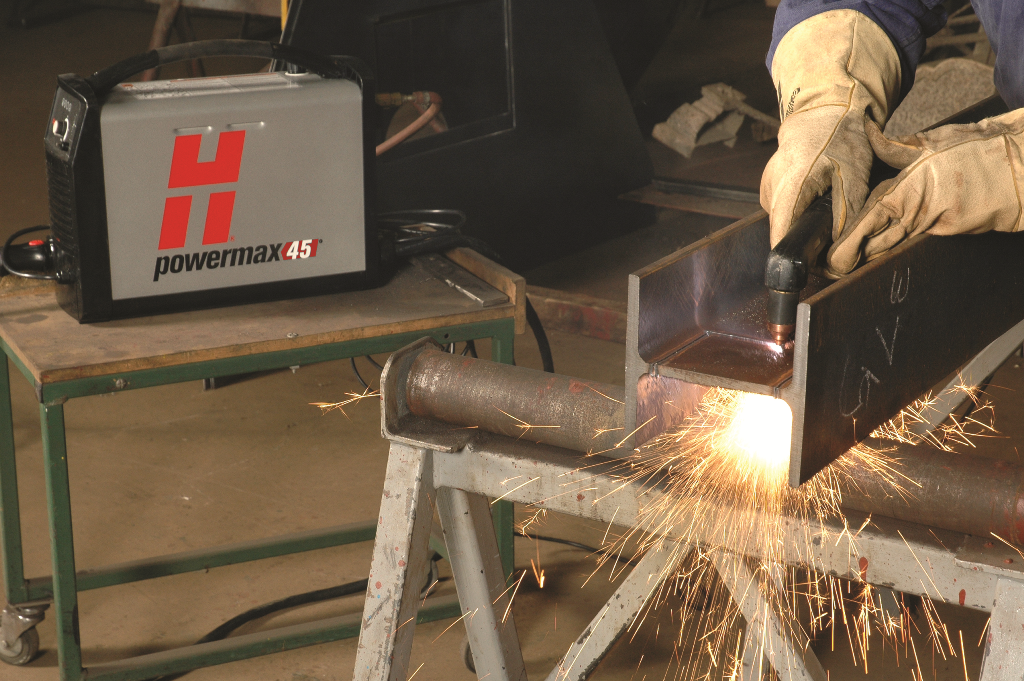
It’s no wonder then that plasma’s popularity on job sites has grown in recent years, driven in part by technological advances that have made the systems smaller and lighter, and thus easier to move. At the same time, the systems are also easier to use: plug it in, hook up compressed air and go. The trick then is choosing the right system in the first place. Here are some questions to ask before buying.
What Type of Cutting?
What do you plan to do: handheld, automated (like on a CNC table) or both? What about gouging? Do you plan to gouge?
Most systems are designed for both hand and machine cutting, which provides the most versatility. Some even include a CNC interface, giving you even more options. However, some systems are only designed for one type of cutting, so be sure you choose a system that supports the type of cutting you plan to do. If you foresee doing both types of cutting, think about how often you’ll switch from one method to the other. That’s an important question to ask because switching between hand and mechanized torches is easier and faster on some systems than others.
What Thickness of Metal Do You Plan to Cut?
Once you know what type of cutting you plan to do, then you should consider the thickness of the material you plan to cut. Most experts recommend the 80/20 rule, which calls for choosing a system with a recommended cut capacity matching the material thickness you plan to cut 80 percent of the time. If you mainly plan to cut 1/2-inch-thick metal and only occasionally cut metal that’s a little thicker (say 3/4 of an inch), you can safely choose a 1/2-inch system.
However, beware when looking at cut speed ratings. If a manufacturer says a system can cut a 1/2 inch, understand how the manufacturer came up with that number. How fast was the torch moving? How much cutting was done? What did the cut look like? This is important because some manufacturers will overstate the cut capacity of their systems. They might say that a specific system can cut 1/2-inch-thick metal, but not tell you that in order to do so, you’ll need to move the torch at a very slow speed.
What Kind of Electrical Power Do You Have?
It’s important to know how you’ll power your system so you can plan accordingly. For example, if you only have 110-volt outlets available then you’ll either need to buy a system that can work on a 110 outlet or arrange to have 220-volt power installed. Also, consider your incoming voltage, whether it is single-phase or 3-phase, and also the breaker size limit. If you plan to use the system with a generator, look at the generator’s peak output power (kW or KvA) to see if it can operate the plasma system at its maximum output.
How Much Cutting and What Kind of Duty Cycle?
Duty cycle is an approximation of how long a system will operate in a continuous cut before overheating within a 10-minute period. Most plasma systems are programmed to shut off once reaching a certain temperature. A duty cycle of 50 percent means a system will cut continuously for five minutes at full output before needing five minutes to cool down. A 50 percent duty cycle is normally more than sufficient for hand cutting.
Beware though as not all manufacturers determine duty cycle in the same way. Some manufacturers will use a lower ambient temperature rating and/or lower load voltage rating when testing to make their duty cycle appear higher.
Is the System Easy to Operate?
Simple operation is a requirement in a plasma tool to allow the job done faster with less headache and frustration. It also means people with little or no experience can get good results. Both are critical for construction companies struggling to find skilled labor in today’s low unemployment environment.
If you make your selection intelligently, based on your answers to the above questions and considerations, your plasma cutter will give you years of reliable performance and lessen the chance of you running into a situation where your new system doesn’t meet your needs.
Michelle Avila is public relations manager at Hypertherm, Hanover, N.H. For more information, visit www.hypertherm.com[1] or call (800) 643-0030.
- www.hypertherm.com: http://www.hypertherm.com
Source URL: https://www.metalconstructionnews.com/articles/choose-the-right-plasma-tool-for-the-job/