Controlling Noise Control
by Jonathan McGaha | 1 March 2012 12:00 am
Install a sound decision with noise control devices
Noise control devices quiet noisy environments. Acoustical wall and ceiling panels, sound absorptive and reflective wall panels, baffles, banners, geometric diffusers and special sound control ceiling tiles can be found in auditoriums, music performance and rehearsal spaces, highways, theaters, gymnasiums, churches and religious sanctuaries, multipurpose rooms, conference and meeting facilities, atriums, computer rooms and executive offices. Anywhere noise intrusion can be disruptive.
Acoustical design is one of the most complex facets of architecture and construction. Depending on the building or room, primary acoustical requirements include sound control between spaces, sound control within a space, or listening efficiency in meeting rooms and auditoriums.

In 1970, the Occupational Safety and Health Act (OSHA) set limits on noise levels to which workers may be exposed in their work environments. This regulation requires that industries monitor the noise in all worker locations, and, where this noise exceeds the permissible limits, abate it by any feasible noise control measures, or by administrative methods such as limiting the employees’ exposure time. If such noise control procedures turn out not to be feasible, then hearing protection must be provided for the workers.
Quiet down
The first step in noise control is identifying what noises are heard. Is it someone’s voice? Is it machinery? Is it the traffic outside a window? A second step is identifying where the noise is coming from. Is the noise coming from inside the same space as you, or is it coming from a separate room? For instance, is it the voice of someone on the phone in the office across the hall? Are the echoes in the room bothering you? If there’s a construction element, such as a wall, that separates you from the noise, then it’s not in the same space as you. Once the sources have been identified and quantified, they can be ranked by how each contributes to the overall noise level. This is important because if lower-level noise contributors are silenced first, this will not reduce the overall level. For example, when the exhaust is louder than the air intake on a gas or diesel engine, reducing the air intake noise gains little noise reduction until a properly sized muffler is installed.
Once the noise sources have been ranked, selecting the correct combination of building materials, system designsand construction technologies that will provide the most appropriate sound control is key to creating a successful acoustical design. The rule of thumb when trying to block sound is: the more layers of heavy dense materials used, and the heavier those layers are, the better your results will be. As a wall’s mass increases, sound waves lose more energy passing through it, reducing their ability to vibrate air on the other side. Relying on mass alone, however, poses limitations. According to Chicago-based United States Gypsum Corp., doubling a wall’s mass can reduce sound transmission by up to 5 decibels. So, achieving a 60 decibel reduction would require a total mass of 320 pounds per square foot. This is the equivalent of approximately 3 feet of solid concrete, not a feasible solution for most building designs.
Metal is a sound choice
Metal is an excellent choice for noise control, especially for walls. Capable of being formed into panels or other components, it can provide reverberation control and sound absorption in large and small areas. Metal walls not only provide some of the same acoustical benefits of mineral fiber and fiberglass ceilings, they are also very damage resistant and sustainable over a long period of time. Used in Europe for many decades, metal walls have become very popular in the U.S. over the last 10 years.
“Metal walls offer great acoustical properties when aluminum or steel panels are perforated,” says Nick Taraborelli, product manager of Armstrong Architectural Specialties[1], Lancaster, Pa. “When different perforation options are backed with acoustical fleece or infill panels, panels can generate acoustical absorption rates up to 95 percent (NRC 0.95). An environmentally friendly product, such as Armstrong’s renewable BioAcoustic infill panels, can be placed behind metal walls to enhance acoustical and sustainable performance.”
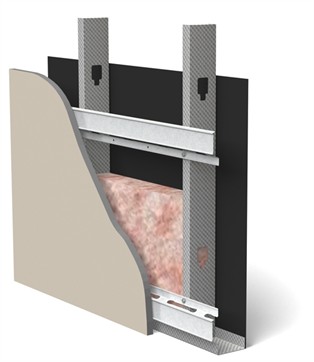
One standard technique for controlling noise in nonresidential applications is resilient furring channels. When correctly installed, these simple metal channels act as an acoustical barrier by disrupting the path of sound waves attempting to pass through the assemblies and into adjoining spaces. “The resilient channel functions as a de-coupler, a means for attaching gypsum board to the studs without actually allowing the board to touch them,” says Michael C. Kerner, co-development manager, ClarkDietrich Building Systems[2], West Chester, Ohio. “This separation of the gypsum board from the studs impedes the transmission of airborne sound waves through the wall assembly by breaking their path.”
To mitigate noise on a larger scale, the Silent Screen Noise System from Acoustical Solutions[3] in Richmond Va., uses reflective metal interlocked panels. The system has perforated sheet steel on one side, with mineral wool contained within and a solid steel panel as a back. “Some will have an intermediate baffle or septum,” says Jack Kay, environmental sales engineer at Acoustical Solutions. “All are set into structurally designed steel beams or channels for support. Noise reduction occurs when impinging sound strikes the perforated side of the panel, allowing the sound energy to be absorbed.”
Installation
Often, installing soundproof wall systems requires only minimal tools. Armstrong’s wall systems only require “an electric drill to install both furring strips and carriers to the wall, while tin snips are utilized to trim panels to appropriate lengths,” says Taraborelli. “Small penetrations through the panels are made with hole saws and larger openings are acquired by the use of tin snips.”
Installation for soundproof materials is usually specific to the product. For many panels, “typically a welder is used to set the mounting angle,” says Kyle Justice, regional sales manager, Zoneworks[4], Milwaukee. “Otherwise it can be drilled or clamped with a drill, wrenches, nuts/bolts or clamps. Also needed is a straight knife or blade for cutting around obstructions and patch tape.”
_321x214.jpg) Most contractors are familiar with resilient channel applications and can install these products without any special tools and in less time than many other noise control solutions. “Resilient channels should be mounted perpendicular to the stud framing, with particular care taken to center the elongated holes directly over the stud-framing members as often as possible,” Kerner says. “This placement helps impede airborne sound vibrations, as the opening slot decreases the area of metal-on-metal contact. The attachment flange must face downward. The open side of the resilient channel should face upward, toward the top of the wall. This placement allows the weight of the installed gypsum board to lead the resilient channel away from the framing. Since the top of the resilient channel has no direct contact with the stud, sound transmission through the wall assembly is disrupted. Installing the open side of the resilient channel downward will press it into the framing, allowing sound waves to resonate through to the stud.”
Most contractors are familiar with resilient channel applications and can install these products without any special tools and in less time than many other noise control solutions. “Resilient channels should be mounted perpendicular to the stud framing, with particular care taken to center the elongated holes directly over the stud-framing members as often as possible,” Kerner says. “This placement helps impede airborne sound vibrations, as the opening slot decreases the area of metal-on-metal contact. The attachment flange must face downward. The open side of the resilient channel should face upward, toward the top of the wall. This placement allows the weight of the installed gypsum board to lead the resilient channel away from the framing. Since the top of the resilient channel has no direct contact with the stud, sound transmission through the wall assembly is disrupted. Installing the open side of the resilient channel downward will press it into the framing, allowing sound waves to resonate through to the stud.”
Joerg Hutmacher, business unit manager at pinta acoustic inc.[5] in Minneapolis, has the following suggestions for installing soundproof wall panels. For best results, cut panels from flat side. Make sure both the panels and the metal surface to which the panels are being applied are dust- and dirt-free. For metal surfaces, use a degreaser. Use a nontoxic, water-based adhesive and cut the end of an adhesive tube to produce a 1/4-inch bead. Apply a 1/4-inch line of adhesive around the perimeter and also from opposite corners through the center of the panel, creating an “X.” Press the panel into position and hold for 5 seconds. For very large noise-control walls for outside applications, a crane or lift may be required, as well as a four- to five-man crew.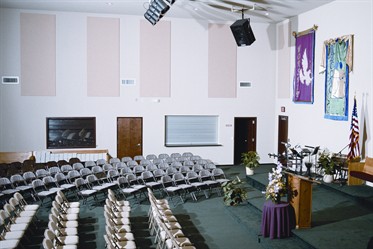
But, “in contrast to many other acoustical panels, which are fabricated in heavy 2- or 4-foot widths, Silent Screen panels come in 12-inch widths,” Kay says. “These lightweight sections can be easily handled and installed by one or two people without special tools. Many installations do not require fasteners between panel sections. All necessary trim pieces and hardware are included. When required, structural supports, framing and girts can also be designed and supplied, resulting in a complete turnkey solution. Holes are dug into the ground and beams are inserted. Concrete is poured around the steel beams so they are anchored to a concrete caisson, and panels are placed either horizontally or vertically between the beams.”
Several new acoustical wallboard and soundproof insulation products have entered the marketplace over the past few years promising higher sound transmission class (STC) ratings and a stronger contribution to the acoustical performance of wall assemblies. But Kerner cautions these new technologies come at a higher price than traditional wall assembly with resilient channels, sound-absorbing insulation and acoustical sealant. “This may be an important thing to consider when clients may be tightening their belts and following a stricter budget,” he says. “By properly installing resilient channels, you can provide the client a high-STC wall assembly at a fraction of the price of those made with newer materials.” Kay cautions that noise barriers should not be confused with visual barriers or screens; the science is not interchangeable. And, “to meet one’s budget the noise barrier must be designed and installed correctly or it will not meet your requirements or expectations,” he adds.
One trend that does involve some blending of materials is integrating noiseproof walls and ceilings. Installers can use the same soundproof metal panels for both walls and ceilings within a space to create a seamless 90-degree or curved transition, Taraborelli says.
sidebar
General principles of noise
Sound is vibration transmitted through a medium. Noise is unwanted and intrusive sound that interferes with speech intelligibility or speech privacy. Noise is a relative term and can range from low levels of intrusive sound in a quiet environment to very loud sounds in an already noisy environment. Sound is propagated in air and expands equally in all directions. Sound can be absorbed by some materials and contained by others. For sound to be generated and heard it must have a source, a medium through which to pass and a receiver. As sound is generated by speech, the voice acts like a diaphragm, which causes the molecules in the air to pulsate back and forth while moving in all directions, at a speed of 1,130 feet per second (770 mph). A single segment of a sound wave may be characterized as pressure compressions and rarefactions.
The distance between the sound compressions and rarefactions is known as a wavelength. Low frequency sounds have a long wavelength and are perceived as low-pitched sounds, such as the rumble of a truck. High-pitched sounds have very short wavelengths, such as sound emitted from a whistle. In the field of music a piano can generate sounds ranging from 20 cycles per second (Hz) all the way up to 4,600 cycles per second. Loudness is the strength of the sound and its intensity is measured in decibels.
The greater the number of decibels produced, the greater the pressure exerted on your eardrums and the louder the sound. Reverberation is the overall effect of reflected sound and the time required for reflected sound to become inaudible. For sound control devices to work best, match their acoustical performance to the noise’s frequency signature. This can be done with tools like a Type 1 1/3-octave band sound-level meter, a sound intensity analyzer and even model analysis.
- Armstrong Architectural Specialties: http://www.armstrong.com/commceilingsna/
- ClarkDietrich Building Systems: http://www.clarkdietrich.com
- Acoustical Solutions: http://www.AcousticalSolutions.com
- Zoneworks: http://www.zoneworks.com
- pinta acoustic inc.: http://www.pinta-acoutic.com
Source URL: https://www.metalconstructionnews.com/articles/controlling-noise-control/