Cooler by design
by anthony_capkun_2 | 24 August 2026 11:51 am
 [1]
[1]As energy performance expectations rise, roofing contractors are increasingly being asked to balance durability, style, and thermal performance within a single roof assembly. Roofing systems designed to better manage heat transfer can help reduce cooling demand, save on energy costs, and support long-term building performance.
Metal roof systems are often specified for energy-conscious homes, thanks to their reflectivity and resiliency. However, thermal performance is influenced by more than just the roofing material itself. While reflective roofing surfaces are an important component, factors such as ventilation, airflow, and overall roof assembly design can have an equally important impact on thermal performance.
Reflective roofing surfaces
One approach to improving thermal performance is to use roofing materials that are designed to reflect more of the sun’s rays. The Cool Roof Rating Council[2] (CRRC) lists products that have been rigorously tested for their solar reflectance and thermal emittance.
CRRC defines solar reflectance (SR) as the amount of solar energy a roof reflects, while thermal emittance (TE) measures how well the roof releases heat. The Solar Reflectance Index (SRI) combines SR and TE into one value, allowing roofing products to be compared by how effectively they stay cool in the sun and reduce heat flow into a building.
SR and TE are used to calculate a roofing material’s surface temperature under ASTM E1980 conditions. CRRC-1 Roof Product Rating Program Manual requirements may also apply.
SRI is then determined by comparing that calculated surface temperature with standard white and black materials under the same conditions.
For example, CRRC notes that a standard white material may have an SR of 0.80, TE of 0.90, and SRI of 100, while a standard black material may have an SR of 0.05, TE of 0.90, and SRI of 0.
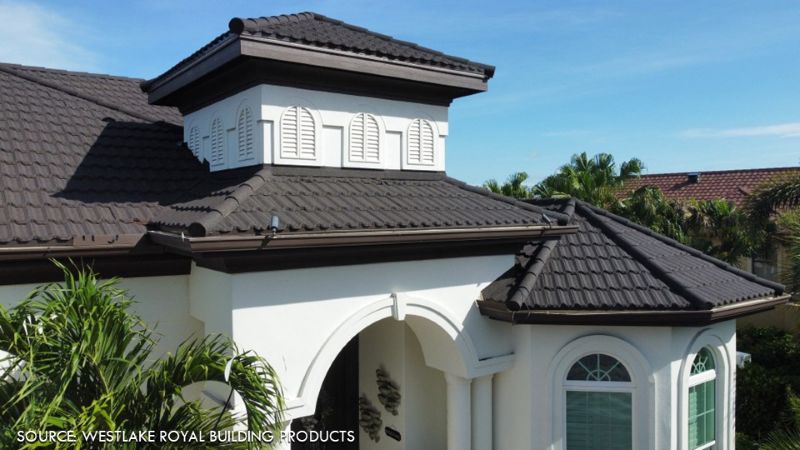
Many high-performing roofing materials are available in cool roof colors that feature specialized pigments that help reflect the sun’s heat back into the atmosphere. The level of reflectance varies from product to product; one stone-coated steel product, for instance, is listed to reflect as much as 53% of the sun’s solar energy compared to 10% for a standard asphalt shingle.
By providing effective temperature regulation, high-reflectance color options keep homes cooler in hot weather. This can reduce the owner’s reliance on air-conditioning and lower energy costs, and could potentially extend the life of the cooling system itself. Similarly, the lower surface temperature of a cool roof can help reduce heat-related stress on the roof assembly.
Ventilated roofing assemblies and systems thinking
While reflective surfaces can help increase solar reflection, ventilation within the roof assembly itself can play an important role in thermal management. For example, such a system could consist of:
- Reflective stone-coated steel panels.
- A thermally insulating, reflective roof underlayment.
- An elevated batten system that allows air to circulate and provides a path for upward airflow.
- A continuous ridge vent that provides a path for circulating air to exit the roof system.
In this example, the components work together to allow rising warm air to exit through the ridge vent, drawing outside ambient air across the roof deck. This continuous airflow creates a cooler attic and living space in the home, and reduces AC usage.
 [3]
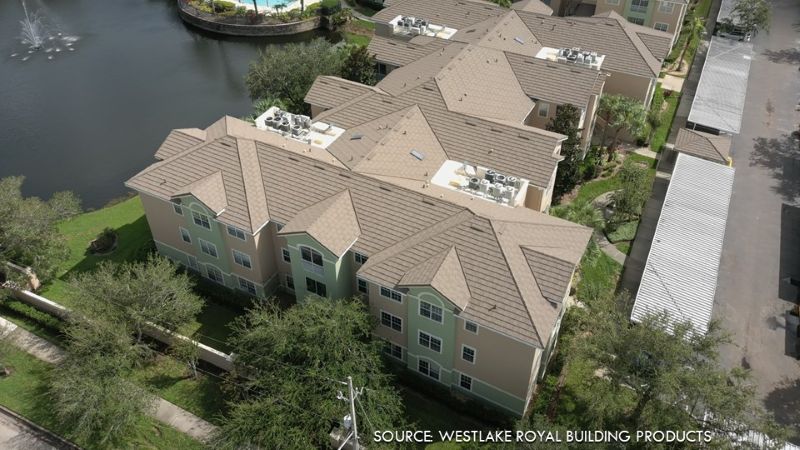
[3]The Summergate condominium project in Orlando, Fla., was reroofed with stone-coated steel using a cool roof-rated color. The switch had a direct impact on energy efficiency, according to Nick Johnson, president of the Summergate Community Association.
“The first thing that I noticed as a third-floor unit owner was energy decreases. Right in the middle of the summer, my energy bill was almost $100 less than it normally would have been, and that’s still tracking throughout the year.”
Testing by Oak Ridge National Laboratory shows that elevated battens on a dark roof are just as important as reflective roofs in achieving energy efficiency. The lab’s 12-month study on the effects of infrared-reflective (IRR) pigments versus metal roofs installed with an airspace showed above-sheathing ventilation can reduce heat flow into a building by nearly 30%.
The roofing system is the first line of defense in the face of extreme weather, and it can provide a similar defense against heat. Contractors can help increase energy efficiencies by considering the full roof assembly, from the reflectivity of the color to ventilation, airflow management, underlayment selection, and installation quality—all without sacrificing aesthetics.
Robin Anderson is technical and strategy development manager for Westlake Royal Building Products, Roofing Solutions[4].
This feature originally appeared in the August 2026 edition of Metal Construction News, which you can find in our Digital Edition Archive.
- [Image]: https://www.metalconstructionnews.com/wp-content/uploads/2026/08/Cool-Roofs-MCNAugust2026-800-01.jpg
- Cool Roof Rating Council: https://coolroofs.org/
- [Image]: https://www.metalconstructionnews.com/wp-content/uploads/2026/08/Cool-Roofs-MCNAugust2026-800-02.jpg
- Roofing Solutions: https://www.westlakeroyalbuildingproducts.com/roofing
Source URL: https://www.metalconstructionnews.com/articles/cooler-by-design-how-reflective-surfaces-and-ventilated-assemblies-can-improve-roof-thermal-performance/