Cranes and their Alternatives
by Mark Robins | 1 August 2022 12:00 am
Today’s cranes and lifting devices are raising metal to new heights

This 65|HT D Crane HT hydraulic truck places façade pieces along the exterior of the new Central Bank Center at Rupp Arena in Lexington, Ky. (Photo courtesy of Link-Belt Cranes)
Generally, cranes are used to hoist prefabricated wall panels, structural steel, metal decking and floor joists into place to create the super structure of light-gauge framed buildings,” says Michael Donovan, president of Panel Systems Inc.[1], Woodbridge, Va. Different cranes are used for various tasks, making it important to understand the distinction between them and know which type is best for a specific application.
Choosing a crane typically involves location and nature of the job site. “For example, metal façade pieces were placed on the new Rupp Arena construction in downtown Lexington, Ky., and a Link-Belt customer utilized a 65-ton 65|HT truck crane for the job,” says Casey C. Smith, public relations specialist, Link-Belt Cranes[2], Lexington. “Cranes could handle the component size of the lift and were also small enough to get into a very congested job site. Space is always at a premium, especially in city centers where you might be confined to just nearby the build.”
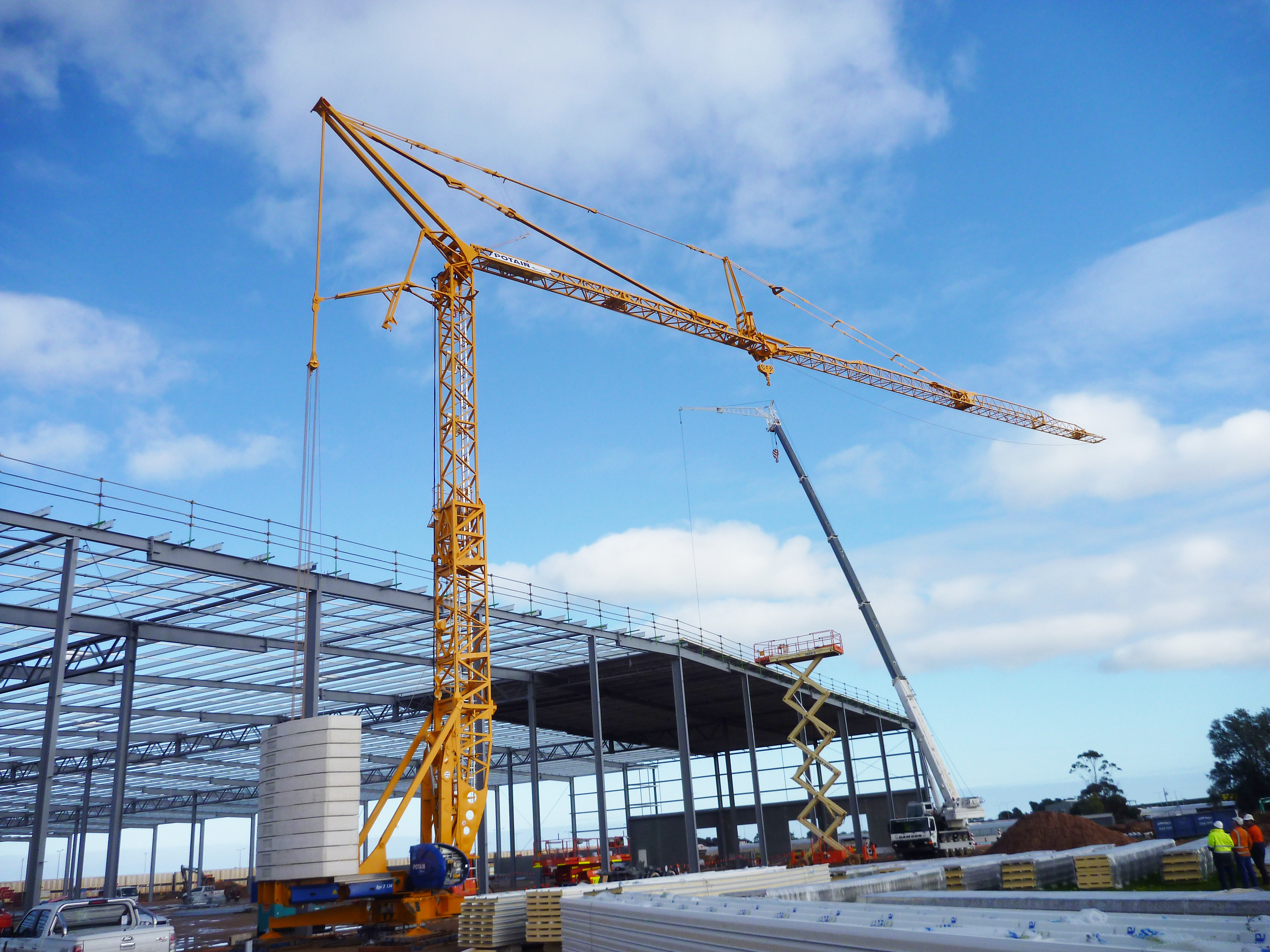
Potain Igo T series cranes are suited for any type of structural steel component work with weights between 5,000 pounds to roughly 7,000 pounds at a 100-foot radius. (Photo courtesy of Manitowac)

Photo courtesy of Manitowac
Sometimes building height impacts crane usage. “The number of times a crane has to climb impacts how long the downtime is for customers,” says Bulle, Switzerland-based Liebherr Tower Cranes[3] project manager Eric Konijn. “We are able to offer our customers a solution with 10 climbing stages, which saves them valuable time and consequently money. One climbing stage takes about two hours, so the cranes stand still for as short a time as possible. In addition, there are significantly fewer stories to reinforce, which also has a positive impact on cost efficiency.”
Mobile Cranes
Mobile cranes are frequently used on job sites because they can be easily moved to move materials around multiple pick points with very little set up or assembly. Mounted to vehicles for easy movement, they can start working immediately with powerful lifting capabilities. They can be cable controlled or hydraulic powered; given power by either electric motors or internal combustion engine. Most can travel on public roads and some can be equipped for off-road use with all-terrain chassis. The wide range of mobile cranes includes rough terrain, all terrain, pick-and-carry, truck-mounted, crawler and side-lift cranes. Long telescopic booms help them reach great working heights quickly and easily. They can be configured quickly using functional lattice extensions, folding jibs, fixed and luffing lattice jibs.
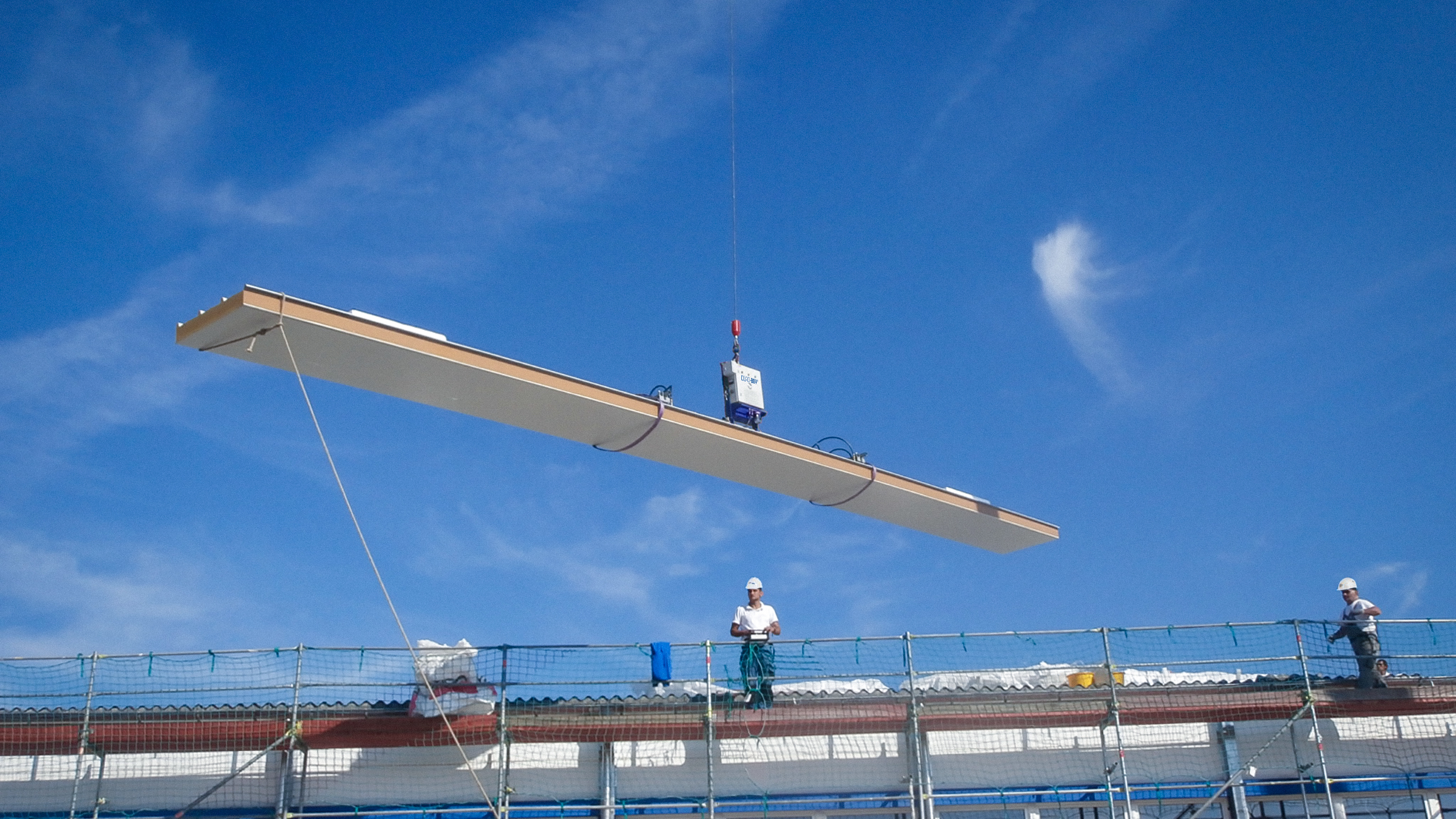
The battery-powered vacuum lifter CLAD-BOY has a compact, mains-independent system and can be used on job sites to install roof panels, fire protection elements, trapezoidal sheets and wall elements. (Photo courtesy of AERO-LIFT)
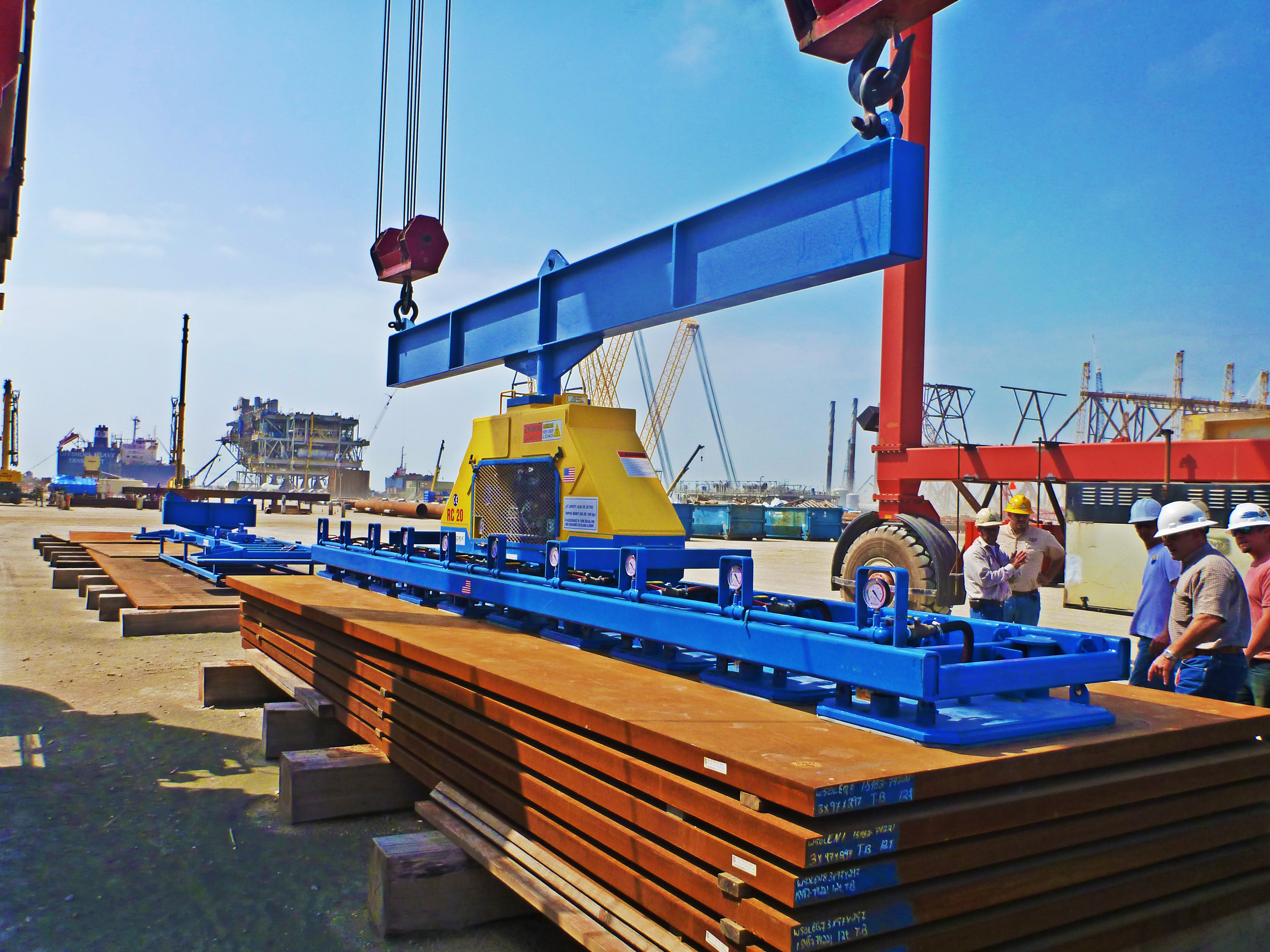
Vacuum lifting handles metal sheets safely and efficiently. (Photo courtesy of Vacuworx)
“On a mobile crane, you may do up to five functions depending on the crane configuration,” says David Polce, Potain’s regional business manager for the eastern and southern U.S., Manitowoc Crane Group[4], Milwaukee. “[These functions are] booming (up or down), hoisting (up or down), luffing (up or down), slewing and travelling. The mobile crane operator is bound to the crane’s cab, this requires an additional signal person to be in communication with him via radio telling him where to place the load as he may be working in the blind.”
Tower Cranes
A tower crane is a modern form of a balance crane. Used for constructing taller buildings or those with many tiers, when fixed to the ground it has powerful height and lifting capabilities. While they come in different forms, most are usually assembled and erected on-site with a horizontal or luffing jib. Tower cranes are always mounted over a strong concrete pad so that anchor bolts can be embedded into the pad, which hold the tower crane when it is lifting heavy loads. “Tower cranes are the most efficient means of lifting light-gauge metal panels, decking, etc.,” Donovan says. “The building footprint, height and access are the determining factors in choosing a mobile crane or a tower crane.”
Telehandlers
While a telehandler is a very useful piece of equipment on metal construction job sites— usually reserved for unloading the delivery of materials from suppliers—it can also be a reasonable alternative to a crane for smaller projects such as two-story residential commercial metal structures. For most commercial construction projects, a telehandler is generally the first machine on-site and the last to leave.
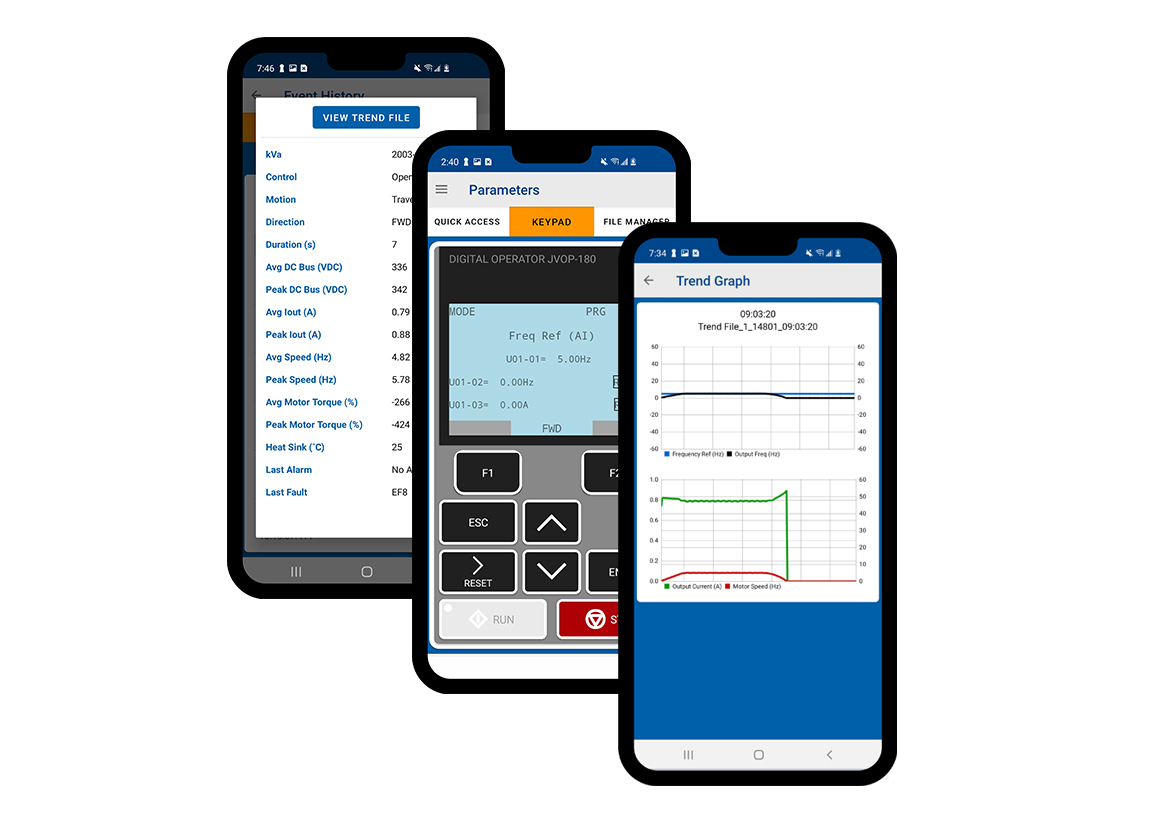
Intelli-Connect’s diagnostic and analytic capabilities deliver system status information, whether you’re using a smartphone or tablet, to help you manage construction equipment like cranes. Intelli-Connect wirelessly connects to crane equipment located up to 100 feet in the air, allowing operators to safely and quickly get an overview of a system’s operation. (Photo courtesy of Columbus McKinnon)
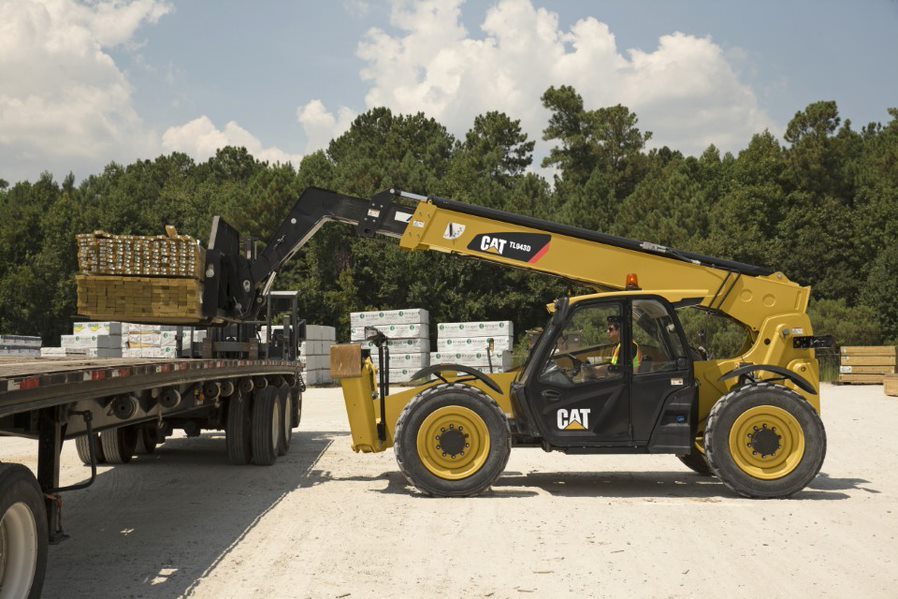
Cat TL943D Telehandler with forks. (Photo courtesy of Caterpillar)
“In the early stages of the larger projects, especially prior to the arrival of a crane, higher capacity telehandlers—with a lift capacity of 10,000 pounds or greater—with appropriate lifting hooks and other equipment, are known to manage the lift and placement of the ground-level columns, as well as the primary and secondary beams,” says Mike Peterson, product application specialist, Caterpillar Inc.[5], Deerfield, Ill. “For smaller commercial projects such as workshops, warehouses, shopping centers and distribution centers, and even larger, two-story residential metal buildings, the telehandler can be the primary piece of installation equipment. Many contractors utilize these versatile telescopic material handlers for placing columns, elevating rigid frames assembled at ground level, or lifting components (rafters, struts, and purlins) in place for riggers to locate and secure. Beyond specific metal building construction tasks, a telehandler is also uniquely designed to pick, carry and deliver most heavy mechanical and electrical components, such as large metal doors, jib or gantry cranes, and HVAC systems to the roof or interior of the building structures via the telescopic reach capabilities.”
Ultimately, cranes essentially serve one purpose on a job site: to lift materials, but Gary N. Weisman, chief operating officer at Magni Telescoping Handlers[6], Roselle, N.J., believes the weight capacity of most cranes is far more than is needed. “In the past, there was no alternative to the crane … there is now a viable alternative for many job sites. Magni offers 16 rotating telehandler models with lift heights starting at 57 feet and going up to 167 feet. We offer over 100 attachments that can be fitted at the boom tip. These attachments allow the machine to serve as a RT crane, telescopic forklift, aerial work platform and more. This means that the Magni can perform multiple tasks on the job and potentially replace several machines with one. The machine can be used continuously where a crane can potentially spend much of the time sitting due to its limited functionality.”
Just as telehandlers can be an alternative to cranes in metal construction activities, Peterson says many other heavy equipment products can support smaller ground-level metal building construction tasks. “For instance, skid steer loaders, compact track loaders, backhoe loaders and compact wheel loaders each have the lifting height and capacity to install of the columns of a single-story building, as well as manage the on-site transport of the truss frame components, struts, purlins and girts from the laydown area to the building site.”
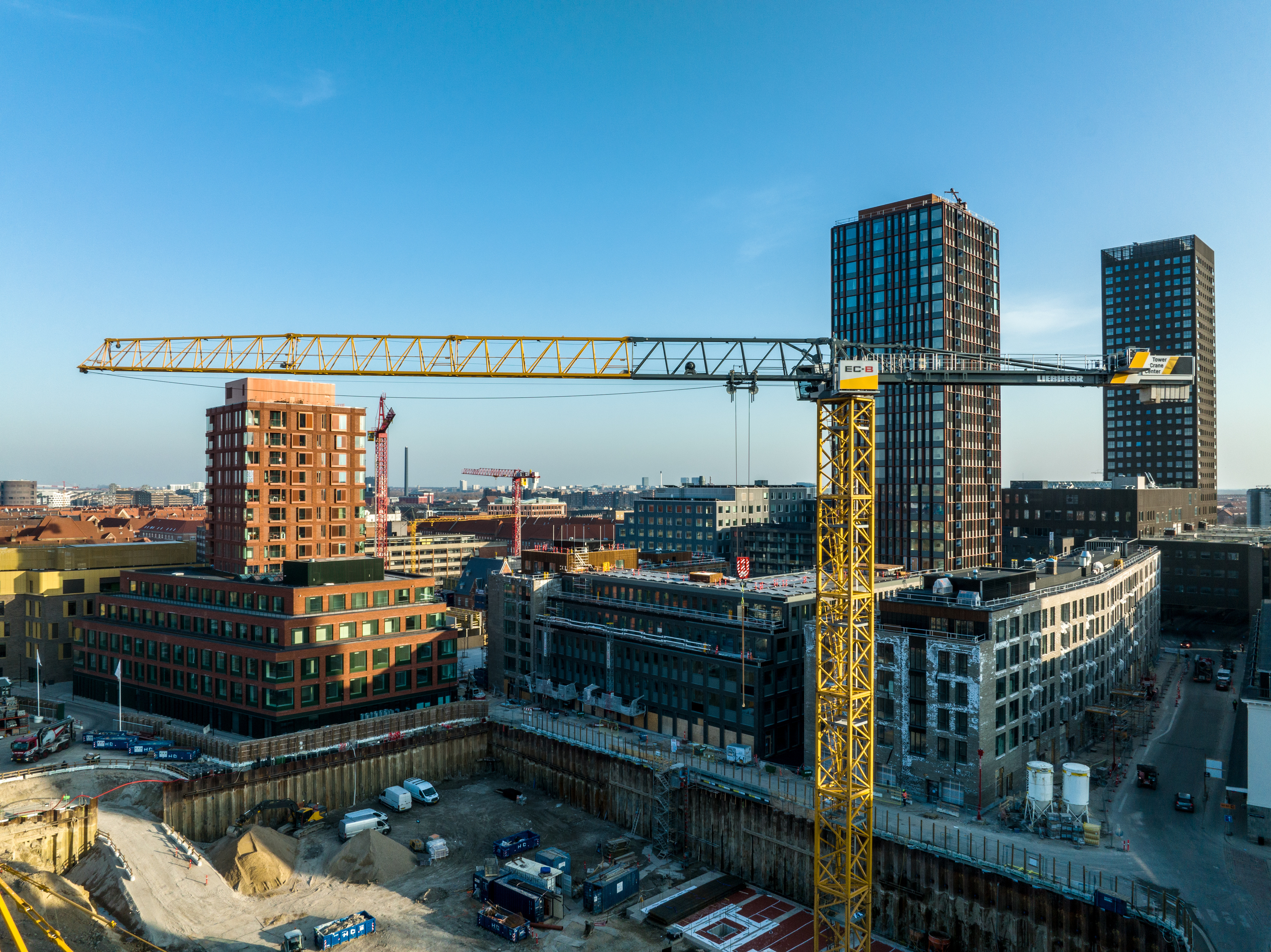
The 470 EC-B Flat-Top crane has a maximum lifting capacity of 16 or 20 tons. (Photo courtesy of Liebherr Tower Cranes)
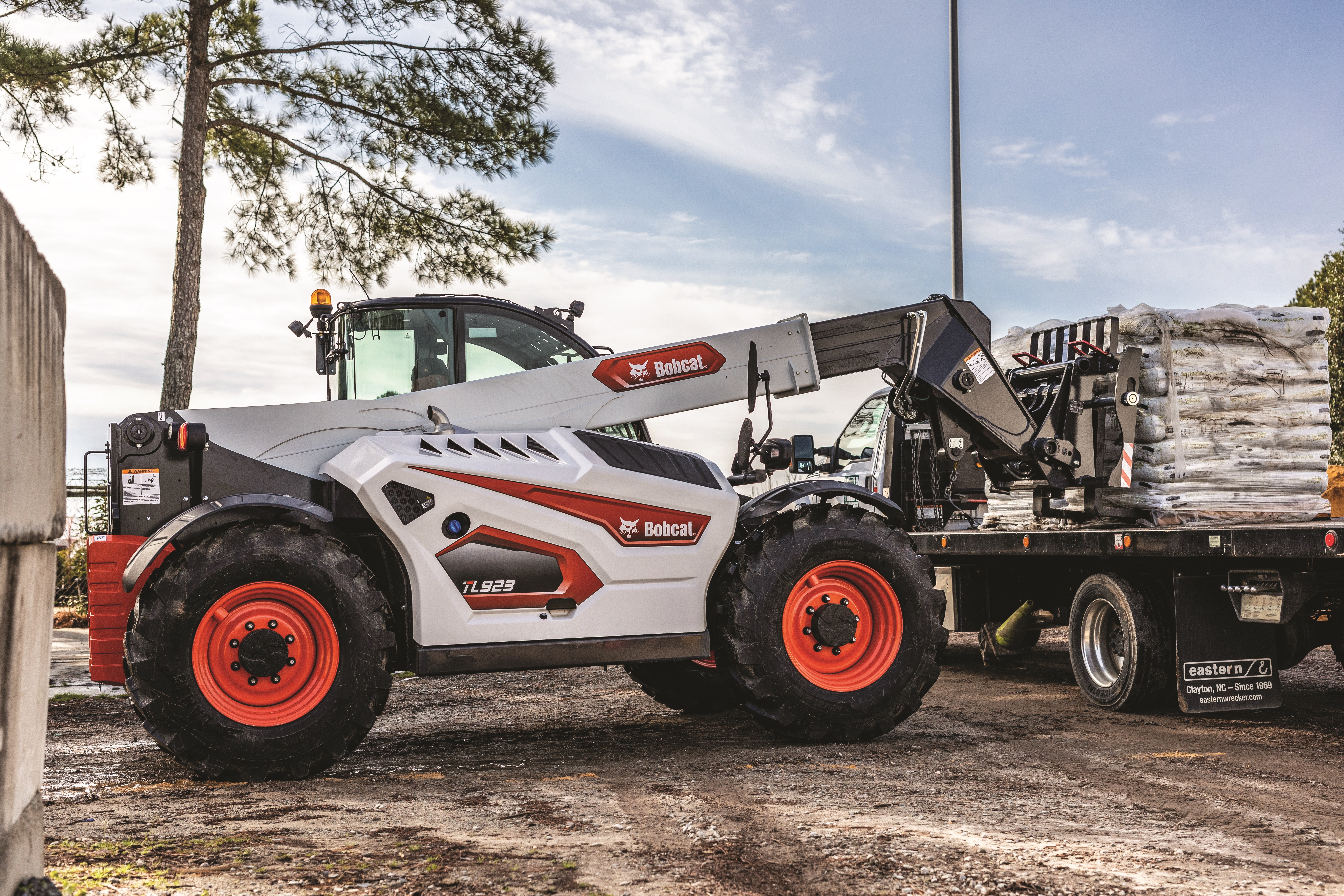
The TL923 hydraulic system is designed for faster boom speeds and heavier lifting, providing operators with smoother handling and control when loaded, and faster boom cycle times when empty. (Photo courtesy of Bobcat Co.)
Vacuum Lifting
One of the limiting factors for cranes handling metal construction materials is their rigging. Too often, expensive material can be damaged by it. Vacuum lifting can remedy this. “Vacuum lifters are often used as below-the-hook attachments on overhead cranes and can be used to transport steel plates into other areas of processing,” says Dan Beilfuss, general manager of automation, Columbus McKinnon[7], Menomonee Falls, Wis. “This type of lift assist is ideal for high-torque offset loads or heavy lifts, and allows operators to precisely and effortlessly position material. They are well-suited for applications such as load suspension, panel transfers, roll handling devices and much more.”
“Classical lifting devices (clamps, etc.) often scratch the panel surfaces or cause damage, which does not occur with a vacuum lifting system,” says Melanie Maier, marketing manager at AERO-LIFT[8], Geislingen-Binsdorf, Germany. “The handling of the material is safe, because the system works with at least double safety according to the standard, so falling panels are not possible per se. The process of lifting and lowering the panels is ergonomic, so that employees are actively supported in the installation process. Classical hoisting equipment does not allow for a lowering adapted to the roof pitch without manual intervention.”
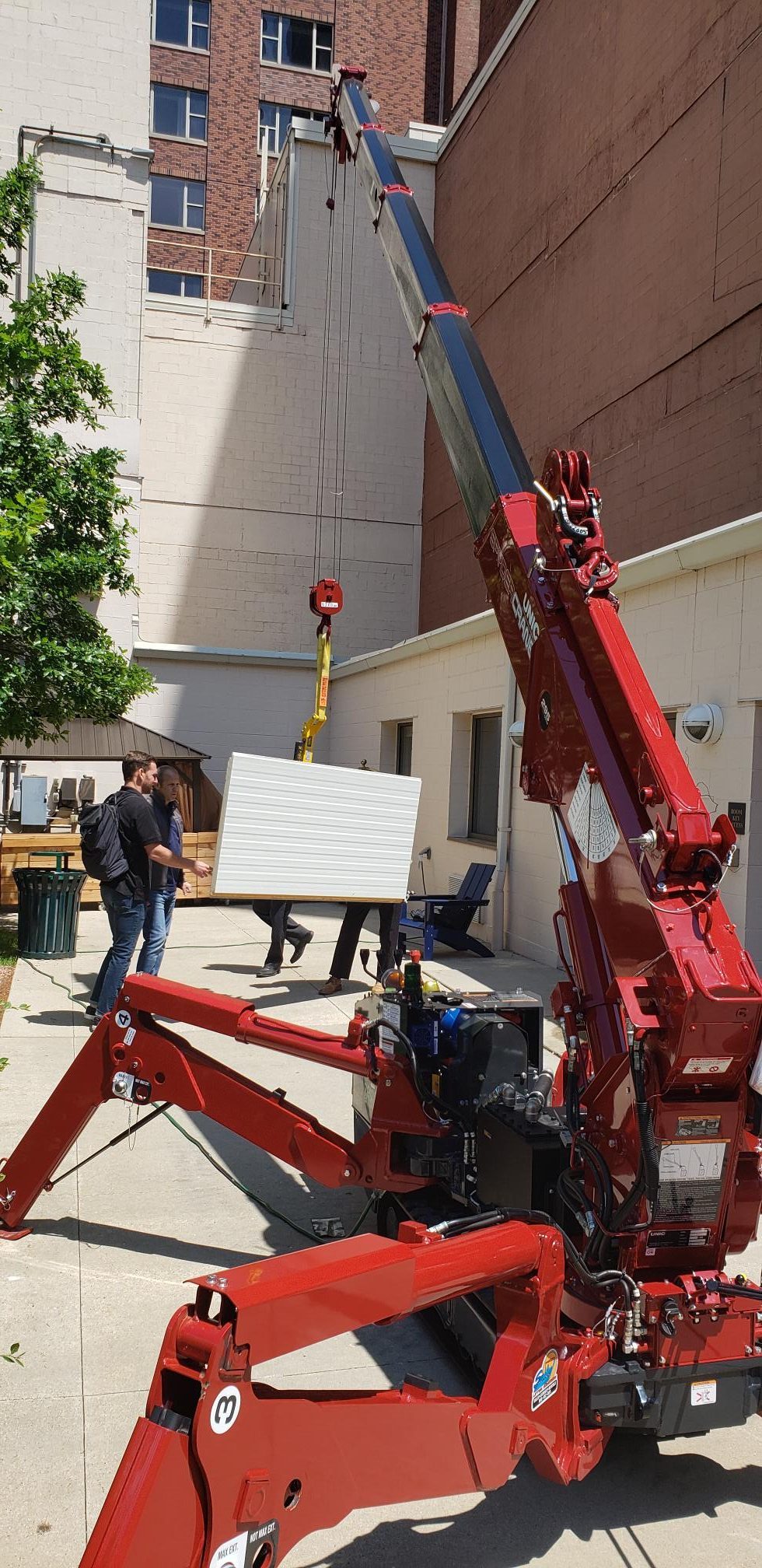
Cranes suitable for use with vacuum lifters range from large tower cranes to smaller “spider” cranes with adequate load capacity like this one. (Photo courtesy of Wood’s Powr-Grip)
Bill Solomon, president of Vacuworx[9], Tulsa, Okla., agrees that for metal materials like panels with surface area—instead of trying to rig them with rig cables or hooks or straps—lifting systems are a safe, quick, efficient and easy-to-use method. “These lifting systems work with virtually all cranes, utilize a wireless remote, have redundant safety mechanisms and won’t damage the material being handled. The operator of the crane is in full control of the lifting, placing and releasing of the material. This allows for ground personnel to be utilized elsewhere. When our Vacuworx lifting system is not needed it can be quickly disconnected and stored until needed. Should metal materials be for small or shorter buildings or projects it can attach to forklifts, telehandlers, excavators, boom cranes, skid steers and many other host machines. It’s a modular system designed to work with the host equipment the contractor already has.”
Laurel, Mt.-based Wood’s Powr-Grip[10] has a wide-ranging line of below-the-hook vacuum lifters that can be suspended by hoisting equipment, whether it’s a crane or a telehandler/forklift equipped with a hoisting-hook adapter. “Cranes suitable for use with these lifters can range from the largest tower cranes to smaller spider cranes with adequate load capacity,” says the company’s marketing director Barbara Murphy. “Vacuum lifters are designed and built to improve efficiency and enhance safety. In particular, IMPhandling lifters from Powr-Grip make panel installations easier by eliminating the need for manually operated slings. Lifters provide more precise positioning of suspended panels, which puts less physical strain on the installers. Fewer workers are needed to complete jobs, too. Lifter use allows a crew to access panel edges and opposite sides of a panel. More importantly, lifter use eliminates the need to making attachment modifications to the material, such as clamping and drilling holes, which could damage a panel.”
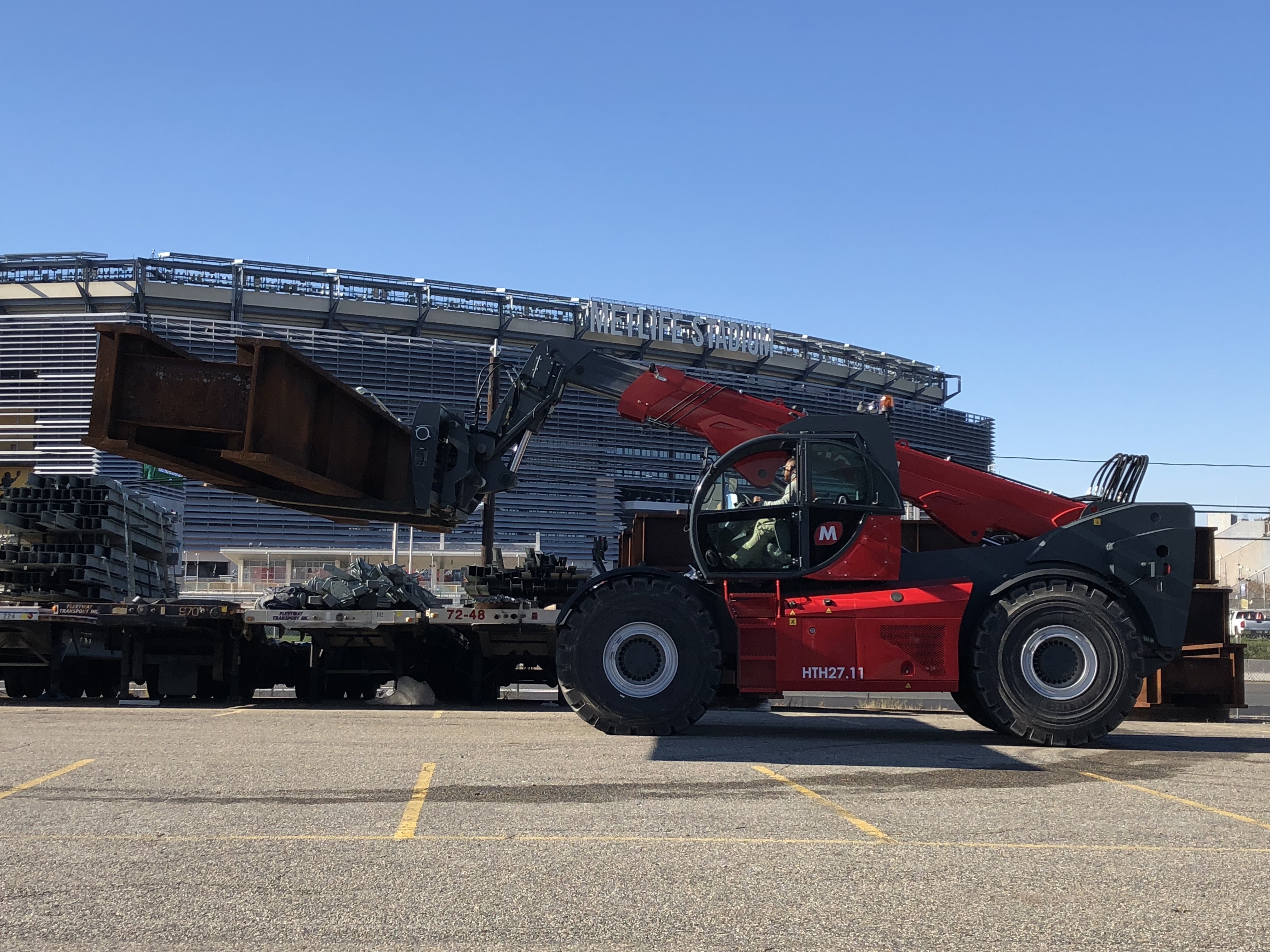
Telehandlers can pick, lift and carry construction material. (Photo courtesy of Magni Telescoping Handlers)
- Panel Systems Inc.: http://www.psiincusa.com
- Link-Belt Cranes: http://www.linkbelt.com
- Liebherr Tower Cranes: http://www.liebherr.com
- Manitowoc Crane Group: https://www.manitowoc.com/
- Caterpillar Inc.: https://www.caterpillar.com/
- Magni Telescoping Handlers: http://www.magnith.com
- Columbus McKinnon: http://www.magnetek.com
- AERO-LIFT: http://www.aero-lift.de
- Vacuworx: http://www.vacuworx.com
- Wood’s Powr-Grip: http://www.wpg.com
Source URL: https://www.metalconstructionnews.com/articles/cranes-and-their-alternatives/