Driving Staff Productivity through the Summer
by Paul Deffenbaugh | 1 July 2019 12:00 am
Summer is the time to produce, but your crew members may have their minds on other things

This is why the mid-summer-stutter presents such a danger to our production season. What is the midsummer-stutter you ask? Well, it’s the name I’ve started to use for the nose dive in productivity that seems to plague our teams in late June and July. You know the one I’m talking about. Feet start to drag, voices start to grumble, jobs drag on, quality slips and the construction machine of a business you’ve spent the last six months building shows its first sign of weakness. You and your team are far enough away from the start of the year to feel tired, but not close enough to the finish to see the light at the end of the tunnel, and we find ourselves stuck in a lethargic, heat-induced daze. Right when producing jobs on time and on budget matters most, our guys and girls stop doing exactly that. And as hot as it is, the snow will be here before we know it. We need to pick the pace back up, and we need to do it fast. So where do we start?
Identify the Performance Gap
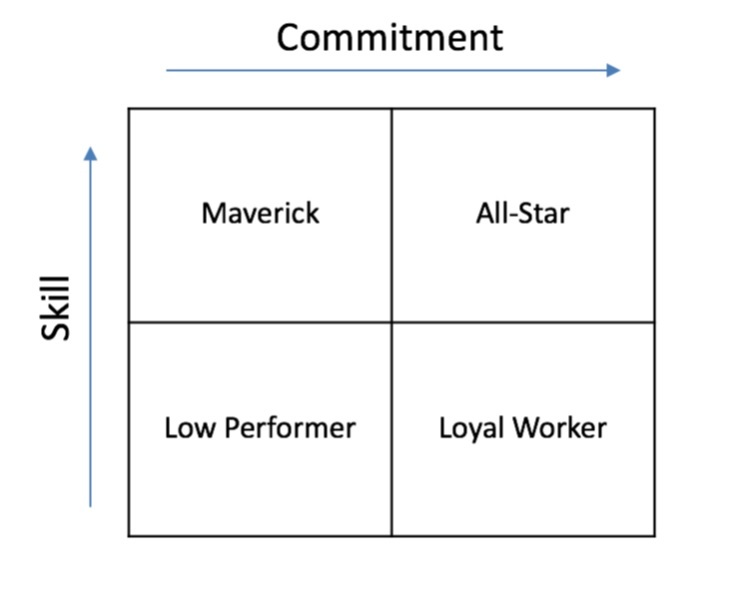
If someone is underperforming, they are usually missing one of two things: skill or commitment. Have a look at this diagram and ask yourself: Who is on my team?
All Star: Always on time. Has a positively killer attitude. Gets s*** done. Customers love her.
Maverick: Mavericks are talented and capable; they can work circles around most of their teammates. But their poor attitudes and lack of buy-in can cause friction and keep them from being the true all stars they have the potential of being.
Loyal Worker: You love this guy. He’s a team player and looks up to you as a leader. Customers and crew members alike love him for his temperament. He cares about the business and your clients. The problem is he’s slow and his quality of work could use an upgrade. It would be crazy to get rid of a team player like him, but if you’re honest with yourself, his performance needs to improve.
Low Performer: Not only is he a lousy worker but his attitude is in the gutter too. You find yourself wondering “why the heck did I hire this guy?”
I like this framework a lot. It’s simple, but that’s the point. It’s always helped me understand who is on my team and what they need to improve. All Stars are the ideal you wish you could clone, so make sure they know how much you appreciate them and treat them like gold. On the other end of the scale, Low Performers are simply too far away from where they need to be to justify pouring your finite resources into an attempt to develop them. Chalk it up to a bad hire, let them go as soon as it’s reasonable to do so and move on.
At 2019 METALCON, Kerr will be presenting two sessions:
“The 3 Keys to Getting Out of the Day-to-Day in Your Business” and “Structuring Your Company for Maximum Productivity.” To learn more about how you can participate, go to www.metalcon.com[1].
The Maverick and the Loyal Worker are people you can work with. Go back to the chart for a second and let it sink in. What is it telling us? The Maverick is lacking commitment. Working on his skills would be a waste of time because at this point he’s probably a more-skilled worker than you are. What’s missing for him is simply buy-in. He needs to care more about the company and his role in it.
The Loyal Worker is already trying his best. He just needs to be skilled up. He needs coaching, mentorship and specific feedback on where he can improve his job-site performance.
Skilling Up: Improving the Performance of Loyal Workers
Staff productivity depends to a large extent on your employees’ competence. But what is competence? Think of it as two parts you can influence:
1. Knowledge: I have learned how to do something.
2. Ability: I have practiced something and am good at it.
So how do you give people the knowledge and ability they need to be productive? You start by giving them a tool that outlines how to do something and then provide a consistent, stepby- step method for practicing that skill in a way that the employee can gain experience and gather feedback on his or her performance. This is called a competency model: a framework for defining the tasks, skills and knowledge necessary for successful performance in a specific role. The purpose of the competency model is to give the Loyal Worker the straightforward, concise instruction an employee needs, and to empower her with a clear method of practice so she can gain feedback and further her ability along the way. What’s the outcome? More productive staff. If you don’t have one of these, don’t worry, you can use the competency model I’ve built and I’ll even give you a fill-in-the-blanks template for you to customize for own company! Just go to www.btacademy.com/resources[2] and use MT19 as your download code.
With a complete competency model in hand, spend an hour a day for a week with your Loyal Workers. Grade their performances against the checklist, and you’ll quickly start to see where these guys need to be coached. The power in observing performance with a competency model is that you are able to give extremely specific feedback. There are a couple of very obvious things your Loyal Workers are doing incorrectly that, once addressed, will bring their speed and quality up substantially. Plus, they will appreciate the time spent with them more than you can imagine.
Increasing Commitment: Improving the Performance of Mavericks
Mavericks are tricky. They’re good at what they do, and (unfortunately) they know it. They ride this talent and see it as more than compensating for their less-than-desirable commitment. For most Mavericks, the first step in increasing commitment requires you to actually have some healthy conflict. You need to have a very real conversation with them. That’s scary, I know, but necessary if you want to turn this guy or girl around. There is likely something left unresolved, something he or she isn’t telling you. He’s mad at you because his crew isn’t as fast as he is and it’s holding him back. She’s frustrated because she feels she is entitled to more compensation. I don’t know exactly what it is and neither do you. That’s the problem!
Offer to buy your Maverick lunch or dinner and go somewhere nice. It’s important not to have this conflict conversation anywhere near work. A gesture like this makes your Maverick feel valued, and being away from anything business related will make him feel a lot safer and open to being totally honest with you. Ask him how he’s been doing: “What’s going well?” “What are you struggling with?” “Are you frustrated with anything?” Get him talking, and then shut up and listen. Once he’s got it all out, acknowledge his challenges and make him feel understood.
Now it’s your turn to calmly and assertively let him know he is underperforming. Tell him how much potential you see in him, that you want to see it fulfilled and that you want to discuss ways of problem solving whatever might get in the way.
For the Maverick, motivation comes from knowing what is important and understanding why it’s important. I like to assume employees want to do good work but they need to know what good work is. The hard truth is that employers often don’t communicate this. The whole point of an employment agreement is to clearly communicate why the role is important, why the employee should care about it, how to do it and what needs to be done.
Now would be a great time for the two of you to reread his or her employment agreement so she knows, in no uncertain terms, what her job entails. If you, like most contractors, don’t have employment agreements for your staff, I’ve got your back. I’ll share with you a completed one, as well as a fill-in-the-blank template so you can quickly make your own. Go to www.btacademy.com/resources[2] and use MT19 as your download code to request these documents.
Keep it simple guys! Your Loyal Workers legitimately need skill development, and as their leader, that’s on you. Your Mavericks need some conflict resolution and a little realignment. Get that competency model built, review some employment agreements, and go coach your team like the epic entrepreneur that you are. There is still a whole lot of season yet … go make the most of it!
Danny Kerr is the co-founder and managing partner of the Breakthrough Academy (BTA), a company made to help entrepreneurs in the trades grow their companies profitability while taking back control of their time. Breakthrough Academy currently works with over 220 business owners across the continent, and was rated as Canada’s 16th fastest startup by MacLean’s magazine in 2018. Kerr lives in Abbotsford, British Columbia, with his wife and three young daughters. When he’s not helping prospective BTA members, you can usually find Kerr exploring mountains in his Jeep.
- www.metalcon.com: http://www.metalcon.com
- www.btacademy.com/resources: http://www.btacademy.com/resources
Source URL: https://www.metalconstructionnews.com/articles/driving-staff-productivity-through-the-summer/