Expanding Your Metal Roofing Offering
by Jonathan McGaha | 27 December 2012 12:00 am
If you are reading this article, chances are 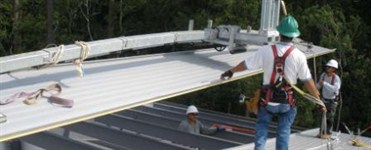 you install metal roofing. But how diversified is your metal roofing offering? Do you only install through-fastened panels such as R panel? How about standing seam? It is very likely that you install a wide variety of both through-fastened panels and standing seam panels. But what about insulated roof panels? Insulated roof panels are available in both through-fastened versions, such as an insulated R panel, and also insulated standing seam panels. In both instances, these insulated panels closely mimic so called singleskin metal panels that have been around for years.
Many installers have shied away from insulated metal panels
(IMPs) because they were traditionally used on large commercial or industrial projects. However, with the energy codes becoming more stringent, higher R-values and better air barriers are being required in the building envelope. With values up to R-48 and impermeable metal skins to provide the perfect air barrier, IMPs excel at cost effectively increasing a building envelope’s energy efficiency. IMPs are being used on all types of large and small projects. Schools, office buildings, warehouses, churches and many other building types are all taking advantage of the high energy efficiency of IMPs.
Another reason installers may be reluctant to bid on an IMP job is their lack of knowledge regarding installation. IMPs typically require different methods of handling during installation due to their bulk and weight. Often a crane is used for setting panels, and on big roofs, a vacuum lift is often utilized. Also, the sealing of the panels to the structure and to each other is somewhat different than with single-skin panels. However, once these two differences are understood, estimating installation time is relatively simple.
Because the insulation is part of an IMP roof panel, you don’t have to deal with blanket insulation, which is typically used with single-skin roof panels. As we all know, when the wind is blowing, the installation of blanket insulation becomes very difficult. The increase in required R-values for roofs often necessitates the use of a double layer of blanket insulation, making installation even more difficult.
Another benefit of IMP roof panels is that they are often wider than their single-skin counterparts. This means that with each IMP panel you install, you are laying more square footage than with a single-skin roof panel. Additionally, the IMPs can generally span further than single-skin panels, requiring fewer purlins or joists in the roof structure. This all translates into faster installation times, handling fewer panels and having fewer clips and fasteners to install.
An interesting phenomenon with IMP roof panels is that you don’t have to deal with the issue of thermal expansion the way you do with single-skin panels. On wide roofs, you can have issues with panels slotting around the fasteners on through-fastened roofs. And with standing seam roofs, you have to ensure that the panel clips can handle the anticipated thermal movement. However, with IMPs, the panels experience something called “thermal bow.”
An IMPs exterior metal skin will still expand as it heats up. But, instead of causing the whole IMP to grow in length because the interior metal skin of the IMP remains a relatively constant temperature, the exterior skin of the IMP will bow up slightly between purlins/joists. The insulating foam that adheres to this metal skin flexes to allow for this bow. Because of this, thermal expansion is accommodated by the small incremental growth (and bowing up) of the exterior metal skin between each purlin/joist, which are usually spaced five to seven feet apart.
Most IMP manufacturers would be very willing to work with a metal roofer to help the roofer understand the fundamental differences between installing single-skin metal roofs and IMP roofs. In fact, some have training classes designed specifically for this. If you are interested in installing IMP roofs, contact a manufacturer’s representative and ask what assistance they have with training. With a little studying and training, you can tap into a fast growing segment of the industry, one that is sure to continue expanding as the need for energy conservation increases exponentially.
Ken Buchinger is the vice president of business development and research & development for MBCI, Houston. He has been instrumental in developing weathertightness warranties, erector training programs, and research and development certifications. The statements and opinions expressed herein are solely those of the author and do not constitute official statements or positions of MBCI or its affiliates. For more information, visit www.mbci.com.
Source URL: https://www.metalconstructionnews.com/articles/expanding-your-metal-roofing-offering/