On the Scene
by Brooke Smith | 1 March 2024 7:00 am
Metal construction is growing. According to Allied Market Research, the compound annual growth rate (CAGR) is projected at 4.8 percent, from 2022 to 2031, and the global market is projected to increase to $34.1 billion in 2030, up from $21.4 billion in 2021.1 According to Metal Construction News’ 2023 Top Metal Builders report, 2022 was the biggest year for top contractors and erectors combined purchasing metal: 2,696.4 tonnes (2,751.8 tons) in 2022, up from 1,974.2 tonnes (2,176.2 tons) in 2021. For metal construction contractors who saw a drop in supply during the pandemic years (2020–2021), this is good news.
It is also good news for any company fabricating metal roof and wall panels. Metal is fast becoming a popular choice given its durability, range of colors and styles, and cost savings compared to other materials (e.g. wood and brick). Plus, it is now a popular aesthetic for homes, and apartment buildings, in addition to commercial structures.
Whether used in-plant or on-site, a rollformer is a great asset, as the options for metal panels in all types of structures are only growing. Standing seam roofs, which last 30 or 40 years, are replacing shingle roofs, which last an average of 15 to 30 years, depending on the climate and the quality of the material.
On the other hand, metal roofs can last up to 70 years, and the cost is not much more than the least expensive shingle roof, at $115 per square foot for standing seam as opposed to $70 to $150 for asphalt shingle. The price differential and durability make metal roofs and siding a great choice.
In the ever-evolving construction industry, portable metal roof panel rollformers have marked a significant difference in how metal roofs are fabricated and installed. These machines, capable of manufacturing metal roofing panels directly at the construction site, are gaining popularity due to their efficiency and versatility. As trends change and markets expand, the need for versatility grows. Transporting a portable rollformer to a jobsite offers distinct advantages.
Trends in popularity
Portable metal roof panel rollformers are becoming increasingly popular, driven by the growing trend toward efficient, sustainable construction. They are more environmentally friendly than in-plant ones, creating less waste and reducing the need for transportation.
The demand for these machines is rising, particularly in areas with logistical challenges or where custom roofing solutions are required. Moreover, as the construction industry continues to embrace automation and on-site manufacturing technologies, the adoption of these rollformers is expected to grow further as roofs measured with drones and satellite imagery provide roof size, pitch, hip, and flashing, for example, so even complex roof dimensions can be uploaded to the rollformer controller and run automatically.
As new profiles and metals develop, specialized demand increases. Metal siding is also gaining in popularity beyond roofing, and metal producers are designing new patterns and textures to accommodate this growing trend in commercial and residential buildings. Portable rollformers can easily and quickly adapt to specialized orders.
Best-suited applications
Portable rollformers are suitable for any size roofing or siding projects but really differentiate where precision and customization are critical. They can run panels for large industrial warehouses, backyard toolsheds, or any size structure in between. Additionally, their ability to produce panels on-site makes them ideal for specialty projects where customization is essential, and in remote locations or areas with limited access.
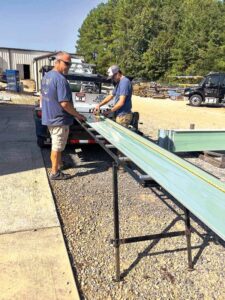
Installers can bring these portable machines to any jobsite, run panels, and immediately install them. Some machines offer optional notching systems, which can streamline productivity even more. To address downtime or increase operational productivity, installers can transport the machine directly to a construction site and run the panels. When the customer can help stack the panels, only one worker is necessary to operate the machine. And there is no need to package or crate the machine since it is right on the site. Likewise, contractors who do not perform installations can use portable rollformers for chop-and-drop jobs.
The benefits
Benefits are numerous for portable rollformers. Consider the following:
Cost-effectiveness
By producing panels on-site, transportation costs and the risk of panel damage during transit are significantly reduced. For example, during transportation, the panels go through many hands, from production to the loaders who stack them onto the trucks to those unloading and stacking them onto the ground. There are many opportunities for damage to occur along the way. However, running panels on-site significantly reduces the chances of scratching or denting the metal. Also, there are not all the related costs of transportation, which involves the costs of delivery, workers, mileage, for example, all of which can cut into profits.
Customization
These machines can produce panels that perfectly fit the specific dimensions of a roofing project, reducing waste and the need for adjustments during installation. Panels can be fabricated longer than what can be transported from a factory, as the machines have no limit to the length of panels formed.
Efficiency
On-site production speeds up the roofing process, as panels can be manufactured in sync with the construction schedule. Installers, then, are not at the mercy of a supplier’s schedule, inventory, or workload. Plus, less waste is produced by running customized panels.
Quality control
A contractor has greater control over the quality of the panels, ensuring consistency and reliability in the roofing material. They can regulate the fabrication process to specifications that can usually be uploaded to the machine’s controller. In addition, as they are the only one handling the panels, there is less potential for damage than when ordering from a manufacturer, where the panels go through many hands.
The drawbacks
While portable rollformers offer contractors control over production and panel fabrication, there are aspects of ownership to be aware of, including costs beyond the price of the machine. In this case, the following should be considered:
Investing
Owning a portable rollformer requires a significant investment. There is the cost of the machine, accessories, any upgrades (like notching or an advanced controller), and a trailer. Depending on the machine, expect to pay anywhere from $50,000 to $180,000—without the trailer. Tooling for additional profiles and specialty accessories will increase the price, not to mention the cost of insuring the machine.
Time on-site
Custom panel production from a portable rollforming machine requires more time on the jobsite, as the coil must be loaded, any necessary profile adjustments made, and panels run. Most rollformers will work at speeds up to 18 to 23 m (60 to 75 ft) per minute, so forming the panels will have to be calculated into the jobsite time.
Specialized training
Operators of rollforming machines require training and expertise to ensure panels are fabricated accurately. They need to know how to perform changeovers, make profile adjustments, form panels, and maintain the machine. Knowledge sharing among the labor force is essential to prevent slowdowns due to turnover or absent employees. In addition, training takes employees away from their primary jobs and responsibilities. Depending on the machine, training can take anywhere from a few hours to two or three days. And if employees need to go to a training location, there are travel costs and incidentals to pay.
Additional costs
Costs of maintaining the rollformer to keep it running smoothly and produce quality panels can add up. These costs include lubricating the shear and cleaning the rollers, providing gas for the engines, and providing hydraulic fluid for annual changes. Any servicing required to address machine damage or malfunction is another cost consideration.
Other considerations
Installers and contractors should look at their business model, projected growth, and their place in the market and then sit down to crunch the numbers before opting to purchase a portable rollformer. Several key considerations should be kept in mind during this decision-making process:
Machine care
A portable rollformer requires trained operators who can fabricate panels, change profiles, and make profile adjustments. Operators must also know how to perform required maintenance, including daily, weekly, and monthly care. Installers and contractors will require a couple of workers they can depend on to care for the machine.
Operation size
As a roofer who occasionally installs metal, then it may not be worth it to invest in a portable rollformer. As a roofer with a stable business, however, the machine can pay for itself quite quickly.
Operational budget
Paying in full to own a rollforming machine is not necessary; financing is available. Analyze the budget and calculate payments into the revenue stream. Remember to include additional costs, such as gas, lubricants, and maintenance. While these costs are still significantly lower than factory panel fees, they still must be figured into the budget.
Workflow
In assessing the justification for acquiring a machine, contractors, especially those engaged in occasional or part-time work, may find that the investment in a portable rollformer may not be economically justified. Additionally, for contractors handling small jobs that don’t necessitate customization, the associated responsibilities of machine ownership may not align with their operational preferences.
Return on investment (ROI)
When considering the acquisition of a portable rollformer, it becomes essential for businesses to meticulously calculate the potential profit augmentation and the prospect of opening new revenue streams, including opportunities like chop-and-drop jobs. Evaluating the financial impact and identifying potential areas of increased profitability is a crucial step for businesses contemplating the integration of this machinery into their operations.
Conclusion
As the market for metal roofs and siding continues to grow, portable rollformers will play a significant role in meeting the demand. Their ability to produce high-quality, custom-fit metal roofing panels on-site offers a combination of efficiency, cost-effectiveness, and customization that is valuable in the industry and translates to increased profits for the contractor.
In addition, if the operation already has an in-plant machine, adding a portable rollformer provides the flexibility to run panels on-site. However, portable rollformers can be used as in-plant machines as well. The flexibility and control of production offered by owning a portable rollformer are real advantages in the evolving metals marketplace.
Note
1 See alliedmarketresearch.com/press-release/fabricated-metal-market.html
Rick Zand previously worked as a freelance journalist and educator. He has been the content specialist at New Tech Machinery since February 2023.
Source URL: https://www.metalconstructionnews.com/articles/features/on-the-scene/