The Role of Thermal Breaks in Rolling Steel Doors
by David Flaherty | 2 March 2026 11:03 am
 [1]
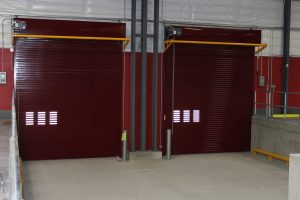
[1]Insulated rolling steel doors are a staple of commercial construction, providing strength, durability, and security while also helping control HVAC costs. But even a door filled with best-in-class insulation can be a source of energy loss if it is not engineered correctly to address points of metal-on-metal contact. Without thermal breaks, these contact points create thermal bridges that undermine door performance, leading to inconsistent indoor temperatures and increased energy demand. For architects, designers, and specifiers, understanding the importance of thermal breaks and how they optimize energy efficiency within insulated rolling steel doors and the broader building envelope is paramount.
How thermal breaks are applied in door design
When two high-conductivity materials, such as the steel slats in an insulated rolling steel door, come into direct contact, they create a high-speed thermal pathway through the assembly. These pathways, called thermal bridges, contribute to significant energy loss if left unchecked. In colder climates, thermal bridges lead to heat loss, and in warmer climates, they allow heat to enter. Thermal breaks address this issue by introducing a low-conductivity material, such as CPVC, between the steel curtain components, effectively interrupting the pathway and significantly slowing thermal transfer.
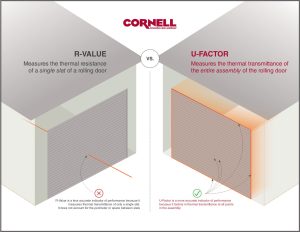
The impact of thermal bridging and the value of properly engineered thermal breaks is clearly illustrated in an insulated rolling steel door with double-wall construction. In this configuration, interior and exterior steel curtains are separated by an insulated core in a sandwich-style design. While insulation improves thermal performance, some rolling steel door designs may still allow the steel curtains to make direct contact at specific points, creating thermal bridges that operate independently of the insulated core. In these cases, the door’s insulated core may have a high R-value, while the overall assembly, represented as a U-factor, experiences energy loss at other points.
To recognize where opportunities for thermal bridging occur in an insulated rolling steel door and how they are mitigated using thermal breaks, here is a look at the individual door components, along with tips on what to look for when specifying for optimal energy efficiency.
Curtains
The curtain is the primary moving part of the assembly, comprising interlocking steel slats that articulate vertically to open and close the door. In an insulated rolling steel door with double-wall construction, the curtain is formed by an interior and exterior layer separated by an insulated core. While this configuration limits thermal transfer across much of the curtain surface, direct steel-to-steel contact does still occur along the slat profiles and interlocking joints where the layers are fastened together. To interrupt these bridging points, some manufacturers replace the backing components with high-durability, low-conductivity CPVC, significantly slowing thermal transfer through the slats while maintaining the door’s structural integrity and operability.
What to look for
Rather than relying solely on core insulation values, evaluate the door based on its overall U-factor, which reflects how effectively the entire assembly controls thermal transfer. Specify double-wall curtain designs that include an insulated core and engineered thermal breaks, such as low-conductivity backers, to eliminate steel-to-steel contact within the slat assembly. When combined with targeted thermal breaks in adjacent components such as the guides, these design strategies can significantly reduce thermal bridging and help achieve U-factor ratings as low as 0.532.
Guides
Guides are the vertical steel track assemblies mounted to each side of the door opening that retain, align, and support the curtain during operation. Guide design can influence air leakage and thermal performance at the door perimeter, particularly when configured with integrated weather seals and thermal breaks.
What to look for
Since weather seals alone do not address thermal bridging, specify guide assemblies that apply thermal breaks to improve the assembly’s perimeter performance and reduce energy loss at the sides of the door.
Hood
The hood is the protective cover at the top of a rolling steel door that encloses the coiled curtain when the door is open and protects the rolling apparatus from dirt, debris, and weather. The hood can also incorporate a seal that helps shield the building’s interior from the outdoor weather.
What to look for
The hood is often treated only as a protective cover, but a quality hood design goes beyond basic enclosure and addresses thermal performance at the top of the door opening. Look for insulated hood construction, tight-fitting joints, and perimeter weather seals that limit air leakage and reduce heat loss where warm air naturally accumulates above the door.
Bottom bar
The bottom bar is the horizontal component attached to the lower edge of the curtain, serving as the interface between the door and the floor when the door is closed. It controls air flow at the sill with continuous weather seals or edge gaskets. Properly detailed sealing elements reduce air infiltration and limit thermal transfer at the base of the door.
What to look for
Instead of evaluating the bottom bar solely for strength and security, also look for designs that actively reduce air leakage at the sill. Specify bottom bars with continuous, compressible seals that conform to floor irregularities and maintain consistent contact, limiting air infiltration and associated energy loss at the base of the door.
Understanding how thermal breaks are applied to door components and complement other energy-conscious features helps building professionals make decisions that deliver on performance. In addition to these features, look for a reputable door manufacturer that supports architects and designers in selecting, incorporating, and specifying products best suited for an application’s needs. This may include self-serve tools or a dedicated architectural support team.
Where thermally broken rolling steel doors shine
 [2]
[2]Rolling steel doors with double-wall construction, insulated cores, and engineered thermal breaks play an essential role in maintaining consistent indoor environmental conditions in commercial buildings. When combined with effective air sealing, these door systems help control temperature differentials, humidity, and condensation—issues that are particularly pronounced in four-season and extreme climate zones. The following is examples of commercial buildings that stand to benefit the most from thoughtfully engineered rolling steel doors.
Warehouses and manufacturing facilities with loading docks
Loading docks feature many doors, each of which represents a thermal weak point in the building envelope. Often, sectional doors (that feature very favorable U-factors) are used in these applications, but there may also be instances where the smaller footprint of a rolling door is required. In that case, insulated rolling steel doors with thermal breaks can help meet energy-efficiency requirements in tighter spaces.
Cold-storage facilities for food, beverages, and pharmaceuticals
Cold-storage environments rely on strict temperature and humidity control to maintain product integrity and regulatory compliance. Thermally efficient rolling steel doors reduce thermal transfer between refrigerated interiors and warmer exterior spaces, helping prevent frost buildup, condensation, and temperature fluctuations. Low U-factor doors also reduce energy loads on refrigeration systems, supporting long-term operational efficiency and equipment longevity.
Commercial storefronts with customer-facing areas
In retail and mixed-use storefront applications, rolling steel doors often separate conditioned interior spaces from exterior environments while remaining visible to customers and occupants. Thermally broken rolling steel doors help maintain comfortable indoor temperatures near the storefront opening, reducing drafts and cold spots that negatively affect customer experience.
Educational facilities with large openings
Schools, universities, and training facilities frequently incorporate large openings for gymnasiums, cafeterias, maintenance areas, and shared-use spaces. In these applications, insulated rolling steel doors help maintain indoor comfort for students and staff while limiting energy loss across large spans of the building envelope.
By thoughtfully specifying insulated rolling steel doors, building professionals can ensure consistent comfort, protect sensitive environments, and reduce energy costs across a wide range of commercial applications.
Little details, significant impact
 [3]
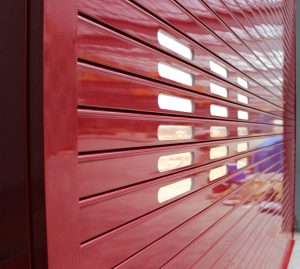
[3]As energy codes become more stringent and expectations for building performance continue to rise, building components such as insulated rolling steel doors require greater scrutiny. Thermal breaks at the curtain and guides, along with ample sealing at the hood and bottom bar, can further improve the performance of a well-insulated assembly. By understanding how thermal breaks are applied to these components, contractors, architects, designers, and specifiers can make more informed choices that improve envelope continuity.
Heather Bender is the director of commercial product marketing at Clopay Corporation. At ClopayDoor.com, Heather leverages 16 years of experience in manufacturing and building materials. Excelling in product management, she adeptly handles product inception to commercialization. Her role involves finding unique solutions for building owners and designers, highlighting her strategic and innovative approach to complex industry challenges.
- [Image]: https://www.metalconstructionnews.com/wp-content/uploads/2026/02/Clopay_Thermiser-Max_1.jpg
- [Image]: https://www.metalconstructionnews.com/wp-content/uploads/2026/03/Clopay_R-Factor-U-Value_Infographic.jpg
- [Image]: https://www.metalconstructionnews.com/wp-content/uploads/2026/02/Clopay_Thermiser-Max_2.jpg
Source URL: https://www.metalconstructionnews.com/articles/features/thermal-breaks-rolling-steel-doors/