Solar PV and Standing Seam: The Perfect Marriage for Commercial Rooftops
by Jonathan McGaha | 8 January 2012 12:00 am
Looking at solar photovoltaic (PV) costs and roof costs together as a single asset reveals the strengths of the standing seam metal roof, making it the most highly favored PV mounting platform for both practical and economic reasons. Roofing costs have always been regarded as a significant line item in the overall construction budget, but those costs pale in comparison to the installed cost of a power generation system that can climb to more than $50 per square foot.
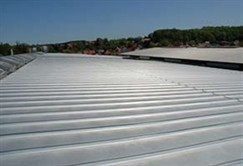 Given these facts, mounting a PV system onto a conventional roof type is a bit like putting a Formula 1 racecar engine on a Ford Taurus chassis-it just doesn’t make sense! Not only is standing seam a much better mounting platform than other roof types, but the cost advantages also make the marriage of PV to metal a nobrainer. Metal roof manufacturers and contractors should know the benefits of their product range as it relates to solar technologies, which Solar array direct attached to a SSMR. The standing seams create a perfect platform to attach solar have become the buzz of the green movement.
The metal roofing community has always been apologetic for higher initial costs when compared to conventional roof types, presenting life cycle cost arguments to justify their premium price tag. Not anymore. When power generation is a building design objective, metal is actually the low-cost alternative not only from a life cycle basis, but also from the initial cost standpoint. This makes the decision for metal roofing a slam-dunk under such circumstances, and opens a whole new market for the retrofit of existing flat roofs.
Comparing costs
When installed on built-up (BUR) and single-ply membrane roof types, PV arrays are mounted on racks. A framework of aluminum must be constructed and mechanically attached through the roof membrane into the building structure to support PV modules. Aside from the obvious disadvantage of punching a lot of holes through the roof, such a scheme is also expensive. Installed mounting system costs range from $0.60 to $1.00 per watt on commercial systems.
In limited instances, the framework is ballasted (to avoid roof penetration and at a lower cost), but this method is constrained to new construction because the building structure must be designed for the added load of the ballast.
On the other hand, when the roof type is standing seam, such framework (or ballast) is 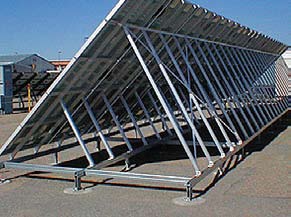 unnecessary, and direct mounting costs range from $0.15 to $0.20. This means an initial cost savings of $ 0.45 to $ 0.80 per watt. It may not sound like much, but to translate into square-foot costs, multiply by 10 watts per square foot (net output of crystalline PV systems). That results in $4.50 to $8 per square foot initial cost savings by mounting to standing seam rather than traditional commercial roof types. Such savings are often 15 percent or more of the completed system cost
(including both roof and PV).
The good news doesn’t stop there. Usable life of crystalline PV is 30 to 40 years. Usable life of most roof membranes (other than standing seam metal roof) is 12 to 20 years. This means that the roof will require replacement before the PV system and in some cases, more than once. To do this, the PV modules, together with their racking system must be removed and then reinstalled following roof replacement, adding logistical difficulty and considerable cost to an already expensive roof replacement.
The added cost of the removal and reassembly of the PV together with roof replacement ranges to an additional $15 to $20 per square foot or $1.50 to $2.00 per watt. Additionally, while this process takes place, the system produces no power, which can mean tens of thousands or more of lost dollars on a large system.
Details of mounting to SSMR
The benefits of structural standing seam metal roofing (SSMR) and PV lie with the methods of mounting the array and the longevity of the completed system. To begin with, the SSMR generally provides a service life in excess of 40 years, outlasting the PV array. The PV array is mounted on SSMR using aluminum seam clamps that pinch the seam within the clamp via round-point stainless steel setscrews. This obviates the need for both racking and roof penetration. The holding strengths of these clamps are, in many cases, published and can exceed the beam strength of the panel seam as well as its attachment to the structure. Interface hold-down hardware is bolted to the clamp body and anchors the PV modules to the top of the seam clamps.
It is common that solar modules are installed in landscape orientation (long dimension traversing seams) and ganged together with adjacent modules upslope and downslope, sharing a mounting point and attachment clamp. Given a module width of 3-plus feet, and assuming industry standard structural purlin spacing of 5 feet, the resulting attachment frequency of PV modules to the SSMR is equal to or greater than the attachment frequency of the SSMR to the building structure.
Depending upon wire-management techniques and other details, it is not only a possible but common practice to mount massive power generation arrays on metal rooftops with zero penetration of the roof. The round-point setscrews ensure no breach of metallic coatings or galling of the roof materials, leaving weather integrity and roof warranties intact.
Because of the longevity of the SSMR, roof replacement prior to expiration of PV service life is not an issue. And, if that isn’t enough, the recyclability, durability and maintenance freedom of metal are also far superior to other roof types. On top of all the foregoing benefits, the installation costs are also significantly lower. The SSMR provides a convenient grid-work of beam-like configurations so direct attachment is simple and the mounting is much less labor intensive, translating into significant cost savings over other roof types.
One thing is certain. Initial PV costs for SSMR are significantly lower than for other roof types. Total life cycle costs analysis that considers necessary roof-replacement costs during the usable life of the PV will also demonstrate that using metal roofing under the PV not only conserves the environment, but conserves the cash as well.
Rob Haddock is the founder of S-5! and has 35 years in the industry. Starting out as a metal building erector, today Haddock is a well-known metal roof consultant, author, speaker and inventor. For 15 years, Haddock operated one of the nation’s largest metal roofing companies with approximately 10 million square feet of successful installations nationwide. He also serves as director of the Metal Roof Advisory Group Ltd., a consulting firm performing a variety of services for a worldwide clientele.
Source URL: https://www.metalconstructionnews.com/articles/guest-column-solar-pv-and-standing-seam-the-perfect-marriage-for-commercial-rooftops/