Innovations in Daylighting for Metal Buildings
by David Flaherty | 15 July 2025 9:05 am
 [1]
[1]Metal buildings have evolved far beyond their utilitarian origins. Once prized primarily for their cost efficiency and fast construction timelines, they are reimagined as high-performance environments prioritizing sustainability, occupant well-being, and long-term energy efficiency. Today, the metal building industry stands at a pivotal crossroads, driven by three converging forces: increasingly stringent sustainability regulations, rising market demand for energy-efficient design, and a growing emphasis on indoor environmental quality.
In response, daylighting has become a key strategy for addressing these evolving priorities. When thoughtfully integrated, advanced daylighting systems reduce reliance on electric lighting, ease cooling loads, and create more comfortable, productive indoor spaces. Modern daylighting solutions are helping metal buildings meet evolving energy codes and transforming them into sustainable, occupancy-focused spaces designed for long-term performance.
The push for smarter daylighting
Sustainability mandates and energy performance standards are accelerating the evolution of daylighting in metal building design. Leading regulatory frameworks, including the International Energy Conservation Code (IECC), ASHRAE 90.1, California’s Title 24, and many local stretch codes, are pushing building professionals to adopt more advanced, integrated daylighting solutions.
These regulations define strict requirements for interior daylighting zones, which mandate that a specified portion of occupied space receive natural daylight as a source of interior illumination. They also state performance metrics for building envelope components, such as visible light transmittance (VLT), solar heat gain coefficient (SHGC), and U-factor, influencing how daylighting systems are selected and deployed.
As these codes become more rigorous with each revision cycle, they drive the daylighting technologies that offer optical precision and thermal performance. At the same time, these systems contribute points toward green building certifications such as the United States Green Building Council’s (USGBC) Leadership in Energy and Environmental Design (LEED) certification and the International WELL Building Institute’s WELL standards by improving daylight access, reducing energy use, and supporting occupant health.
In short, code compliance is no longer a checkbox but a catalyst for innovation, and daylighting is one of the most impactful levers in achieving these ambitious goals.
 [2]
[2]Performance meets innovation: Modern daylighting technologies
The demand for daylighting solutions has intensified. Fortunately, today’s innovations keep pace with these demands and expand what is possible in metal building design. Technologies such as tubular daylighting devices (TDDs), high-performance metal-framed glass skylights, and polycarbonate translucent panel systems each offer distinct advantages aligned with modern performance goals.
Tubular daylighting devices (TDDs)
TDDs are engineered to capture daylight on the roof and redirect it through a highly reflective interior system, delivering it deep into the building without compromising the envelope’s thermal performance. Their compact rooftop footprint makes them ideal for metal buildings with limited structural allowances or complex layouts in retrofits and new construction. Precision diffusion ensures consistent lighting with reduced glare, while optional controls regulate daylight levels throughout the day. With inherently low solar heat gain and U-factor values, TDDs strike a powerful balance between daylight delivery and energy conservation, making them ideal for meeting IECC and ASHRAE daylighting zone requirements, particularly in hard-to-reach interior spaces.
High-Performance metal-framed glass skylights
High-performance metal-framed glass skylights combine architectural elegance with robust environmental performance. These modern skylights minimize unwanted heat transfer while maximizing visible light transmittance. They also offer advanced glazing technologies, such as triple glazing, low-emissivity (low-E) coatings, and thermal breaks. Their modular designs offer scalable daylight solutions that seamlessly integrate into metal roofing systems, while high recycled content and recyclability support green building goals. Skylights are well-suited for applications where visual transparency, aesthetic quality, and code-driven performance must converge.
Polycarbonate translucent wall and roof assemblies
Polycarbonate panel systems are lightweight, durable, and highly customizable. They provide diffused, glare-free daylight with built-in thermal insulation. Their flexible shape, size, and color give designers a broad creative palette, ideal for large-scale commercial or industrial metal buildings that require broad daylight coverage. Their impact resistance and structural adaptability make them an especially attractive solution in areas where durability and code compliance must coexist. Like TDDs and skylights, these assemblies contribute to energy savings and comfort while satisfying the daylighting criteria outlined in Title 24 and LEED standards.
Each daylighting solution brings a unique set of strengths to the table. TDDs offer precision control and efficiency in constrained spaces. Skylights provide clarity and connection to the outdoors while offering excellent insulation. Translucent panels excel in uniformity and scale, particularly in expansive applications. Together, they provide a comprehensive toolkit to balance light transmission, thermal performance, and compliance, paving the way for the next generation of high-performance metal buildings.
Aligning with market expectations: Energy, comfort, and cost savings
As energy costs rise and occupant expectations evolve, the demand for high-performance, human-centric buildings has become a central driver in metal building design. Owners, developers, and facility managers increasingly focus on reducing operational expenses while enhancing indoor environmental quality (IEQ). Daylighting offers a powerful strategy to meet both goals. Modern daylighting solutions significantly reduce the need for electric lighting during daylight hours, leading to immediate energy savings. By minimizing solar heat gain and decreasing reliance on mechanical HVAC systems, these technologies help regulate indoor temperatures more effectively, easing the burden on HVAC equipment and extending its operational life. A study by the Energy Center of Wisconsin found that test rooms utilizing daylighting achieved an overall operating cost savings of 22 percent
compared to control rooms, with lighting energy use reduced by 32 percent and cooling energy requirements lowered by 25 percent. These performance gains translate into substantial financial savings over the building’s lifetime.
Beyond utility savings, the human benefits of natural daylight are substantial. Numerous studies show that well-daylit environments support visual comfort, boost mood and productivity, and enhance occupant satisfaction, especially in workspaces, classrooms, and industrial settings. These performance benefits make advanced daylighting a critical component in meeting market expectations to perform, not just protect, and daylighting plays a vital role in making that performance visible, tangible, and impactful.
Case Study: Roper Mountain Science Center – Greenville, S.C.
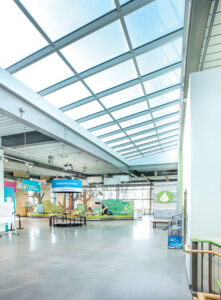
The Roper Mountain Science Center (RMSC), an environmental science and sustainability Center, prioritized daylighting to reduce energy use and enhance the educational experience. To support these goals, the design team installed a large, single-slope metal-framed glass skylight above one of the main exhibit areas, flooding the space with natural daylight and minimizing the need for electric lighting. This feature improved energy efficiency and reinforced the center’s sustainability mission while strengthening its connection to nature and enhancing occupant comfort.
Material and system innovation: The manufacturing response
Manufacturers are addressing evolving codes and consumer expectations by reimagining daylighting systems from the ground up. This new generation of products is being engineered for enhanced energy performance, seamless architectural integration, and environmental responsibility.
Advances in dome and lens design, glazing assemblies, and thermal barrier materials have significantly improved daylighting systems’ performance. Products are now optimized for lower U-factors and solar heat gain coefficients (SHGC) while maintaining high visible light transmittance (VLT), ensuring ample daylight delivery without compromising thermal comfort. Many of these components are also manufactured using recycled materials, aligning with broader industry shifts toward low-carbon construction practices.
Customization is also taking center stage. No longer limited to standard configurations, daylighting systems match project aesthetics, performance requirements, and building geometry. Product flexibility enables design creativity without sacrificing performance, whether it is color-matched flashing for curb-mounted skylights or modular translucent panels designed for
multi-span facades.
Case Study: 103 CityPoint – Waltham, Mass.
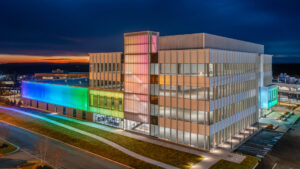
Designed to combine lab, manufacturing, and office spaces under one roof, 103 CityPoint required daylighting solutions that could deliver on aesthetics, energy efficiency, and occupant productivity and well-being. Polycarbonate translucent wall systems were selected to provide glare-free
natural daylight to interior spaces, reducing dependence on electric lighting and supporting the building’s LEED Silver certification. By day, these systems create a clean, modern façade. By night, integrated LED lighting transforms the exterior with dynamic, eye-catching displays that reflect the building’s innovative spirit. This project shows how advanced daylighting products are engineered for high performance, architectural cohesion, and environmental responsibility while offering flexibility to meet evolving design and sustainability goals.
Future-ready design: The role of daylighting in next-gen metal buildings
As the building Sector moves to more integrated, performance-driven strategies, daylighting is increasingly recognized as a foundational element in future-ready design. Rather than functioning as standalone enhancements, daylighting systems now work harmoniously with ventilation, insulation, and lighting controls to form a cohesive performance strategy.
This shift supports both lifecycle performance and net-zero building goals. By incorporating daylighting early in the design process, building teams can optimize daylight distribution, minimize thermal loss or gain, and reduce dependence on mechanical systems. These are key steps in extending the useful life of building systems and structures. Moreover, integrated daylighting systems contribute significantly to performance modeling outcomes used to meet LEED, WELL, and other certification standards.
The next generation of metal buildings will comply with codes and embody resilience, flexibility, and sustainability. For those in the metal building industry, daylighting offers both a proven foundation and a pathway to innovation.
Case Study: ASU Student Pavilion – Tempe, Ariz.
 [3]
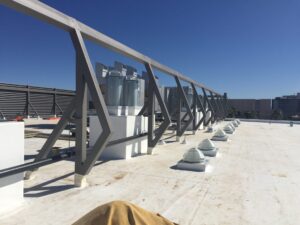
[3]As part of Arizona State University’s climate net neutrality goals, the Student Pavilion was designed to achieve net-zero energy. One of the biggest challenges was delivering daylight to internal stacked collaboration corridors, where traditional skylights were not an option. To solve this, the design team installed TDDs engineered to span long distances and navigate multiple 90-degree bends. Performance modeling guided the optimal placement of each unit, ensuring consistent daylight distribution across the 1,951 m2 (21,000 sf) zones on every floor.
Insulated panels and extension turrets were used to further enhance energy performance, control heat transfer, and minimize shading. The result is a LEED Platinum-certified facility where integrated daylighting contributes to energy efficiency, occupant well-being, and long-term building performance.
Conclusion: Daylighting as a defining element of progress
The metal building industry is undergoing significant transformation. As energy codes become more stringent and the demand for sustainable, human-centric design increases, daylighting has evolved beyond a simple illumination source. It now represents a robust integration, performance, and long-term value tool.
Today’s advanced daylighting technologies are not only helping metal buildings meet evolving regulatory standards, but also redefining what it means to design efficient, flexible, and inspiring environments for the future.
Neall Digert, Ph.D., MIES, vice president, innovation and market development, Kingspan Light + Air | North America, has over 30 years of consulting and education experience working in the energy/lighting/daylighting design and research fields, specializing in the design and application of advanced lighting and daylighting systems for commercial building applications.
- [Image]: https://www.metalconstructionnews.com/wp-content/uploads/2025/07/4.-At-night-integrated-LED-lighting-transforms-103-CityPoints-facade-into-a-striking-visual-display-reflecting-the-innovation-within-1.jpg
- [Image]: https://www.metalconstructionnews.com/wp-content/uploads/2025/07/1.-A-single-slope-glass-skylight-floods-the-exhibit-space-at-Roper-Mountain-Science-Center-with-daylight-cutting-energy-use-and-enhancing-the-learning-experience.e.jpg
- [Image]: https://www.metalconstructionnews.com/wp-content/uploads/2025/07/8.-To-support-ASUs-Net-Zero-Energy-goals-insulated-panels-and-extension-turrets-were-paired-with-long-span-TDDs-to-reduce-heat-transfer-and-minimize-shading-1.jpg
Source URL: https://www.metalconstructionnews.com/articles/innovations-in-daylighting-for-metal-buildings/