The Cost of Getting It Wrong: Insulation’s Role in Retrofits
by David Flaherty | 26 October 2025 11:42 am
 [1]
[1]Metal buildings have become a mainstay in industrial and commercial construction. Their structural efficiency, long service life, and relatively low maintenance requirements make them cost-effective for various uses. Their most valuable quality, however, is adaptability.
Over time, a single structure can serve multiple purposes: a warehouse converted into offices, a manufacturing facility adapted into a logistics hub, or a storage complex transformed into a mixed-use development.
That adaptability has helped make retrofit work one of the fastest-growing segments in construction. Yet research from the Global Retrofit Index shows the retrofit rate in the United States is still too low to meet performance targets, leaving a large share of existing buildings at risk of underperforming.
For insulation contractors, this reality presents two sides of the same coin: an accumulation of risk versus a significant market opportunity. The appeal is clear for owners: repurposing an existing structure often delivers shorter schedules, lower costs, and reduced embodied carbon compared to constructing a new building.
At the same time, a retrofit is either an opportunity or a liability. If planned and executed well, a retrofit extends the useful life of an asset, reduces operating costs, and maximizes performance. If handled poorly, it creates hidden risks, costly failures, and operational setbacks. The outcome can often hinge on a commonly overlooked detail: insulation.
Why insulation is a critical retrofit decision
In retrofit projects, insulation is not just a code requirement or meeting R-value targets. It is a system that governs heat transfer, air leakage, and moisture movement. These three factors are interdependent and neglecting one can undermine the others.
With their high thermal conductivity, metal buildings amplify the consequences of poor insulation choices. Even a minor flaw in the envelope can lead to measurable losses in energy efficiency, increased risk of condensation, and reduced occupant comfort.
Four common points of failure
Insulation problems in retrofits often originate from one of these conditions:
Air infiltration
Buildings constructed before adopting ASHRAE 90.1 air leakage provisions frequently have unsealed joints, penetrations, or interfaces. Uncontrolled air movement increases HVAC loads, creates uneven temperatures, and carries moisture into assemblies.
Condensation control
Without correct insulation placement and a continuous vapor retarder in accordance with ASTM C755, Standard Practice for Selection of Water Vapor Retarders for Thermal Insulation, metal components can become cold enough to trigger condensation. This can result in corrosion or bacterial growth.
Material compatibility
Installing new insulation over existing systems without proper evaluation can trap moisture or create other systemic breakdowns due to a lack of material compatibility or assembly sequence.
Code compliance gaps
Changing a building’s occupancy often triggers new fire or energy code requirements. For instance, the International Building Code (IBC) mandates that exposed insulation in certain occupancies must meet ASTM E84 flame spread and smoke development limits.
These risks can be managed, but only if project teams take a proactive approach to planning and evaluation.
Questions that shape a high-performance retrofit
 [2]
[2]Before selecting insulation materials or methods, project teams should address:
- What is the building’s new function? Requirements for thermal comfort, sound reduction, and humidity control vary widely between an office and a manufacturing line.
- What are the applicable R-value and energy code targets? Climate zones, mechanical design, and regulatory compliance all affect performance criteria.
- Will insulation be left exposed? Exposed insulation must meet energy, fire, and durability standards, as well as aesthetic considerations. Protective facings or coatings may be required.
- What are the fire safety considerations? Some occupancy scenarios may demand fire-rated assemblies or protective treatments such as intumescent coatings, tested by ASTM E119 (Standard Test Methods for Fire Tests of Building Construction and Material) standards.
These questions help define specifications, reduce mid-project design changes, and align the project with performance goals and regulatory requirements.
Cost-effectiveness over the whole life cycle
A cost-effective retrofit is not necessarily the one with the lowest upfront material cost. Life cycle value, which factors in operational energy use, maintenance, and risk of premature failure, can often tell a different story.
Proven approaches include:
- Air sealing first: Sealing joints, penetrations, and interfaces is widely recognized as one of the most cost-effective steps in improving building performance.
- Using fiberglass batts in the right conditions: When installed in dry, ventilated areas in line with ASTM C1320, Standard Practice for Installation of Mineral Fiber Batt and Blanket Thermal Insulation for Light Frame Construction guidelines, batts offer excellent value.
- Applying sprayfoam where it makes sense: Closed-cell foam (ASTM C1029, Standard Specification for Spray-Applied Rigid Cellular Polyurethane Thermal Insulation) provides a high R-value per inch and doubles as an air barrier and vapor retarder. It is beneficial for complex geometries or high-humidity zones.
- Planning for fire safety: Choosing insulation with fire-resistant facings or assemblies helps meet code, protects occupants, and avoids future expenses.
Sacrificing quality in materials or skilled labor often leads to failures such as sagging batts, delaminated foam, or breached vapor retarders. Repairs in these cases typically cost far more than prevention.
Lessons from the field
Real-world projects show how thoughtful planning and the right insulation approach can deliver lasting performance in retrofit work.
Airplane Hangar Retrofit
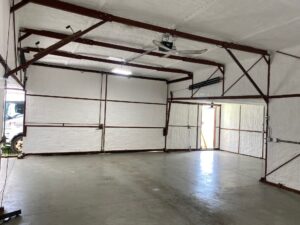
One company was contracted to install 51 mm (2 in.) of closed-cell sprayfoam on the walls and ceilings of a 232 m2 (2,500-sf) airplane hangar. The project began when the general contractor initially requested a quote for fiberglass vinyl blanket insulation. After discussing performance goals with the contractor and the owner, expert insulation technicians demonstrated the advantages of sprayfoam, especially its ability to create a continuous air barrier. The owner, a retired engineer, was highly satisfied with the results, noting that the upgrade now allows him to enjoy comfortable, year-round use of his hangar.
Amazon Distribution Center Conversion
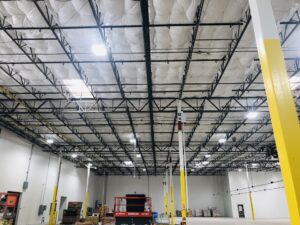
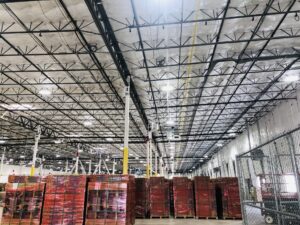
When Amazon acquired a warehouse in Indianapolis to convert into a distribution center, its insulation partner provided and installed metal building insulation across both walls and roof areas. By selecting systems tailored to the building’s new use, the retrofit supported thermal performance, code compliance, and long-term durability while helping Amazon meet the demanding operational needs of a modern logistics facility.
Together, these projects illustrate how insulation choices, aligned with performance goals and building requirements, can turn retrofit opportunities into successes.
Choosing a partner: What to look for—and what to avoid
 [3]
[3]The insulation contractor plays a defining role in the outcome of a retrofit. Choosing the wrong partner can introduce risks; selecting the right one can unlock long-term performance.
The wrong partner has:
- Limited technical knowledge, leading to code compliance oversights or misapplied materials.
- Poorly trained crews who treat installation as a checklist rather than a system.
- Short-term focus that ignores continuity, moisture, or
durability concerns. - Minimal collaboration with designers and engineers, resulting in sequencing conflicts and reworks.
- Supply limitations that cause delays, substitutions, or scope reductions.
The right partner delivers:
- Deep technical expertise in building science, insulation materials, and codes.
- Ongoing technician training that emphasizes how and why to install correctly.
- Performance focused on thermal continuity, moisture control, and long-term durability.
- Collaborative communication with architects and engineers to anticipate and solve challenges early.
- Reliable supply chains and national reach to keep schedules intact and materials available.
And remember, before mobilizing, ask your project team: “What performance risks have we not addressed?” This question often uncovers site-specific issues that standard specifications overlook.
Insulation’s final word on retrofits
Insulation is not an add-on in a metal building retrofit; it is part of the infrastructure. A well-executed plan protects structural components, supports the building’s new purpose, and extends service life.
For contractors, that means treating insulation as a system, not a line item. For owners, it means choosing partners who anticipate risks and deliver durable solutions. In retrofits, the cost of getting insulation wrong is measured in failures and liabilities but getting it right will pay off for decades to come.
As the vice president and third-generation leader of The Goley Companies, Joseph Goley has worked for the Dupo, Ill.-based insulation contractor since February 2019. He is a member of the Owens Corning CEE customer advisory council, the Knauf Insulation customer advisory board, the Home Builders & Remodelers Metro East Association board, and Southern Illinois University Edwardsville’s construction management industry advisory board. The Goley Companies deliver building performance solutions—insulation, air sealing, firestopping, and energy testing—for new and existing homes and commercial buildings.
- [Image]: https://www.metalconstructionnews.com/wp-content/uploads/2025/10/IMG_7098.jpg
- [Image]: https://www.metalconstructionnews.com/wp-content/uploads/2025/10/IMG_1399.jpeg
- [Image]: https://www.metalconstructionnews.com/wp-content/uploads/2025/10/IMG_7099.jpg
Source URL: https://www.metalconstructionnews.com/articles/insulation-in-retrofits/