The Retrofit Roofing Game: Should You Get In It?
by Jonathan McGaha | 8 January 2012 12:00 am
To start the New Year, each month we will publish a monthly column about the retrofit business. We will start with market history and opportunities and finish in December with the benefits of metal roofing and how you can take advantage of them to grow your business. Everything in between is what you will come to see as being really important. This will include a description of the perfect project team, some roof design basics, retrofit project feasibility, framing fundamentals, anchorage, existing building structural analysis, incorporating energy efficiency and renewable solar technologies.
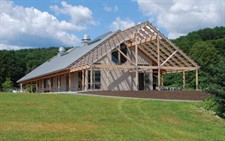 To say the least, a number of contractors and manufacturers have tried the retrofit business. Most attempts haven’t been fruitful, but some have, which is a good thing because in our economy- driven construction market the ones that survived are now holding their own. Some have even experienced an increase in their workload.
Retrofit metal roof and wall systems have been in use for more than 30 years. They were formally introduced to the construction market back in the late 1970s with Armco Buildings being the first to publish a Retrofit Roofing Manual. That early reroofing concept offered contractors, design professionals and building owners a perfect solution to end the headaches related to existing flat roofs. They can be engineered for a low-slope assembly that serves utilitarian purposes or a steep-slope assembly that can be used for the beautification of an older building.
Clad with metal roofing and siding, the early framing systems were made up of some very basic components including base members, variable height vertical members, purlins and bracing. The funny thing is this has not changed much. If you take all of the systems out there that are now being offered, they are basically the same except how they are braced. Earlier systems had so much “X” bracing/strapping that it was nearly impossible to walk through the framing while erecting it. Today, most companies provide strut bracing using rigid structural members combined with minimal strapping. The retrofit roofing concept is not rocket science, but it does fall into a Fully Engineered System category, which we will explain more about in the months ahead.
To know how much opportunity is out there, you have to understand the existing building stock in the United States. Excluding residential, there are more than 5 million buildings, covering more than 83 billion square feet.
Of course, most of these were built decades ago, and it would purely be a guess as to how many 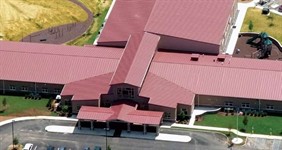 now need new roofs. However, reroofing is almost 80 percent of the total roofing industry. In addition, a large percentage of our roofs, according to the U.S. Department of Energy, are plagued with poor thermal resistance and air infiltration. And let’s not forget that metal roofing now has a service life in the 50 to 60 year range where flat roof membranes are lucky to have half that. Get the picture? There are lots of reasons to retrofit a building.
Let me leave you with some tidbits to think about if you want to get into this business. Retrofit roof systems require nothing more than the combination of three things:
• First is a knowledgeable project team, which includes the building owner, design professional (you need one of these for sure), the material supplier and you-the contractor.
• Second is what I will call the weathering membrane, which is the metal roof and wall cladding. This provides the building owner his or her well-deserved, long-lasting protection.
• Third is the framing system that supports that weathering membrane. Without this, you don’t have a retrofit. The framing is the most important element in all of this. It must be engineered with consideration of the existing building’s structural integrity while at the same time supporting a building-code-compliant metal roof system.
The trick to retrofit is knowing how to marry the existing with the new.
Mark James has more than 40 years experience in the retrofit and metal construction markets, working for leading manufacturers and executing great projects. Currently, he is president of RetroSpec LLC, a consulting company offering direction and deep knowledge of the retrofit business for manufacturers and contractors. James can be reached at mark@retrospecllc.com.com
Source URL: https://www.metalconstructionnews.com/articles/january-2012-retrofit-business/