Managing Moisture in Pressure-Equalized Rainscreen Wall Systems
by Jonathan McGaha | 2 November 2014 12:00 am
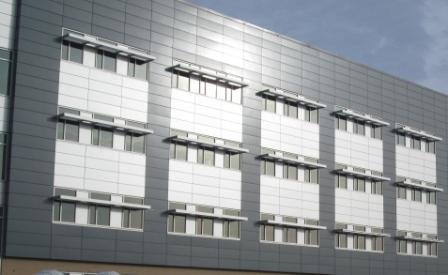
How a dry seal installation provides moisture management in high-performance walls
Understanding the mechanics of a pressure- equalized rainscreen wall system and how a dry seal installation system can provide optimum moisture protection can be confusing. A drainable wall assembly incorporates an unregulated airspace along with an air and water barrier (AWB) to shed any water that gets past the cladding. Pressure differentials between the interior and exterior of the wall system can drive rainwater through joints that would typically be weathertight. A pressure-equalized rainscreen system prevents pressure-driven moisture infiltration by naturally regulating the pressure within the wall cavity. This ensures the pressure inside the wall cavity and outside of the wall cavity is equal.
This is achieved by employing top and bottom vents located at designed intervals on a compartmentalized portion of the wall, essentially isolating a given volume of air within the wall cavity. The compartments are designed in a manner so that all lateral airflow between compartments is restricted, and pressure differentials between the interior cavity and exterior environment are equivalent as the result of natural airflow.
Pressure-equalized
A pressure-equalized rainscreen is specifically designed with a series of pressurized compartments vented at the top and bottom and closed on the sides. When wind pressures act on the wall, the compartments fill with air. However, because the sides are closed and the airflow through the vents is calibrated, the compartments can only fill to the point where the air pressure matches the pressure of the incoming wind. The air pressure within the compartments in the cladding assembly prevents negative relative pressure inside the cavity from “pulling” water in to the wall assembly keeping out the bulk of the water (technically, exterior pressures that are higher than the pressure inside the cavity push water from the outside in).
 Like any rainscreen system, a pressure-equalized rainscreen system must be designed to manage incidental moisture within the wall system so an AWB and proper flashing details behind the exterior cladding are imperative to ensure the water drains away from the interior wall structure. The realisms that pressure equalization may not be instantaneous and that every design scenario cannot be anticipated for every building make it important to maintain an AWB that can direct water away from the interior of the building and out of the system.
Aluminum composite material (ACM) lends itself particularly well to a pressure-equalized rainscreen wall system. This is because as a cladding element, it is completely impervious to moisture and is a perfect air barrier. In addition, ACM can be easily fabricated to create compartmentalized chambers. Joints can be designed to pass air between the cavity and the exterior to maintain pressure equalization. Mounting extrusions are used as exterior guttering to channel rainwater away from the interior while simultaneously creating pressurized chambers to prevent water from passing the vented joints.
Dry seal
A dry seal installation system, such as that designed by Laminators Inc., Hatfield, Pa., is based on a traditional rout-and-return style installation system featuring a deep reveal look, but it is achieved without the use of caulk. During the installation, the ACM panels are fabricated with a 1-inch return on all four sides with mitered extrusions attached to the back of the panel creating pre-assembled, compartmentalized panel assemblies. Panels are attached to the wall using a combination of end-of-run and divider extrusions, aluminum extrusion elements designed to fasten the pre-assembled panel assemblies to the substrate. Exposed miters joints are sealed while hidden joints are left open to encourage drainage along the outer plane of the panels.
A dry seal installation is considered a high-performance wall system and is typically more complex than a barrier or back-drained and ventilated system since the system does not rely on caulks or sealants to keep water out or manage the water. Joints that are not sealant-dependent are sometimes preferred to reduce the need to maintain exposed sealants that will degrade over time due to ultra-violet radiation exposure. Though dry seal systems typically have a higher perceived cost associated with their complexity, the long-term benefits of managing moisture and the labor savings associated with not having to maintain caulk joints, often show life cycle cost savings to the building owner over the facility’s lifetime.
Melissa Grimes is marketing manager at Laminators Inc., Hatfield, Pa. To learn more, visit www. laminatorsinc.com[1].
- www. laminatorsinc.com: http://www.%20laminatorsinc.com
Source URL: https://www.metalconstructionnews.com/articles/managing-moisture-in-pressure-equalized-rainscreen-wall-systems/