MCN’s report from the Rockies
by anthony_capkun_2 | 23 June 2026 1:04 pm
 [1]
[1]
As a newbie, there is perhaps no better way to sink my teeth into the metal building industry than by attending the Annual Conference of the Metal Building Contractors and Erectors Association (MBCEA[2]) and Spring Meeting of the Metal Building Manufacturers Association (MBMA[3]).
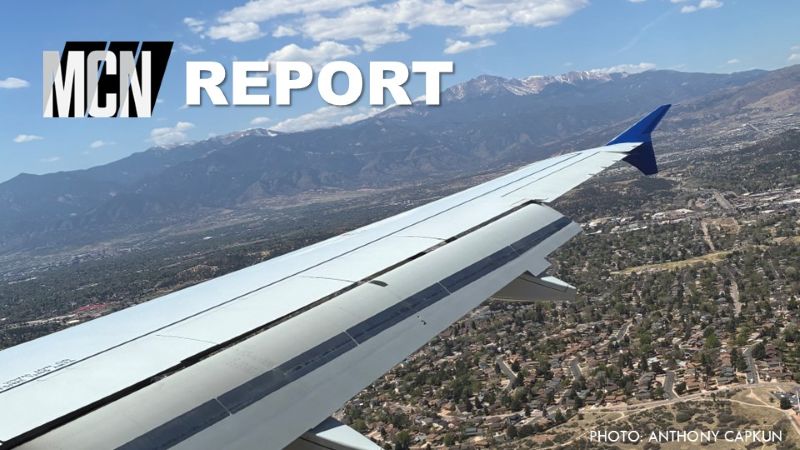
Which is why, after just two weeks under my belt as the new editor-in-chief of Metal Construction News, I was on a jet with my MCN teammates, heading to Colorado Springs, Colo., to do just that.
Located next to the U.S. Air Force Academy, the one-year-old Hotel Polaris served as the backdrop for this gathering of metal professionals, who were there to support their associations, learn from both the conference’s expert speakers and solutions providers in the exhibition, and to simply reconnect with one another.
I played the part of a sponge, trying to soak up as much as I could so that I could share it with you.
Will there be a recession?
As economists go, you would be hard-pressed to find one more engaging than Sage Policy Group’s[4] Anirban Basu, who managed to weave about a dozen Sylvester Stallone movies into his economic forecast keynote address. (I didn’t think it was possible, but there you have it.)
Word to the wise: he did not have anything good to say about Alarum.
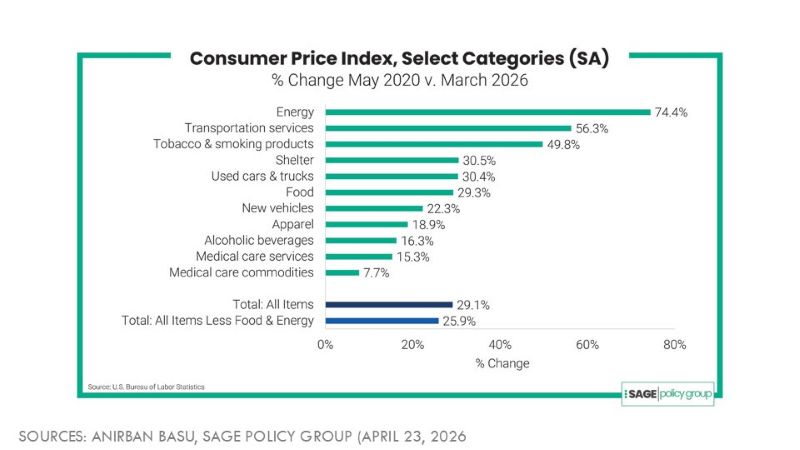
Anyone would be hard-pressed to provide an economic forecast without first explaining where we are now. Basu’s presentation focused mainly on data from May 2020—when our current economic expansion commenced—through to March 2026.
While the stock market has been hitting record highs, many Americans still feel uneasy, he said. Not surprising, considering the high prices we’re paying for everything from groceries (up 29.3%) to energy (up a whopping 74.4%).
 [5]
[5]
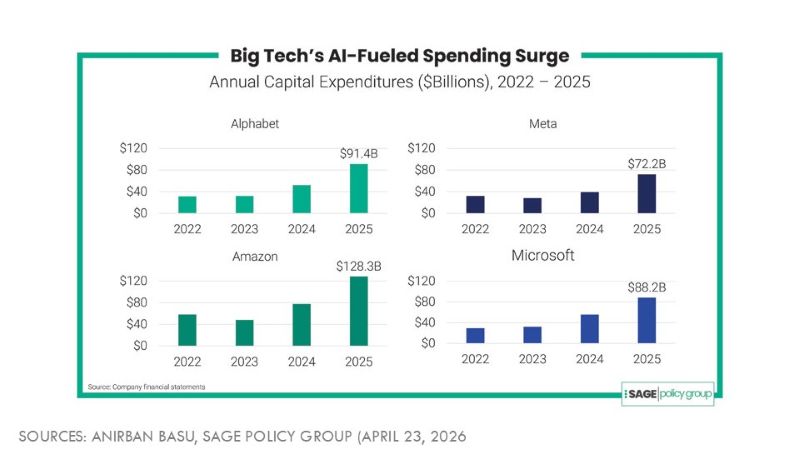
There is also a massive increase in borrowing costs for financing construction projects, business investment, and household borrowing. Despite those higher financing costs, some parts of the economy continue to perform well, especially hyperscalers (hyperscale data centers).
After OpenAI launched ChatGPT, hyperscalers began spending aggressively to compete for global leadership in artificial intelligence. They are spending hundreds of billions of dollars on data centers (DCs) and associated systems, Basu noted, which is one of the reasons that corporate earnings forecasts remain strong.
 [6]
[6]
DCs also carry serious implications for electricity. Private construction spending on electric power generation and distribution has risen sharply, Basu said. Some of that relates to the Inflation Reduction Act and the subsidies it created for investment in clean energy, but a great deal relates to the power needs of DCs.
As those projects move forward, we are likely to see continued strength in construction related to DCs and associated energy generation and distribution.
On the construction labor front, Basu expected that tighter immigration policy and enforcement would produce a more visible increase in demand for native-born or documented construction labor.
“But we have not really seen that to the degree I expected. Despite shifting immigration policy, there has not been a surge in construction job openings,” he said. One reason could be that construction spending itself is not strong enough in the affected categories to produce a hiring surge.
Basu shared data from U-Haul showing Americans are moving to Texas, Florida, North Carolina, Tennessee, and South Carolina—jurisdictions that have been doing well at attracting investment. And, where people move, jobs often follow. More people also create demand for housing, healthcare, retail, professional services, and construction.
Most economists agree the United States still has a housing shortage, Basu said, yet residential construction has weakened. “Why? Financing costs are high. Materials prices are still elevated. Tariffs on steel, copper, aluminum, and related inputs raise costs further. Delivering construction services is more expensive.”
This could create opportunities for cost-saving building approaches, including certain prefabricated and metal building systems, but the reality is that residential construction remains weak. Building permits show little momentum, and even multifamily construction activity has cooled.
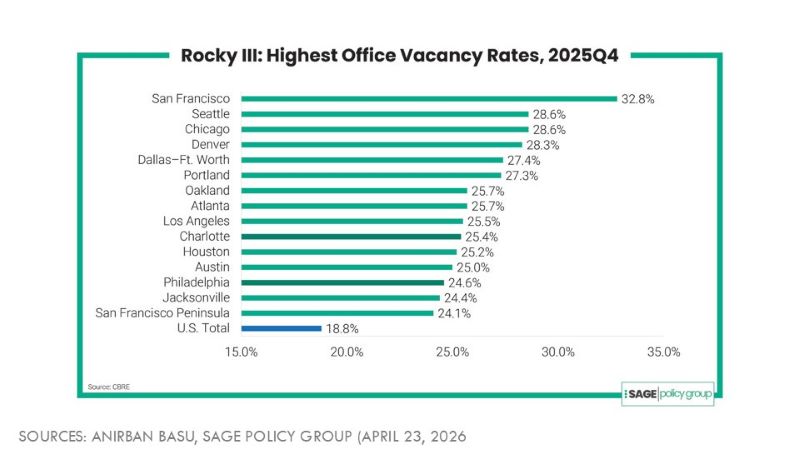
Offices remain one of the weakest major property types. Even though some large employers have pushed return-to-office policies, remote and hybrid work remain common. As a result, office vacancies are still very high in many cities.
 [7]
[7]
San Francisco is one of the clearest examples, but Chicago and other major downtowns also have a large amount of vacant office space. That has implications not just for building owners and suppliers, but for the broader economy.
In some cases, buildings that once sold for hundreds of millions of dollars now trade for a tiny fraction of their earlier value. That means lenders face collateral write-downs and will be more cautious about financing new development.
Cities are also affected because commercial real estate helps support the property tax base. When office values fall, municipal finances come under pressure, limiting their ability to support future public projects. This is bad news for construction, Basu concluded.
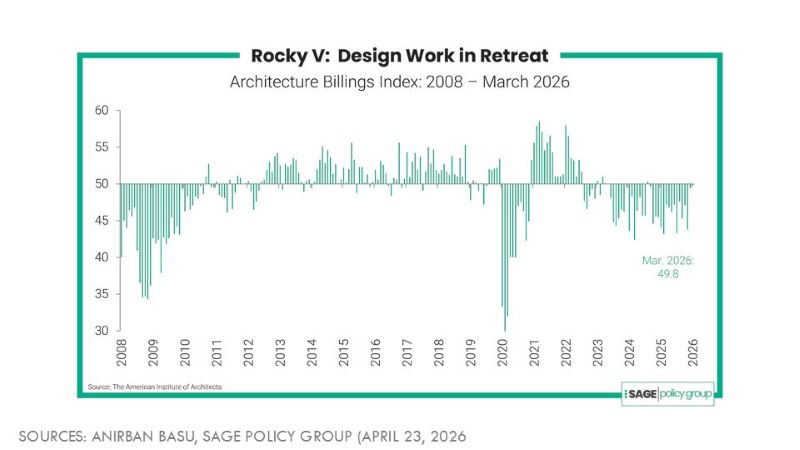
He also pointed to the Architecture Billings Index published by the American Institute of Architects—a leading indicator for commercial construction. Readings below 50 indicate contraction, and while recent readings have been below this threshold, they haven’t been disastrous—but they have been in retreat.
 [8]
[8]
Some construction categories are still growing, particularly publicly funded segments such as water supply, sewage and waste, flood control, and transportation.
Construction input prices remain a major challenge. Using February 2020 as the pre-pandemic baseline, construction input prices are up about 48%. Some of the biggest increases are in materials that are most directly affected by tariffs and industrial supply pressures. Copper products have risen sharply. Fabricated structural metal products are also up dramatically.
If you look across a range of U.S. forecasters—the Fed, Bank of America, Wells Fargo, Goldman Sachs, the Conference Board, and others—most forecasts for 2026 GDP growth fall between about 1.5% and 2.5%. On average, that is a little above 2%.
Not bad, yet the risk of recession is higher than normal because the current economic expansion has become narrow and lopsided. So while Basu feels that the most likely outcome is continued growth in 2026, the odds of recession are higher than normal.
Awards and honorees
Beyond learning where our economy may be headed, a conference highlight was, of course, the awards program. MBMA[3] general manager Tony Bouquot (a.k.a. Travels with Tony) presented this year’s MBMA Safety Awards, which recognize member companies demonstrating exceptional performance in maintaining workplace safety.
(With every location mentioned, Bouquot would share something unique or interesting from TripAdvisor about that facility’s location.)
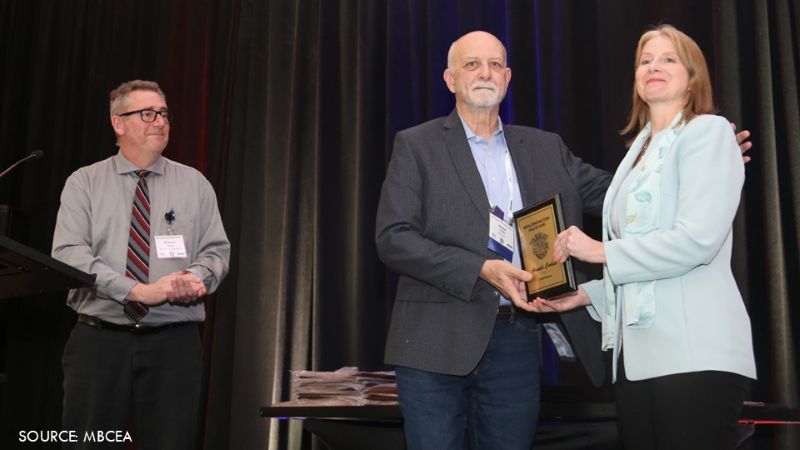
Following MBMA’s awards, MCN’s Melanie Kowal and I took to the stage to formally induct this year’s MCN Metal Construction Hall of Fame honorees. It is difficult to get everyone together at the same place at the same time, so we were very grateful for those who were able to attend, or to have someone accept on their behalf.
Thank you: Mark Detwiler, Arnold Corbin, Christen Funk, Tony Raimondo, Jr., and Patrick Raimondo!
 [9]
[9]MBCEA[2] kicked off its awards segment by adding new members to its Pioneer Club—members who have demonstrated decades of leadership, craftsmanship, and commitment to advancing the metal building industry:
- Randy Haefli of Component Construction Company (Fort Worth, TX)
- Steve Herrman of S&H Construction Co. Inc. (Oak Grove, MO)
- Barry Daigle of BB Gunn Contracting Ltd. (Linwood, ON)
Joseph Allen of Thomas Phoenix International was named this year’s recipient of the Robert and Beverly Ketenbrink Service Award (a.k.a. the “oil can” award) in recognition of his outstanding service and dedication to both MBCEA and the industry. (When I congratulated Allen afterward, he told me he had been taken completely by surprise.)
MBCEA also presented its 2026 Building of the Year awards, which will be explored in greater detail in next month’s Metal Construction News, but here is a quick recap of the awards of Merit (M) and Excellence (E) across several categories:
Commercial (under 30,000 sf)
- Jersey Meadow Golf Clubhouse, Red Dot Buildings (E)
- Premier Custom Paint and Collision, C. Tucker Cope & Associates Inc., Chief Buildings (M)
Commercial (over 30,000 sf)
- Mitchell Subaru, PDS Engineering & Construction Inc., Metallic Building Systems (E)
- Ring Power Facility, Steel Worx Solutions LLC, Kirby Building Systems (M)
Community
- St. Vrain Sanitation District Administration & Maintenance Buildings, Baker Steel Erectors, Alliance Steel Buildings (E)
- Trinity Presbyterian Church, Metal Building Industries (M)
Manufacturing
- IMC Metals America Upcast, Hoke Enterprises Inc., Schulte Building Systems (E)
- Nucor Towers and Structures, Kaiser-Martin Group Inc., Nucor Building Systems and Metl-Span (M)
Building of the Year 2026
- The Refinery Sports Complex, GBS Enterprises, Behlen Building Systems
Education tracks
BIM for the win
While AI continues to dominate the headlines—and many of the conversations at construction conferences—the world of BIM (building information modeling) is becoming ever-harder to avoid.
Kim Harrell with All Weather Insulated Panels (AWIP) is an unabashed BIM enthusiast. During his session “Driving efficiency and sustainability through digital construction,” he dove right into why BIM is important for builders and erectors.
“With BIM, you can see detail you couldn’t see before. So what’s important, practical for you guys? Clash detection: are there conflicts between your work and someone else’s?”
I think we would all rather uncover conflicts in a project before they turn into costly rework during actual construction.
So what is BIM? It’s a single 3D model—a digital twin—of whatever is being built, whether that’s a data center or cold storage facility. BIM objects are the things that go into that model. Objects can be anything from IMPs to bicycle racks, but each object can display varying Levels of Development (LODs).
At the low end is LOD 100, where objects provide basic information, such as area, width, and height. As we go from LOD 100 to LOD 500, that object becomes infused with progressively richer information, moving from things like rough area to precise dimensions and MEP penetrations to, eventually, the as-built drawings. At LOD 500, that object should contain information that pertains to maintenance, environmental product declarations, LEED, and more.
BIM also provides accurate cost estimation, streamlines scheduling, and reduces rework. Harrell cited a global survey of very heavy BIM users, in which 34% of respondents reported fewer errors as the most important reason for using BIM. Those same users expect a 5% to 10% cost savings on jobs. Around the world, BIM users, on average, see a 25% ROI.
But for BIM to work and deliver the promised benefits, Harrell said everyone involved in a project must share information and share early—ideally two years before the start of construction.
“If you’re doing BIM during construction, it’s too late. You’ve missed the window for true BIM benefit.”
And here is why you cannot afford to ignore BIM: it will become the expected standard across construction. For large GCs, BIM penetration is already nearly 100%.
Damned if you don’t … and if you do (maybe)
Earlier in the conference, Zach Giglio shared practical AI applications for construction leaders and teams, and even conducted live demonstrations.
“AI takes on chores so that we can focus on higher-value tasks,” he said. But there is more to AI’s exponential growth than just handling drudgework, Giglio said, pointing to reasons like workforce shortages and margin compression as key drivers.
So I was intrigued by what speakers Josh Quinter and Karin Corbett would say about AI for business during their session “Policy and risk management in the age of artificial intelligence.”
After conceding that AI provides “unbelievable opportunity” for the advancement of everyone’s businesses, they moved directly to: “We’re here to talk about the dangers of AI. It’s a tool, and all tools carry risk.”
Some of those risks—like data integrity—are already known in the pre-AI world. When you input incorrect data, you cannot expect the AI to identify and correct it. Nothing new here.
What is new, however, is data ownership. When you upload your forecasts, client lists, and accounts receivable into an AI, do you still own that data, or does the AI company now own it? Will it remain private, or will the AI share that information with other users? You may have just become the unwitting cause of your own trade secret leak.
Attorney-client privilege could also be at risk if you were to share information about a legal dispute with AI.
“AI usage is still like the Wild West,” Quinter said, adding that this is not necessarily a bad thing because “you have the opportunity to set the tone in your contracts.”
To that end, the presenters feel AI should start being addressed right away in construction contracts to address questions such as:
- Do we mandate or prohibit the use of AI? Who will pay for it?
- Who will be responsible for any AI “hallucinations” or data corruption? What do we do if the AI company becomes insolvent?
- Who will be responsible for developing project data and training models?
- Do we need AI indemnity and insurance?
- Who gets paid for an AI-generated work product?
Although the speakers themselves are supportive of AI, their session largely focused on how its use can expose companies to technological, legal, ethical, privacy, and contractual risks. Their message was clear: use AI cautiously, define its use in contracts, and do not let it replace good human judgment.
Association business and AC478
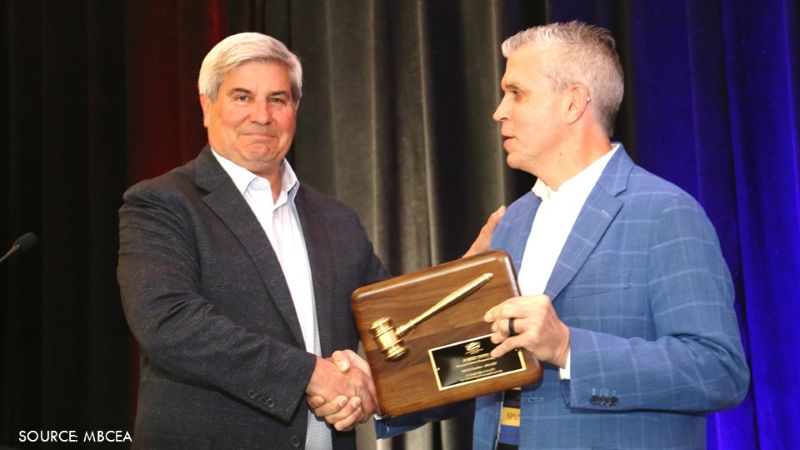
On the association side, outgoing MBCEA[2] president Robert Tiffin passed the gavel of leadership to incoming president David Leinbach, who then swore in several new board members and directors.
 [10]
[10]He also promoted the importance of the AC478 accreditation program, asking more member companies to commit to getting themselves accredited. According to MBCEA, AC478 is the most comprehensive quality assurance accreditation of its kind for metal building assembly.
AC478 provides third-party validation that assemblers have the people, processes, training, and quality systems in place to do the work properly. It can help you compete for more jobs, particularly projects that specifically require accredited assemblers.
Accreditation also signals your commitment to quality, giving owners, architects, specifiers, and regulators greater confidence in your company. A perk of MBCEA membership is free consultative support for this program.
To new friendships
There are simply too many people to mention and thank for their warmth and hospitality, but Rob Haddock and the S-5! team warrant a special thank you for the pre-conference tour of their Black Forest headquarters and prototyping lab.
Next year’s MBCEA Annual Conference and MBMA Spring Meeting will be held May 5-7 at the Sheraton Kansas City Hotel at Crown Center in Kansas City, Mo. Hope to see you there!
Anthony Capkun is the editor-in-chief of Metal Construction News.
This feature originally appeared in the June 2026 edition of Metal Construction News, which you can find in our Digital Edition Archive.
- [Image]: https://www.metalconstructionnews.com/wp-content/uploads/2026/06/MBCEA-Colorado-MCNJune2026-01-800.jpg
- MBCEA: https://www.mbcea.org/
- MBMA: https://mbma.com/
- Sage Policy Group’s: https://sagepolicy.com/
- [Image]: https://www.metalconstructionnews.com/wp-content/uploads/2026/06/MBCEA-Colorado-MCNJune2026-04-800.jpg
- [Image]: https://www.metalconstructionnews.com/wp-content/uploads/2026/06/MBCEA-Colorado-MCNJune2026-05-800.jpg
- [Image]: https://www.metalconstructionnews.com/wp-content/uploads/2026/06/MBCEA-Colorado-MCNJune2026-06-800.jpg
- [Image]: https://www.metalconstructionnews.com/wp-content/uploads/2026/06/MBCEA-Colorado-MCNJune2026-07-800.jpg
- [Image]: https://www.metalconstructionnews.com/wp-content/uploads/2026/06/MBCEA-Colorado-MCNJune2026-03-800.jpg
- [Image]: https://www.metalconstructionnews.com/wp-content/uploads/2026/06/MBCEA-Colorado-MCNJune2026-02-800.jpg
Source URL: https://www.metalconstructionnews.com/articles/mcns-report-from-the-rockies/