Modern Plasma Cutting Technology’s Many Pluses
by Jonathan McGaha | 28 February 2013 12:00 am
It brings new levels of quality, productivity and cost cutting to the steel construction industry
The technology slowly progressed and improved throughout the 1960s and into the 1990s with better cut quality, better reliability and even minor gains in operating cost reduction. The majority of plasma cutting up through about 1985 was done with large mechanized plasma systems with their real cutting strengths in the nonferrous (stainless and aluminum) materials from flat plate.
Typical issues with plasma cut steel using older technology plasma systems included bolt holes and slots that were out of round or incorrectly sized. This required grinding or modifications at the erection site that proved to be time consuming. In an effort to avoid rework and higher erection costs, many structural steel shops used multiple processes to fabricate splice plates, gusset plates, base plates and any structural components requiring better accuracy in the field. Often, parts had to be cut from flat plate on a CNC plasma or oxyfuel burning machine, and then moved to a punching or drilling operation, before finally moving onto welding or another secondary operation. All of this movement added cost and time to the steel fabrication process.
Dramatic leaps in technology through the 1990s and up to the present have completely changed the scope of plasma cutting. Today’s systems offer a range of benefits, from portability for easy field use, to the ability to cut steel with extreme precision at high speeds. Further developments in motion control technology allow for automated, high-speed 3-D structural shape cutting, perfect for fabricating structural components that fit as designed at the erection site.
Developments made over the years for better plasma cutting in the fab shop, and their benefits are as follows:
• Oxygen plasma cutting improves steel cut quality and accuracy.
• LongLife consumable technology lowers cutting costs by increasing consumable parts life.
• High-definition plasma improves cut quality and allows for cutting, gouging or beveling a wide thickness range.
• True Hole technology cuts bolt ready holes with minimal metallurgical changes.
• Integrated plasma technology eliminates the need for expert cutting machine operators by using the CNC and CAM software to intimately control all components of a mechanized cutting installation.
Developments that have improved the field use of plasma cutting equipment and their benefits are:
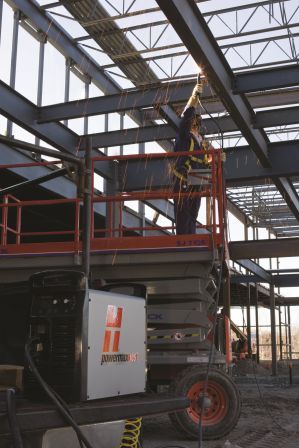
• Portable inverters dramatically reduce power supply size and weight to about 20 pounds while improving performance and reliability so they are easy for one person to pick up and move.
• Air plasma cuts metals up to 2 inches thick with ordinary compressed air eliminating the need for gas cylinders making the cut process easier, faster and cleaner when compared to oxyfuel.
• Multi-voltage power supplies operates on any voltage between 200 and 600 volts, single or three phase.
• Quick disconnect torches facilitates switching from a machine torch (e.g., track burners, pipe cutters and other portable mechanized cutting devices) to a hand torch in seconds without tools.
• Gouging settings allow for quick work in the field making it easier and safer to remove welds when reworking or dismantling metal.
Recently, Hanover, N.H.-based Hypertherm Inc., a manufacturer of plasma, laser and waterjet systems, moved into a newly constructed 160,000-square-foot facility. The building, built by Middlebury, Vt.-based Bread Loaf Construction, was built using LEED principles. The energy-efficient building was built to have minimal impact on the surrounding environment, with materials sourced from suppliers within 500 miles of the site. The vast majority of the steel used for the new facility’s construction was recycled, and virtually all of the steel was cut and fabricated using the latest in plasma cutting technology.
The major steel fabricator involved in the project, Norgate Metals from Quebec, used two plasma cutting machines to fabricate the majority of the structural steel for the Hypertherm building. Using a PythonX from Burlington Automation, a fellow Canadian company that manufactures steel fabrication equipment, Norgate has turned what is often a manual process involving several steps, into an automated process involving just one step. The PythonX uses plasma cutting technology to process 3-D structural steel shapes such as beams, channels, square and rectangular tubes, iron and plate. This machine eliminates a tremendous amount of manual layout, as well as manual cutting, trimming and drilling operations.
 |
Another benefit of the new machine is less material handling-an enormous plus when dealing with 60-foot-long steel beams that weigh at least 2,000 pounds-which has drastically reduced the space and labor expenses associated with a multistep process. Now the PythonX, drills, saws, punching machines, and oxyfuel torches are all replaced by a single plasma torch connected to a HyPerformance HPR260XD system from Hypertherm. The Hypertherm torch is capable of quickly moving from thinner sections of the beam to thicker flanges, cutting AISC-approved bolt holes and making bevels in no time without any operator intervention. There are many advantages in productivity that the latest plasma cutting technology developments can bring to the construction industry. These developments are making it easier for companies to create accurate structural steel components much faster and at a lower cost than before, leading to more projects completed on time and on budget. Jim Colt is application technology manager at Hypertherm Inc., Hanover, N.H. For more information, visit www.hypertherm.com[1].
- www.hypertherm.com: http://www.hypertherm.com
Source URL: https://www.metalconstructionnews.com/articles/modern-plasma-cutting-technologys-many-pluses-1/