Not All Coil Coatings are the Same
by Jonathan McGaha | 28 January 2013 12:00 am
Get the highest-quality, most reliable coating for your application
Precoated metals are used virtually everywhere in both residential and commercial construction. Outside, they commonly appear as siding, roofing, gutter and eve trough, windows and garage doors. Indoors, they can be found in lighting fixtures, ceiling tiles and grids, HVAC components, wall panels and backsplashes, just to name a few.
Regardless of their application, precoated metals are created through a process called coil coating, where coils of steel or aluminum are uncoiled, painted in the flat, recoiled, and then sent on for cutting and forming into their final configuration. Developed in the 1930s by California industrialist and inventor Joseph L. Hunter for painting Venetian blinds, the process really took off in the 1950s when companies formed to coat steel and aluminum for construction (and other) applications, driven by the inherent advantages of the process. These include more consistent coating and lower cost due to the nearly 100 percent transfer efficiency of paint to metal and lower environmental impact due to the ability to capture nearly 100 percent of the VOCs associated with the painting process. Despite its growth through the years, the coating process has remained largely unchanged from Hunter’s original method.
One development that has significantly changed the coil coating process for steel and aluminum is the introduction of paint temperature control. In 2005, Washington, Mich.-based Saint Clair Systems (SCS) teamed with Raleigh, N.C.-based Alsco Metals to study the significant temperature variations that build up in the process. Applying the experience gained from more than 3,500 applications across myriad industries, SCS developed a method for accurately measuring and recording the temperature of the paint being applied across the width of the metal strip in real time. This led to the development of tools to analyze those measurements, producing a visual representation of the temperature variations that were resulting in film variations throughout the coil. Using these new tools, SCS was able to develop systems to both control paint temperature and eliminate those variations.
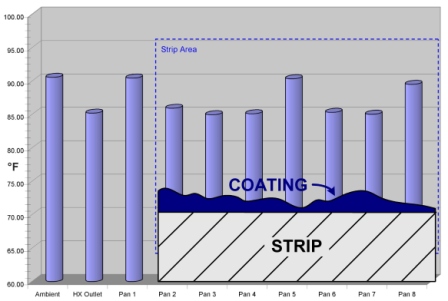 |
| If the coil coating temperature varies from edge-to-edge across the width, or as painting continues from the leading edge to trailing edge of the coil (called “head-to-tail”), the film will vary proportionately. |
In late 2005, the result of this research and development was introduced to the coil coating industry. Since then, more than 20 companies in North America, Europe and Asia, have adopted this technology, installing it on 130 heads across 39 lines.
So why does temperature matter? It’s all about viscosity. Paint gets thicker as it gets cooler. This is the reason you have to add solvent to get it thin enough to spray on a cold morning. Conversely, paint gets thinner as it gets warmer. This is the reason it’s easier to get runs and sags when painting on a hot summer afternoon.
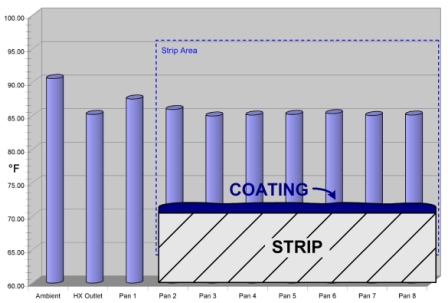 |
| If the coil coating temperature can be held constant at all points and times in the coating process, the result is a controllable, consistent film. |
So how does this apply to the coil coating process? It’s pretty complex, but basically, colder, thicker paint produces a thicker film and warmer, thinner paint produces a thinner film. If the temperature varies from edge-to-edge across the width, or as painting continues from the leading edge to trailing edge of the coil (called “head-to-tail”), the film will vary proportionately. If the temperature can be held constant at all points and times in the process (which we call the “thermal profile”), the result is a controllable, consistent film.
So why does this matter? Two words: quality and warranty. Film build variations create a host of potential issues. First, color is directly related to film thickness. Even slight variations are obvious when placed side-by-side on a roof or building wall in direct sunlight. Visual variations like this can reflect negatively on even the best construction. Films that are too thick are susceptible to blisters and other adhesion issues. The paint film is the primary defense against corrosion. Clearly, insufficient film or defects in the continuity of the film, even if not initially obvious, can end in warranty problems.
All coated coils are not the same. Ask your supplier for more information. If your coil-coated products are not being coated with a temperature-controlled, profile-aligned system, you’re not getting the highest quality, most reliable product that your application and your customer deserves.
Michael R. Bonner is the vice president of engineering and technology for Saint Clair Systems Inc., Washington, Mich. For visit www.stclairsystems.com[1].
- www.stclairsystems.com: http://www.stclairsystems.com
Source URL: https://www.metalconstructionnews.com/articles/not-all-coil-coatings-are-the-same/