Preventing Slips and Falls With Non-Slip Metal Flooring
by David Flaherty | 3 December 2025 9:48 am
 [1]
[1]Falls, slips, and trips made up 39.2 percent of all construction fatalities in 2023. In addition to endangering employees, slip-and-fall incidents create financial burdens for companies.
Within the United States, the medical compensation associated with falls is an estimated $70 billion annually. Injured workers also require time off to heal, pausing productivity.
Depending on the industry, fall protection can be essential for supporting employee safety and may be required by law. In addition to providing sufficient personal protective equipment, installing slip-resistant industrial flooring can significantly prevent slips and falls.
Understanding slip and fall hazards
The National Safety Council (NSC) states that falls are 100 percent preventable. Understanding what types of hazards cause these injuries can help contractors take a proactive approach to workplace slip and fall prevention.
While most falls are from higher levels, not all injuries result from climbing a ladder or working at height. Many slip and fall injuries occur without elevation. A variety of hazards on the ground commonly causes these types of injuries.
Some common causes of falls include:
- Hallway clutter and tripping hazards: Boxes, equipment, and other obstructions can create unexpected obstacles.
- Uncovered and loose cables: Electrical cords and data cables that are not properly secured pose a significant tripping risk.
- Uneven and irregular flooring: Cracks, potholes, and transitions between different flooring types can lead to falls.
- Water, grease, oil, and other liquid spills: These substances create slippery surfaces that can easily cause a loss of traction.
- Ice, rainwater, and other weather hazards: Wet or icy conditions can make outdoor surfaces extremely hazardous.
- Incorrectly installed carpets or rugs: Loose or improperly secured floor coverings can bunch up and create tripping hazards.
Specific industries have an increased risk for workplace injuries, including:
- Construction
- Transportation and warehousing
- Professional and business services
- Agriculture, forestry, and fishing
- Manufacturing
- Retail and wholesale trade
- Leisure and hospitality
- Educational and health services
Slip-resistant metal floor safety solutions
 [2]
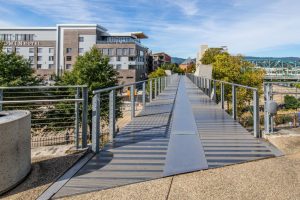
[2]Beyond minimizing clutter and addressing tripping hazards, integrating slip-resistant industrial flooring, particularly in high-traffic zones, is a proactive step toward preventing falls. Flooring solutions designed with enhanced traction offer an essential layer of safety, reducing the likelihood of slips and falls.
With various options available, slip-resistant metal flooring stands out as a preferable option. While concrete is durable, it is incredibly slippery when wet, making it a fall hazard that would require additional elements to ensure Occupational Safety and Health Administration (OSHA) compliance. Options like anti-slip tiles can be challenging to clean due to grooves in the design, and can be a less durable, long-term solution.
In contrast to other types of flooring, slip-resistant metal grate flooring offers several benefits:
- Drainage: The open design of metal grating allows for efficient liquid and spill drainage, ideal for reducing slip hazards and maintaining optimal traction.
- Pollutant mitigation: This flooring allows light and air to pass through, minimizing chemical and dirt pollution.
- Easy installation: Metal flooring systems are designed for straightforward installation, often allowing for seamless retrofitting onto existing structures.
- Regulation compliance: Engineered with anti-slip surfaces and appropriately sized grates, these flooring options are designed to meet both the Americans with Disability Act (ADA) and OSHA requirements.
- Corrosion-resistant: Metal flooring is suitable for indoor and outdoor applications and is resistant to corrosion and harsh environments.
- Environmental benefit: Metal flooring is often more environmentally responsible than other materials and has the potential for recyclability.
Best uses for metal flooring
Slip-resistant metal flooring can be an effective solution in a variety of locations:
- High-traffic areas
- Factory floors
- Warehouses
- Outdoor environments
Care and maintenance for anti-slip metal flooring
Proper maintenance will keep anti-slip metal flooring in the best condition possible:
- Do not damage the anti-slip finish protection: If the flooring has an anti-slip finish, keep abrasive materials and products, such as floor buffers, away from it. These items can damage the coating and make it ineffective.
- Conduct periodic cleaning: Use a vacuum and brush to remove debris caught between the grates.
- Implement thorough cleaning: For a deeper cleaning, remove the grates and use a vacuum or power washer to clear away debris. Specialty cleaning products can also be used to spot-clean the flooring.
Regulations and guidelines for workplace safety flooring
 [3]
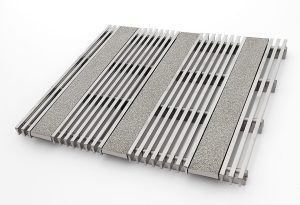
[3]Regarding workplace accident prevention, OSHA and the ADA outline legal rules to prevent trips and falls. Finding flooring solutions that meet these standards is crucial when designing or updating workspaces.
OSHA-compliant flooring is:
- Clean, dry, and free of hazards
- Regularly cleaned and maintained
- Free from loose floorboards
ADA-compliant flooring is:
- Stable and firm
- Slip-resistant
- Easy to navigate
The ADA also emphasizes that any floor with openings should be able to accommodate mobility devices, such as wheelchairs. The surface must be uniformly slip-resistant, meaning the level of slip resistance should be consistent across the entire flooring area. Changes in level should be minimized and, when necessary, clearly marked and gradually sloped for safe transitions.
Some manufacturers offer metal entrance grilles and grating specifically designed and engineered for workplace safety and material longevity.
Some examples include:
- Entrance grilles
- Stair components
- Tree grating
- Trench grating
- Drain covers
- Fountain grating
- Pedestrian bridges
With long-lasting durability and compliance with safety standards, slip-resistant metal flooring can be a cost-effective way to mitigate workplace injuries and avoid costly financial consequences.
Carissa Dau is the architectural product manager at Hendrick Screen Company, where she has been employed for eight years. She works closely with architects, designers, and contractors to match Hendrick’s products to project specifications and provide detailed quotes and technical support.
Sarah Bisaha has been with SLIPNOT for eight years. Through her various roles, she has gained a wealth of knowledge about the risks and costs associated with slip, trip, and fall events. During that time, Sarah has also become well-versed in flooring solutions that can help mitigate slip and fall risks.
- [Image]: https://www.metalconstructionnews.com/wp-content/uploads/2025/12/Sarasota-Ringling-College-7.jpg
- [Image]: https://www.metalconstructionnews.com/wp-content/uploads/2025/12/Holmberg-Bridge_Hendrick-Architectural-Metal-Grating-and-SLIPNOT.jpg
- [Image]: https://www.metalconstructionnews.com/wp-content/uploads/2025/12/IPSAVzRg-1.jpeg
Source URL: https://www.metalconstructionnews.com/articles/preventing-falls-non-slip-metal-flooring/