Radiant Barriers Explained
by Jonathan McGaha | 1 January 2017 12:00 am
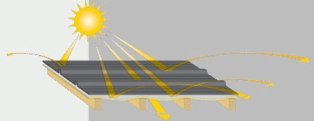
Radiant barriers maintain the temperature of the interior environment
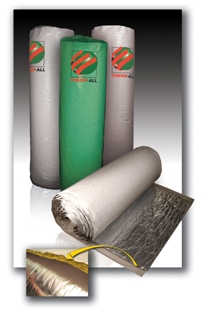 Radiant barriers consist of a reflective material adhered to a substrate material, such as kraft paper or a plastic film. As an insulation laminator, radiant barriers act as facing material for insulation systems. This typically includes laminating an aluminum facing, which is positioned toward the exterior side of the building, to fiberglass, along with a vapor retarder laminated to the interior-facing side of the building. Reflective vapor retarders are used in a variety of applications, including metal building, post frame construction, and HVAC applications.
How Radiant Barriers Work
As the U.S. Department of Energy notes, “most common insulation materials work by slowing conductive heat flow and-to a lesser extent- convective heat flow.” However, radiant barriers work by reducing radiant heat gain. Here’s how it works: infrared waves are produced by the sun. These waves turn into radiant heat, which travels downward in straight lines. Usually, heat waves penetrate a building’s envelope and heat slowly enters the indoor atmosphere. Radiant barriers and reflective insulation systems, however, deflect those heat waves, thereby helping prevent infiltration and maintaining the temperature of the interior environment.
This means that condensation is better controlled, and the building is kept cool during warmer months and tepid during cooler months. When a reflective vapor retarder is laminated to fiberglass, such as Reflect-R, building owners can see up to 97 percent of radiant heat gain deflected. With better moderation of indoor temperatures, less energy is used and utility bills are reduced. Contractors in the South and on the West Coast tend to use more reflective insulation products, since radiant barriers are ideal for use in moderate temperatures where the sun is more intense year-round.
Fire Safety
While reflective insulation products offer excellent thermal performance and condensation control characteristics, a fiberglass core reflective insulation product also aids in fire abatement. According to the North American Insulation Manufacturers Association’s (NAIMA) Insulation Facts issue #30, “Fiberglass itself is inorganic and, as such, is noncombustible.” When considering insulation’s fire protection capabilities, buyers should ensure that the product has been subjected to ASTM and UL testing for the product’s core. The fire test procedure typically specified for fiberglass insulation is ASTM E84, also known as the Steiner tunnel test. Fire-rated fiberglass should achieve a Class A/Class 1 rating.
Most building codes require foil faced metal building insulation or duct wrap to have a flame spread rating of 25 or less, and a smoke developed rating of 50 or less when tested in accordance with ASTM E84 or UL 723. UL 723 is Underwriters Laboratories designation for ASTM E84. Code officials typically accept data from either procedure. For cellulose insulation, two test procedures, both developed by the National Bureau of Standards (NBS) exist. Bubble wrap manufacturers normally test products to E84 for flame spread and smoke development. However, some manufacturers do not test to the most upto- date version of ASTM E84.
 Due to the lack of consistency in E84 testing methods for bubble wrap insulation, many longtime industry players are skeptical of its ability to act as a flame retardant. “Bubble wrap might technically do what insulation is meant to do, but it doesn’t help prevent the risk of fire spread like a fiberglass core insulation will,” says Bill Beals, district manager, Therm-All Inc., North Olmsted, Ohio.
In a NAIMA test evaluating smolder resistance in cellulose and fiberglass insulation, a standard 75-watt light bulb caused the cellulose insulation to smolder, whereas the fiberglass insulation was unaffected. In a different test comparing fiberglass insulation to that of bubble wrap in a metal building, the fiberglass insulation dramatically delayed the spread of fire compared to bubble wrap. When lit amongst bubble wrap, the fire spread rapidly, and eventually lead to the roof collapsing. Conversely, the fiberglass insulation smoldered but never caught on fire.
R-Value Recovery
As with any laminated fiberglass product, it’s important to purchase reflective insulation products that are ASTM tested. ASTM, the American Society of Heating, Refrigerating & Air Conditioning Engineers (ASHRAE) and the Federal Trade Commission
(FTC) recognize ASTM C-518 as an appropriate R-value test for fiberglass core reflective insulation.
Bridget Jammoul is marketing specialist at Therm-All Inc., North Olmsted, Ohio. To learn more, visit www.therm-all.com[1].
- www.therm-all.com: http://www.therm-all.com
Source URL: https://www.metalconstructionnews.com/articles/radiant-barriers-explained/