Rollforming solutions for roll-up door manufacturing
by anthony_capkun_2 | 29 July 2026 2:10 pm
 [1]
[1]Roll-up door performance begins long before installation. Manufacturing precision plays an important role in how smoothly doors assemble, operate, and withstand years of service in the field.
The production of roll-up doors has evolved significantly over the past decades, driven by manufacturer demands for higher efficiency, consistent quality, and reduced dependence on manual labor.
Modern manufacturing facilities rely on a combination of advanced rollforming systems and integrated automation to produce durable and high-performing door systems.
Primary production lines
Typically, four primary production lines or stations are required to manufacture the key components of a roll-up door:
- Panel rollforming line
- Seaming and rewind station
- Guide track rollforming line
- Bottom bar rollforming line
1. Panel rollforming line
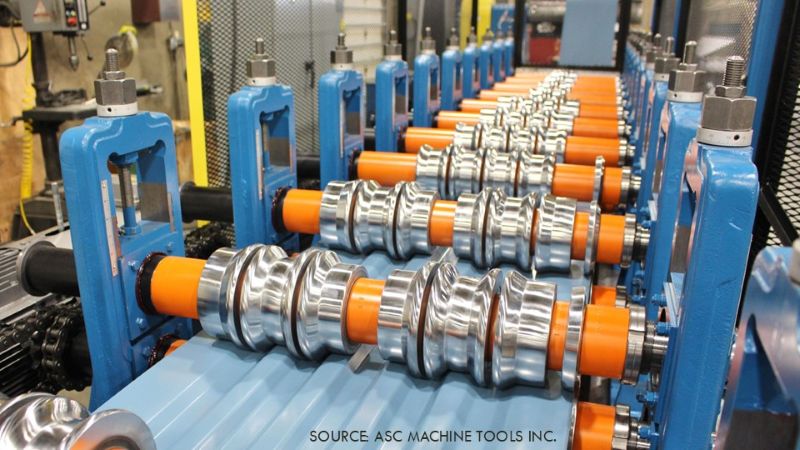
The panel rollforming line forms the backbone of roll-up door production. This system is designed to process coil material—commonly 24-ga or 26-ga steel—into corrugated panels with an approximate coverage width of 20 inches. The corrugation not only adds strength and rigidity to the panels but also ensures proper interlocking during the seaming process.
Equipped with a post-cut shear, the panel line allows manufacturers to produce panels at precise lengths based on the required door height. The panel line can also be equipped with an integrated C-frame punching station, allowing for inline production of accurate hole patterns required for door latch installation, eliminating secondary operations and improving overall efficiency.
[1]Since roll-up doors can range in width from 3 feet to 20 feet, maintaining tight tolerances and consistent panel geometry is essential. Any deviation in panel shape or length can lead to complications during assembly and negatively impact the performance of the finished curtain.
2. Seaming and rewind station
Once panels are formed, they are transferred to the seaming and rewind station, where the door curtain is assembled. This station is typically available in standard lengths of 10 feet and 20 feet, accommodating various production requirements and facility layouts.
At this stage, an operator positions two panels into a seaming channel and mechanically hooks them together. A powered seaming sled then travels along the joint, closing the hooks and forming a secure seam. This process is repeated until the full curtain height is achieved.
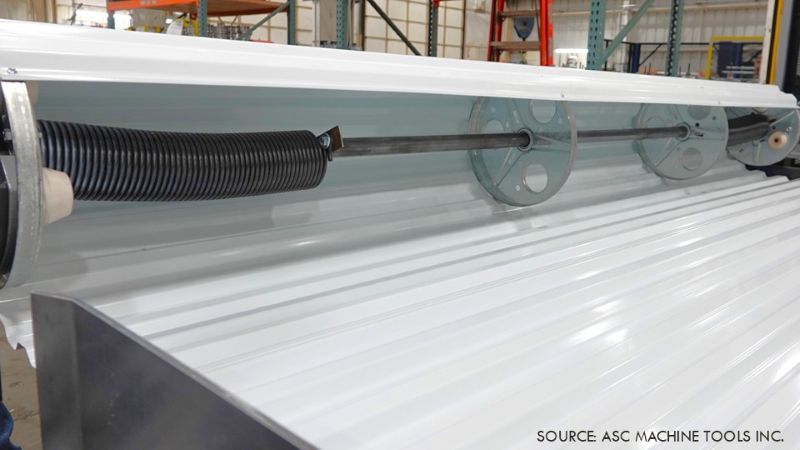
After assembly, the completed curtain is conveyed to the winding unit. Here, it is attached to a drum—usually with mechanical fasteners such as screws—and wound into its final rolled configuration. The winding system may be equipped with either a single- or dual-motor drive system, depending on the size and weight of the curtain being handled.
To further enhance product quality, some rewind stations offer optional curtain tensioning systems. They help ensure the curtain is wound tightly and evenly, preventing issues such as telescoping or uneven rolling during installation and operation.
3. Guide track rollforming line
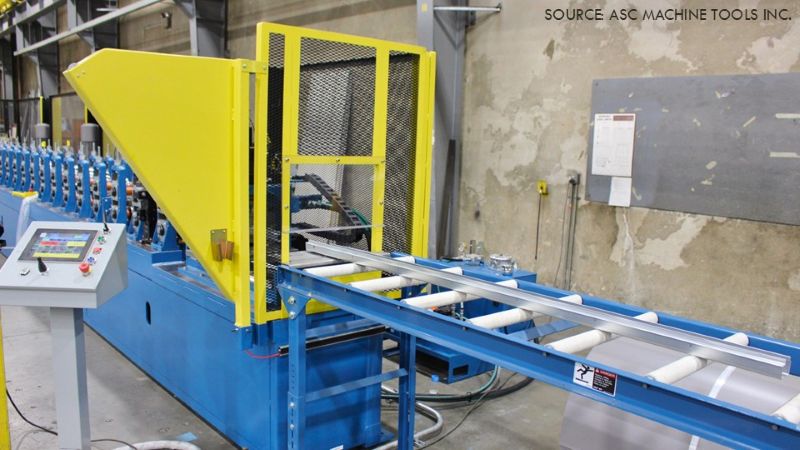
The guide track rollforming line is responsible for producing the track profiles that guide the roll-up door during operation. These profiles are critical components, as they ensure smooth movement and proper alignment of the curtain.
This production line typically includes an inline punching station followed by a rollformer and a flying post-cut shear. The punching station creates all necessary mounting holes, fastening points, and lock openings prior to forming. The flying shear enables continuous production while cutting the profiles to precise lengths without stopping the line.
 [2]
[2]Both left-hand and right-hand track profiles are produced, requiring precise tooling and alignment to maintain dimensional accuracy. Consistency in track geometry is essential to avoid operational issues such as binding or excessive wear.
To further improve efficiency, some systems include automated insertion units, which feed and install the guide runner material—typically a plastic or nylon insert—directly onto the track during the rollforming process. By eliminating manual insertion, manufacturers can reduce labor costs while ensuring consistent placement and quality.
4. Bottom bar rollforming line
The bottom bar serves as the final structural component of the roll-up door curtain, providing reinforcement and acting as the interface between the curtain and the floor. It also typically houses the astragal, a sealing element that helps improve insulation and weather resistance.
Bottom bar profiles can vary significantly in shape and are typically manufacturer-specific in design. Most configurations are engineered to accommodate additional components such as kick plates and door locking mechanisms.
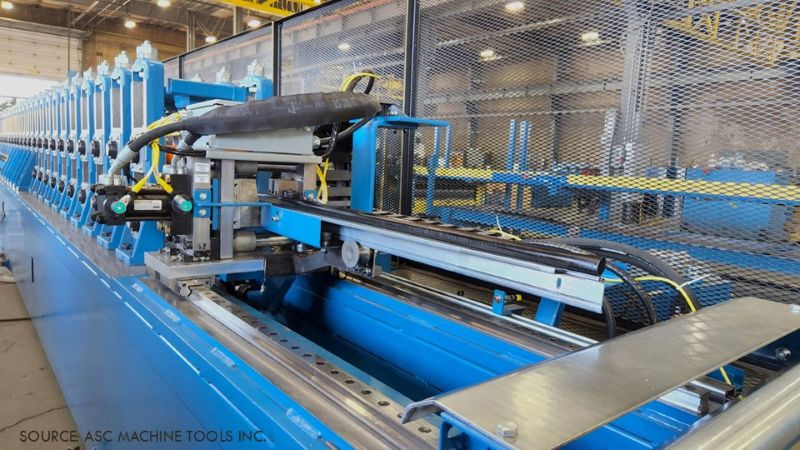
The bottom bar rollforming line includes an integrated punching station to create holes for handles, locks, and other hardware components. Precision in this process is critical to ensure proper fit and functionality during installation.
 [3]
[3]Some rollforming lines incorporate inline astragal insertion, allowing the sealing strips to be fed directly into the profile as it is being formed. This eliminates the need for secondary manual operations, reducing labor requirements and improving consistency.
Integrated manufacturing advantages
The integration of these four production systems into a cohesive manufacturing workflow provides significant advantages. Automation reduces reliance on manual labor, minimizes human error, and increases throughput. At the same time, inline processing ensures that each component is produced with consistent quality and precision.
By leveraging modern rollforming technologies, manufacturers can achieve higher production speeds while maintaining strict quality standards. Features such as servo-driven systems, automated material handling, and inline insertion capabilities contribute to an efficient, cost-effective operation.
 [4]
[4]Roll-up door manufacturing relies on a combination of specialized rollforming systems working in harmony to produce high-quality components. From panel production to final assembly, each stage plays a critical role in ensuring the performance and durability of the finished product.
Manufacturers that invest in modern rollforming technology are better positioned to meet growing demand, improve operational efficiency, and deliver superior products to the market.
Thomas Schwarzer is the Northeast regional sales manager for ASC Machine Tools Inc.[5], which provides manufacturing solutions for C/Z purlin, panel, trim, door, and decking production. The company also serves the agricultural sector with high-production grain bin roof, wall, and stiffener lines.
This feature originally appeared in the July 2026 edition of Metal Construction News, which you can find in our Digital Edition Archive.
- [Image]: https://www.metalconstructionnews.com/wp-content/uploads/2026/07/Rollup-Doors-MCNJuly2026-01-800.jpg
- [Image]: https://www.metalconstructionnews.com/wp-content/uploads/2026/07/Rollup-Doors-MCNJuly2026-02-800.jpg
- [Image]: https://www.metalconstructionnews.com/wp-content/uploads/2026/07/Rollup-Doors-MCNJuly2026-03-800.jpg
- [Image]: https://www.metalconstructionnews.com/wp-content/uploads/2026/07/Rollup-Doors-MCNJuly2026-04-800.jpg
- ASC Machine Tools Inc.: https://www.ascmt.com/
Source URL: https://www.metalconstructionnews.com/articles/rollforming-solutions-for-roll-up-door-manufacturing/