Selecting a Commercial Door
by Jonathan McGaha | 2 November 2015 12:00 am

There are many options to consider for various types of commercial doors
Selecting a commercial door is not as simple as one may think. There are various types of commercial doors to choose from and many options to consider when selecting one that best suits the building. Protection of an opening is the purpose of the door and hardware. When bidding, standard door packages will provide the best value. When electrical door controls are required, the door manufacturer must know this soon in the process. The strength, security, durability, energy conservation, water resistance and fire resistance desired by the designer and building owner can be difficult to wrap into one package, and careful specification writing is required.
One thing to consider when recommending a door for commercial projects is the door’s use. Doors secure the opening and hardware controls the door. Doors, frames and hardware work together as a system and can be completely assembled and shipped as a completed opening package. Discussion about the features and functionality of different door and hardware choices available is important. Door and hardware failures often come from the unintended misuse of the door that could have been avoided by taking the time to discuss the intended use of the door to determine which options are best suited for the purpose.
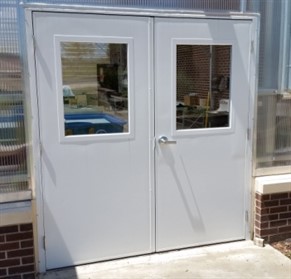 |
| Photo courtesy of Plyco Corp. |
The value of good hardware becomes more important with higher frequency of use. The number of door and door hardware options available has increased over the years, making the selection process more difficult. Fortunately, standards have been developed by the Builders Hardware Manufacturers Association (BHMA) using procedures established by the American National Standards Institute
(ANSI). BHMA has established three levels: Grade 1 is the highest, most durable level of performance, while Grade 3 is least durable. Grade 1 hardware may be worth the extra cost in some cases, but Grade 3 may be fine in others. Grade 1 bored locks are tested to 1,000,000 cycles and Grade 3 bored locks are tested to 200,000 cycles.
Specialized door frames and connections are available for ease of assembly and installation. The frame can be specified for installation directly into a steel-framed building wall using adjustable anchor clips. Most doors are 18-gauge steel with 16-gauge frames.
Know the code requirements
The Americans with Disabilities Act (ADA) led to the requirements in ICC/ANSI A117.1 Accessible and Usable Buildings and Facilities. This standard has been adopted by many jurisdictions through the ICC model building codes. This standard affects all hardware in a building, not just the threshold height.
ADA requirements for doors include:
• Threshold height of 1/2-inch or less.
• Ease of operation with one hand that does not require tight grasping, pinching or twisting.
• Clear width of 32-inch minimum distance between the face of the door and the opposite stop.
• No projections into the door clear width beneath the 34-inch height.
• Limited projections of 4 inches or less into the door clear width between 34 and 80 inches.
• Unglazed below the 10-inch height.
• Closer speed from the 90-degree to 12-degree swing arc is 5 seconds minimum.
• Vision lites are located 43 inches maximum above finished floor
(exempt if above 66 inches above finished floor.)
The 2015 International Building Code (IBC) requires storm shelters comply with ICC 500 Standard for the Design and Construction of Storm Shelters in K-12 schools with more than 50 occupants and in critical emergency operation centers in tornado-prone areas. Included are fire stations, rescue stations, police stations, ambulance stations and 911 call centers.
Exit doors in storm shelters are required based on the number of occupants designated. Testing to be met by the doors includes resistance to 250-mph wind speeds and impact resistance and cyclical pressure as per ASTM E1886/E1996. The well-known product approval process through the State of Florida Building Code has been updated for the 2014 FBC. The Texas Department of Insurance product approval process has also been continued as in past years.
Choosing glass size for full accessibility and convenience is important. The building code requires that glazing is fully tempered and labeled to meet CPSC 16 CFR Part 1201 Category II. Plain wired glass is no longer accepted. Tempered glass is available with low-E coatings.
The service is what matters in the end; delivery on time and undamaged on a company truck can control this for the erector. The distributor will generally provide a one-year warranty and will do whatever is possible to minimize callbacks for the installer. When selecting a commercial door consult with the door distributor to ensure best fit for the project needs. It is important to plan early in the design process. Waiting until it is time to install the doors may result in compromises that may result in having to accept components that will not perform optimally in the application.
Al Geisthardt is lead engineer at Plyco Corp., Elkhart Lake, Wis. To learn more, visit www.plyco. com[1] or call (920) 876-3611.
- www.plyco. com: http://www.plyco.%20com
Source URL: https://www.metalconstructionnews.com/articles/selecting-a-commercial-door/