Sunshades and Louvers: Balancing Aesthetics and Functionality in Building Design
by David Flaherty | 28 July 2025 3:09 pm
 [1]
[1]Designers must find ways to balance a growing list of varying needs within a building, including efficiency, sustainability, health and wellness, form, and function. Designers work with owners to create structures and spaces that deliver expression and performance. At the intersection of those elements is light, itself a powerful design element. The art of aesthetics in building design often centers on the interplay of light. The way it strikes the exterior and expresses color or texture, and how it enters and fills an interior, is central to the design, operation, and appeal of any building. Optimizing natural light, as well as airflow, is key to creating a comfortable, healthy, and effective space for occupants. Building materials that play a key role in controlling the way light and airflow reach a building include louvers and sunshades, products often seen as strictly utilitarian. They serve a functional purpose and must be integrated into designs in ways that are often strategically hidden from view. This perspective is changing as designers understand functional elements do not have to detract from aesthetics, and manufacturers have developed more sophisticated and customizable options. Now, there are options to seamlessly incorporate elements that deliver essential performance benefits while serving as integral design features that enhance a building’s visual impact.
Performance and comfort
Sunshades and louvers deliver measurable performance advantages that benefit just about any building. Properly positioned sunshades reduce solar heat gain and interrupt direct sunlight before it reaches interior spaces, decreasing overall cooling loads and associated energy costs. Louvers allow a building to “breathe” as they control airflow in and out of a structure while also keeping out unwanted elements such as rain, debris, and even sound.
Reducing the load from HVAC systems by using exterior shading elements and managing airflow helps optimize building performance, extend equipment life, and reduce maintenance requirements, lowering operating costs over the building’s lifecycle.
For people experiencing an interior environment, whether an office, educational facility, or other type of building, good airflow and light management can greatly enhance that experience. Quality daylighting supports the regulation of circadian rhythms, which research indicates is a major contributor to positive health outcomes. Adding this biophilic element to design supports cognitive function, physical health, and psychological well-being. Meanwhile, air quality directly affects the physical and mental health of the occupants, as well as the “health” of the building.
Design considerations
Successful sunshade and louver applications rely on determining optimal placement. Each building and site is unique, and it is important to analyze and understand the orientation, surrounding conditions, and the specific shading needs of that environment. Usually, east and west façades benefit most from solar control elements, while southern exposures require different approaches depending on latitude, climate, and the time of year.
Shading elements can also conceal HVAC equipment, electrical systems, or other building components that are necessary, but are not something owners want visible to the public. In many cases, manufacturers can serve as collaborative partners to engage in helping to develop creative solutions that transform potential eyesores into design opportunities.
No matter the budget or project objectives, bringing manufacturers to the design discussion at early stages can be very helpful. Standard products can often be used to achieve custom appearances through artful color selection, spacing modification, and creative application. Honest conversation and early collaboration identify cost-effective solutions that meet budgetary, performance, and aesthetic goals.
Aesthetic appeal
 [2]
[2]Performance and function are obviously important, but in a competitive commercial real estate market, curb appeal ranks high among customers’ wants and needs. The good news is that using sunshades and louvers does not mean sacrificing form. On the contrary, these products can readily contribute to a project’s overall aesthetics.
Digital printing
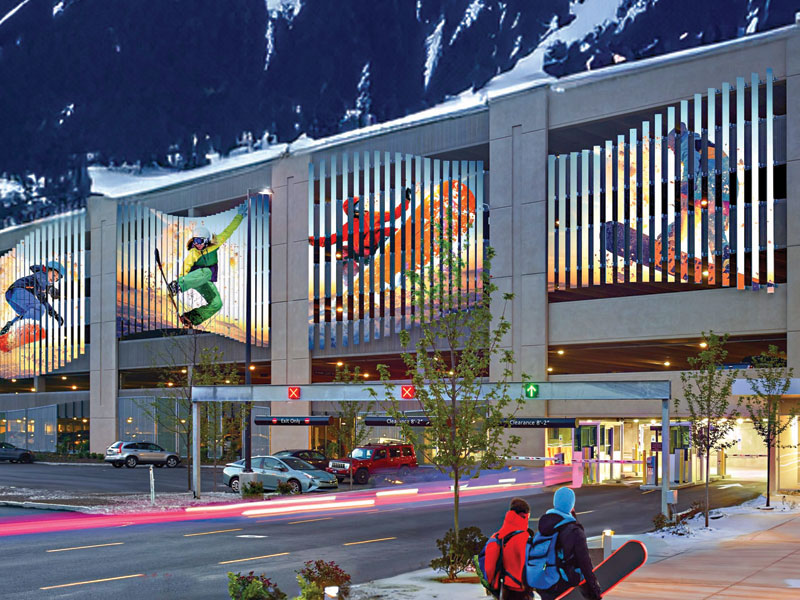
New capabilities in digital printing have elevated façade solutions to a new level of visual impact. For example, one innovation allows the application of imagery onto any flat surface, including perforated sheets, linear sun controls, and louvers, as well as custom profiles and extrusions. Photography, graphics, patterns, and color can be incorporated into design planning, using these elements to support any kind of branding and even serve as signage or wayfinding.
Visual movement
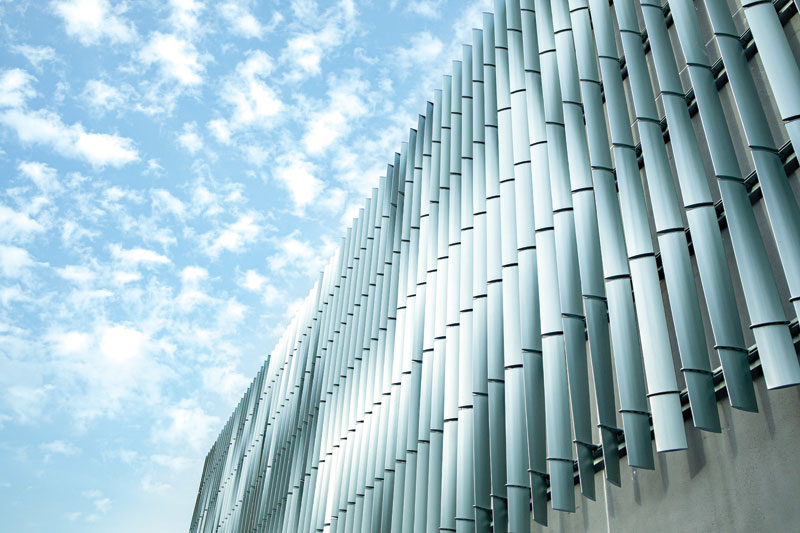
With constantly emerging innovations in the appearance and performance of louvers, these products can create the illusion of movement. Products such as twisted sunshades, colorful fins and blades, and perforated patterns create a dynamic visual experience. As viewers observe the building from different perspectives and elevations, the design effects of the building add life and visual impact in contrast to static facades.
Changing orientation
Vertical louver elements draw the eye upward, emphasizing building height and creating a sense of grandeur. Conversely, horizontal orientations can underscore vast expanses while suggesting strength and stability. The strategic use of linear elements helps coordinate with other facade components like curtain walls and metal panels.
Evolving finishes
Creative façade design often involves blending multiple materials within a single sightline. Sunshades and louvers can bridge different façade materials from perforated to solid surfaces and simulate textures such as wood or stone. This has the effect of providing visual complexity while maintaining overall aesthetic harmony. Adding perforated products to the mixes, such as fins, screens, or panels, brings technical sophistication and visual interest that creates depth and changing shadow play throughout the day.
Integrated LEDs
Advancements in technology have enabled LED lights to be integrated into just about any extrusion, including standard airfoils and tubes. This creates a dual-function opportunity. During daylight hours, lighted blades can provide the needed solar control and shading, then after dark they transform into dramatic lighting features that can convey branding and messaging or simply provide a unique and attractive look to catch the eyes of passersby. This day-to-night functionality maximizes the design investment while creating distinctive nighttime aesthetics. Lighted blades as long as 4.9 m (16 ft) are available and can be mounted in either a vertical or horizontal orientation.
Concealed function
 [3]
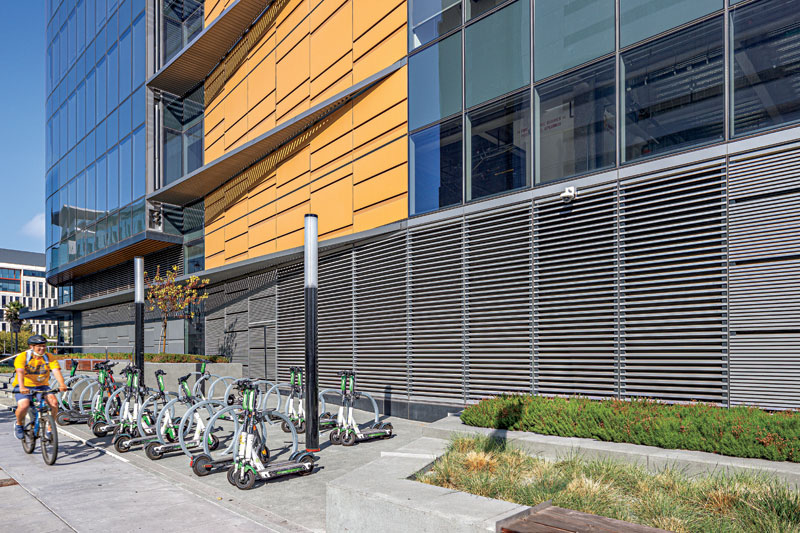
[3]The best designs do not just balance form and function—they elevate both together. The integration of louvers into contemporary building design represents an evolution in the way to think about performance, comfort, sustainability, and aesthetics. For example, concealed louvers provide the air movement, security, and sight-screening performance of standard louvers, but are covered by a modern perforated aluminum skin. Concealed louver systems can integrate into any curtain wall system and are engineered to work in harmony with the louver blades hidden behind them. Manufacturers can offer a full range of products to meet any performance needs or code requirements, including Dade County Certification.
There is a significant opportunity to leverage the potential of daylighting modulation and control systems to create buildings that are visually compelling and operate at a high level. In an era where buildings must work harder and perform better while making memorable impressions, sunshades and louvers offer a way to contribute meaningfully to a thoughtful, integrated design.
Surbhi Ghadge, business development manager – facade solutions at Construction Specialties, has more than 11 years of experience in the construction industry, building a career rooted in technical expertise with a deep focus on architectural product solutions. She has been with Construction Specialties for six years, starting as a sunshade estimator and advancing through multiple roles within the Architectural Product Solutions group. For more information about Construction Specialties’ products and solutions, visit c-sgroup.com.
- [Image]: https://www.metalconstructionnews.com/wp-content/uploads/2025/07/Snow-Boarders-Facades-by-Design-Snow-Mountains-crop.jpg
- [Image]: https://www.metalconstructionnews.com/wp-content/uploads/2025/07/Twisted-Sunshades_Riazzi-5.jpg
- [Image]: https://www.metalconstructionnews.com/wp-content/uploads/2025/07/CS-Standard-Louvers_-Uber_Offices.jpg
Source URL: https://www.metalconstructionnews.com/articles/sunshades-louvers-building-design/