This is not your grandpa’s metal building
by anthony_capkun_2 | 20 May 2026 3:23 pm
 [1]
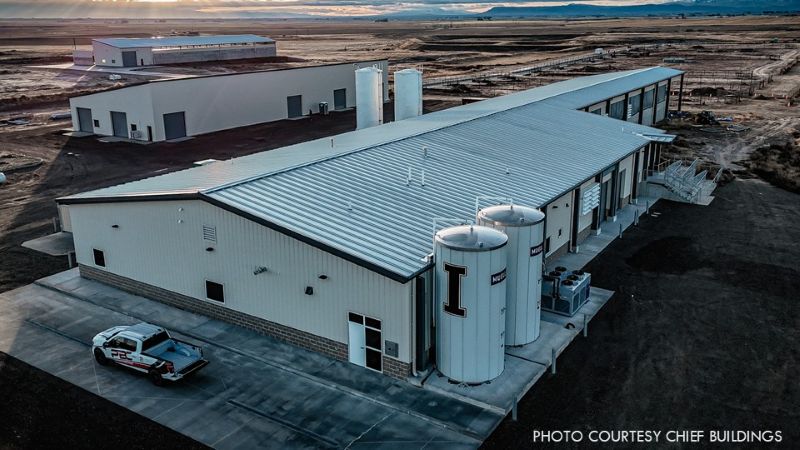
[1]Newsflash! The widespread use of metal buildings in low-rise commercial construction is far from a new phenomenon. The roots of the industry can be traced back to the early 1900s, but it really wasn’t until after World War II that metal building systems began dotting the American landscape.
As their use expanded over the next three decades, they largely remained aesthetically … well, boring. They were intended to be utilitarian structures and deservedly earned the moniker “tin sheds.” Their attractiveness was reduced to their practicality, driven by quick assembly, minimal skilled labor, and low lifecycle costs.
At that time, these buildings truly were “pre-engineered.” Building codes were much simpler then, so manufacturers could create catalogs listing available standard-sized members selected from a matrix that blended the desired building dimensions with the required snow and wind load capacities.
As building codes evolved, manufacturers were forced to invest more into engineering and drafting to adapt, which opened the opportunity to offer a custom-engineered product for use in applications far beyond simple shade and shelter. Owners and building designers intrigued by the inherent benefits of metal buildings began pushing the boundaries like never before.
Over the past 35 years, the industry has undergone a major transformation. Advancements in engineering, design software, and manufacturing technology—combined with demand for speed, sustainability, and cost efficiency—have elevated expectations for how these buildings function while challenging the stigma of being “cheap-looking” by enhancing their form, as well.
The modern-day metal building not only offers a blend of performance and economy, but can also accommodate compelling geometry, a wide variety of complementary features, and a growing array of cladding options. They are increasingly sophisticated architectural solutions utilized in everything from corporate headquarters and higher education campuses to multi-purpose recreational facilities, aviation complexes, and everything in between.
The aesthetic renaissance of metal building systems
Metal panels remain a popular choice for building exteriors due to their durability, long lifespan, recyclability, and minimal maintenance requirements. This has spawned a growing range of metal wall and roof cladding selections.
Though traditional through-fastened metal panels remain popular, higher-end projects increasingly incorporate concealed-fastener systems, horizontal panels, “flat” panels, or a blend of products. The strategic use of reveals, horizontal banding, and varied panel modulation is increasingly common in high-end commercial projects.
Advanced rollforming technology offers more rib profile options, and deep shadow lines can provide the visual interest and distinctiveness many owners and designers are looking for.
Along with dozens of available panel profiles, the spectrum of colors and finishes offered today bears little resemblance to the limited, dull palettes of the 1990s. High-performance coatings such as PVDF (Kynar 500/Hylar 5000) and FEVE (Fluoroethylene vinyl ether) provide long-term color retention, enabling bold architectural statements.
Contemporary trends include matte/low-gloss finishes; metallic coatings; weathered steel aesthetics; and woodgrain, textured, and embossed surfaces.
Mixed-material treatments
Metal panels are far from the only option for high design. Masonry, precast/tilt-up concrete, and stucco have been common material choices for many years. However, there is an increasing trend toward integrating more natural elements, such as stone and reclaimed wood/mass timber accents, along with the more prevalent use of glass curtain walls—particularly when energy codes are driving daylighting requirements. Rainscreens are also increasingly popular.
Contrasting and/or layering materials creates depth and texture, while breaking the traditional monotony of homogenous, stale wall planes.
The industrial-modern aesthetic
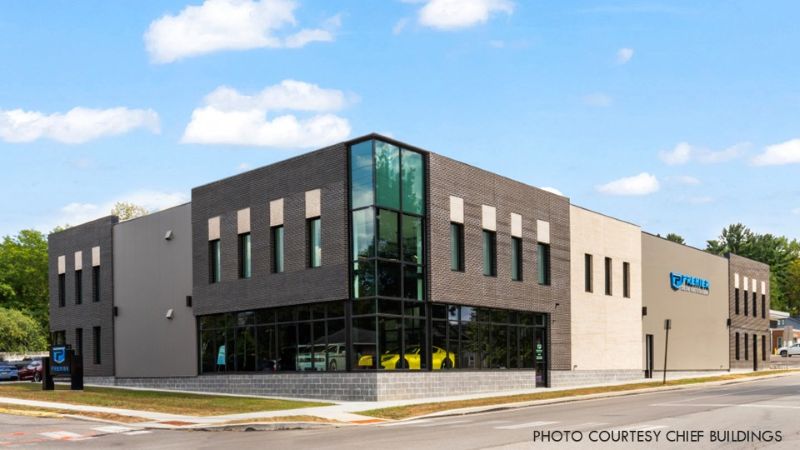
It was not long ago that exposed framing was relegated to simple utilitarian structures, but structural elements and industrial materials are now often intentionally integrated into the design. The popularity of adaptive reuse projects and loft-style interiors has elevated steel framing to a celebrated design feature. Painted or architecturally finished primary members contribute to an industrial-modern aesthetic. Metal buildings naturally lend themselves to that.
 [2]
[2]There are, however, a few things to consider in these situations. The standard metal building columns and rafters are built-up three-plate tapered members. Since they are designed to be very light, stability and strength of webs and flanges are often achieved with flange braces, which can be intrusive and unsightly. If a clean look is desired, the building can be designed with uniform-depth (straight) columns and/or without column flange bracing.
Architectural roof forms and daylighting
Getting creative with roof lines has also become a popular trend. While the traditional low-sloping symmetrical gable frame shape remains preferred for its cost-effectiveness, varying roof configurations and slopes can be a simple way to create something more unique.
Steeper roof slopes tend to draw more visual interest, especially with the crisp look of a vertical rib standing seam roof panel. Integrating clerestories or steps into the roof plane can bring natural light in without penetrating the roof, something to be avoided whenever possible.
If the intent is to hide the roof, parapets can be provided relatively easily, either with framing supplied by the building manufacturer or with other materials, such as stud framing, masonry, or concrete. In situations with a long, continuous roofline, the parapet can be stepped or, if desired, sloped. (Note: Parapet walls at the low side of a building will invite drainage challenges.)
Defying stigmas
Designers of high-end non-residential projects are choosing metal buildings because they combine structural efficiency, construction speed, and cost control with aesthetic flexibility that also align with brand identities, support overall design intent, foster architectural freedom, and comply with community covenants.
Those interested in learning more about the capabilities, efficiencies, and limitations of metal building systems can access a wide range of educational resources from manufacturers, industry organizations, and technical publications.
One of the most reliable ways to obtain accurate information is to work with contractors who specialize in metal building construction and are associated with a company that is a member of the Metal Building Manufacturers Association[3].
MBMA-affiliated companies adhere to established engineering standards and contribute to extensive research, design guides, and best practices that help ensure quality and performance in metal building construction.
These manufacturers often provide design manuals, continuing education programs for architects, project case studies, and direct consultation with experienced engineers who specialize in metal building systems.
By leveraging the expertise and technical resources of MBMA members, contractors, architects, and owners can better evaluate how metal building systems can meet project goals related to cost efficiency, structural performance, energy efficiency, and architectural flexibility, while also understanding when alternative construction methods may be more appropriate.
Mike Pugach is the general sales manager for Chief Buildings.
This feature originally appeared in the May 2026 edition of Metal Construction News, which you can find in our Digital Edition Archive.
- [Image]: https://www.metalconstructionnews.com/wp-content/uploads/2026/05/Grandpa-MCNMay2026-01-800.jpg
- [Image]: https://www.metalconstructionnews.com/wp-content/uploads/2026/05/Grandpa-MCNMay2026-02-800.jpg
- Metal Building Manufacturers Association: https://mbma.com/
Source URL: https://www.metalconstructionnews.com/articles/this-is-not-your-grandpas-metal-building/