Understanding Mezzanine Differences
by Jonathan McGaha | 31 March 2016 12:00 am
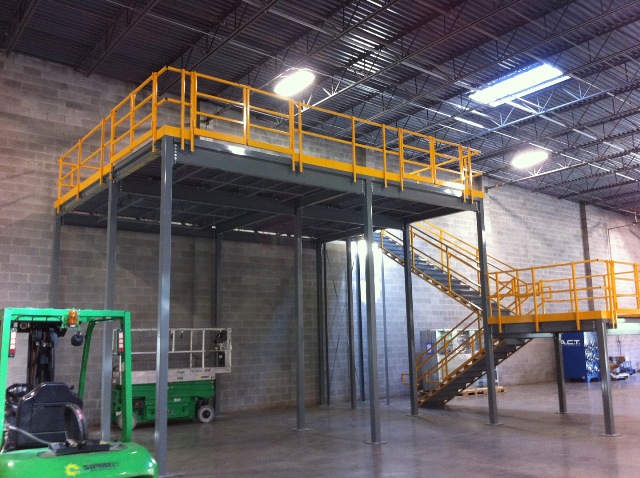
Understanding mezzanine decking options is crucial to ensure the right product for the job
 When it comes to increasing space, it is widely accepted that building up is better than expanding outward. The most common method for doing this is with a mezzanine. A mezzanine is an intermediate floor inside a building, usually open and not walled off. There are a few different types of mezzanine construction, depending on the size and application. Understanding the differences in the way mezzanines are manufactured and finished, as well as the decking options available for each, is crucial to ensuring you choose the right product for the job.
Cold rolled refers to the method of bending sheet metal into a c-channel to use as the framework of the mezzanine floor. Cold-rolled material is much lighter than structural steel and therefore easier to handle. It can also be pre-galvanized; offering a substantial savings over hot-dipped galvanized, stainless steel or aluminum mezzanines.
The major disadvantages of cold-rolled mezzanines is the very limited column spacing (usually 10 to 15 inches max) and the inability to reach the high live loads or heavily concentrated point loads accomplished with structural steel mezzanine systems. Structural steel mezzanines are constructed of structural I-beams, which connect in a postand- beam manor to tubular columns or I-beam columns. Open web bar joists and/or more steel I-beams are then used to construct the sub-floor support.
The most common benefit of structural steel is greater column spacing. Instead of the limited 10 to 15 feet achievable with cold-rolled, structural steel mezzanines can have column spacing over 25 feet as well as load ratings well over the standard 125 psf. This means more material can be stored in a smaller area⎯with more space for maneuverability underneath.
Wet Paint or Powder Coated
Both types of mezzanine systems can be finished with wet paint or powder coated. Powder coating is a type of coating applied as a free-flowing, dry powder that is baked on to achieve the ultra-smooth and durable finish used across a wide array of industries including aviation, marine and military applications.
There are many advantages to using powder coating versus liquid coating. One advantage is powder coating is environmentally friendly. While liquid finishes contain solvents which have pollutants known as volatile organic compounds (VOCs), powder coating contains no solvents and releases negligible amounts of (if any) VOCs into the atmosphere. Powder coated items also have fewer appearance differences between horizontally coated surfaces and vertically coated surfaces than liquid coated items. The coat is tough, durable and has excellent hardness and abrasion resistance, which in turn provides improved product performance over most liquid coatings.
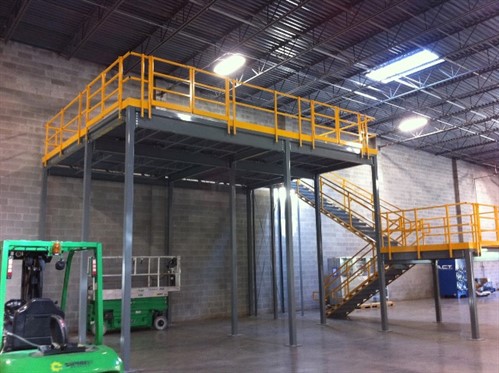
Flooring or Decking Type
The final decision when building a mezzanine is the type of decking (or flooring) to utilize. Advantech is one of the most common options for decking a mezzanine. Advantech is laid over a corrugated steel sub-deck and provides a surface superior to ordinary plywood. Its advanced density provides a solid and secure resistance to foot traffic, and is designed to withstand weather conditions better than ordinary plywood.
ResinDek LD is another viable option similar to Advantech. It is high-density composite flooring, recommended for mezzanines requiring a solid floor subject to heavy loads from the use of pallet jacks, carts or dollies. This option is also installed over corrugated steel decking and has a load capacity of up to 2,000 pounds. It has an acryseal surface which is not only skid-resistant but also easy to clean. It’s also available in heavy duty and/or with concealed fasteners,
ResinDek is ideal for interior decking where heavier loads and a more finished look are desired. Heavy-duty steel tread plate
(diamond plate) is an even more durable option, generally installed over Advantech. Advantech is mounted over corrugated steel deck to provide greater durability with higher point load and wheel load capacities. It also enables a quiet floor for the work environment as opposed to having diamond plate directly over a steel deck.
Concrete is the most durable type of mezzanine decking. With a high point load and minimal transmission of noise through the deck, concrete should be used in high-capacity industrial and military applications where the mezzanine is considered to be permanent. Steel decking (VL decking) is provided with pour stop for pouring up to 6 inches of concrete. Steel grating, commonly referred to as bar grating or press-locked grating, is a common choice in the waste management, mining and food service industries. Steel grating allows for air, light, heat and fluids to pass through the deck surface. It is strong, durable and virtually maintenance free. In many cases, insurance companies only require sprinkler systems above grated mezzanines, since the open grating allows the water to reach lower levels.
In the end, there is no single best choice for mezzanine construction. Carefully consider your application, budget and insurance requirements to determine the best system for your situation. This article was written by a team of Blairsville, Ga.-based Panel Built Inc. employees. To learn more, visit www.panelbuilt.com[1] or call (800) 636-3873.
- www.panelbuilt.com: http://www.panelbuilt.com
Source URL: https://www.metalconstructionnews.com/articles/understanding-mezzanine-differences/