Using metal for low-slope roofing has clear advantages
by David Flaherty | 7 June 2024 2:43 pm
 [1]
[1]There are many things to consider when designing a new building with a low-slope roof. Common building types with roofs between 6 and 22 mm per meter (0.25 and 0.5 in. per foot) include warehouses, data centers, manufacturing facilities, shopping centers, schools, gymnasiums, arenas, and airplane hangars. This is predominantly the realm of modified bitumen and single-ply roofs installed over rigid insulation and a steel deck on bar joists. It is also the realm of 76-mm (3-in.) tall standing seam roofs over purlins or bar joists on a metal building or tilt-wall construction.
Although traditional construction methods like modified bitumen and single ply often dominate this space, for owners interested in the longevity and lifecycle cost of their roofing systems, metal roofing may often be a better choice.
Metal advantages
Metal has several advantages over traditional low-slope materials, with longevity being the biggest. It is well known that a Galvalume-coated standing seam roof can outlast most other low-sloped systems by a factor of two to three.
Based on decades of historical in-service experience, several Galvalume manufacturers recently increased their material warranty from 25 to 45 years on bare and 50 years with polyvinyl fluoride (PVF) paint. These upgraded warranties make it difficult for an educated building owner to continue down the same path of accepting 15- to 20-year life expectancy systems that can fail catastrophically in major hail events.
Metal roofing also outshines the more traditional products when overall project lifecycle costs enter the equation. The initial cost difference between metal and competing systems like modified bitumen and single ply varies based on project specifics and the construction method. The cost spread is most favorable to metal roofing when a standing seam roof is installed directly over open framing with batt insulation. In contrast, a much lower lifecycle cost comes into play when comparing a metal roof over rigid insulation, with or without a steel deck.
The better choice
When determining the best roofing system for any project, it is important to consider factors like roof slope; length of run from eave to ridge; roof geometry; internal or external drainage; the quantity, type, and location of penetrations; and the amount of anticipated foot traffic. Roofs with complicated geometry, internal drainage, crickets, wall scuppers, large irregular penetrations, curb-mounted penetrations installed after the roofing system, or extremely long lengths in slope all lend themselves well to single-ply or modified bitumen roofing systems.
The sweet spot for low-sloped metal installations includes rectangular roof planes, minimal penetrations, and a slope dimension up to 91 m (300 ft). Drainage is also an important consideration. External drainage (installing gutters outside the building envelope) gives the owner the best chance for long-term success in any building design, but it is crucial when working with metal roofing products. The building design that lends itself to each individual panel carrying its share of the rainwater from ridge to the eave without crossing any horizontal seams or other obstructions will provide the owner with a roof system that will well outlast the 50-year material warranty.
Panel options
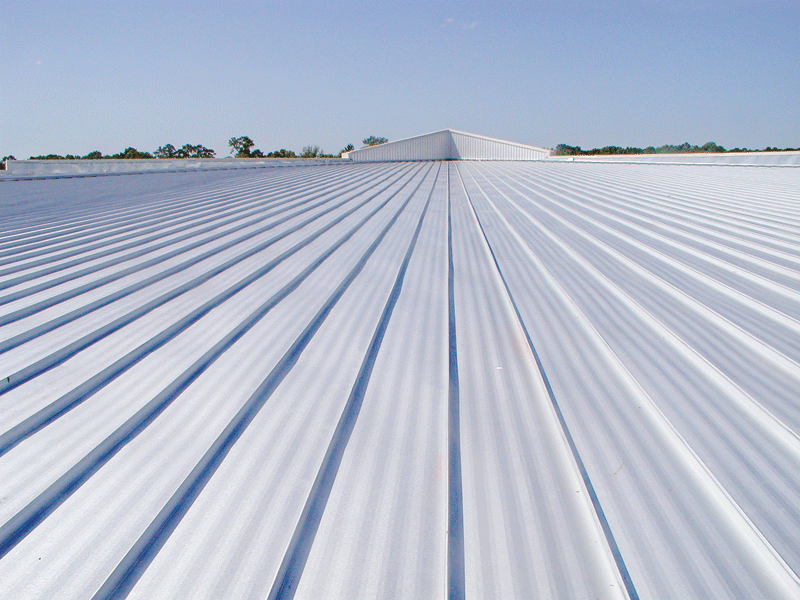
There are four basic styles of standing seam metal roof systems suitable for low-sloped applications. All are approximately 76 mm
(3 in.) tall.
- Asymmetrical trapezoidal panels with snap-together seams
- Asymmetrical trapezoidal panels with a double-folded mechanically seamed joint
- Asymmetrical trapezoidal hook-and-roll-style panels with a mechanically seamed joint
- Symmetrical T-shaped panels with a mechanically seamed cover over the joint
These four systems are attached directly to the purlin or bar joist using clips that allow the roof system to expand and contract with changes in temperature. These clips are integrated into the seam. Beyond that, the legs on asymmetrical panels look different on each side and install from right to left or left to right across the entire roof plane. In contrast, the legs on symmetrical panels look the same on both sides, allowing for bidirectional installation, and involve the use of a seam cover and mechanical seamer to complete the installation. The asymmetrical panel clips are two-piece clips with a floating top that is folded into the seam and a fixed base. The amount of movement in these panels varies, but it is limited by the amount of play in the clip base. The symmetrical panels use a fixed clip that allows for unlimited thermal movement.
While snap-style panels can skip the seaming process during installation, they are much more susceptible to wind uplift and seam leakage than mechanically seamed versions. Consequently, mechanically seamed panels are more watertight and have much better wind uplift capacity but can also be extremely difficult to alter or repair after installation. Curb installation or modification after the initial roof installation also represents a huge challenge with asymmetrical systems.
Symmetrical standing seam panels offer many advantages. However, individual panel replacement anywhere in the field of the roof is the single biggest win, with panel length being a close second.
Currently, most manufacturers of low-slope metal roofing use stationary, fixed-base rollformers to manufacture their panels. These machines are known for producing a consistent panel profile, which, in most cases, is limited in length to 15 m (50 ft). While that may not seem problematic at first glance, that limitation automatically means that for any panel runs over 15 m (50 ft), a lap joint or step-down is introduced. While a handful of manufacturers regularly ship panels in excess of 30 m (100 ft), shipping 30-m (100-ft) panels to a jobsite and getting those panels onto the roof can be a significant challenge. When successfully accomplished, the owner is provided with the best possible roof with the lowest chance of leaks.
On-site panel production
The purpose of a roof is to keep water out of the building. Unfortunately, every year there are millions of square feet of low-slope metal roofs that get covered with single ply because they are leaking at the end laps and no repair has been permanent. This leaves many building owners with a negative impression of using a metal roof in the future.
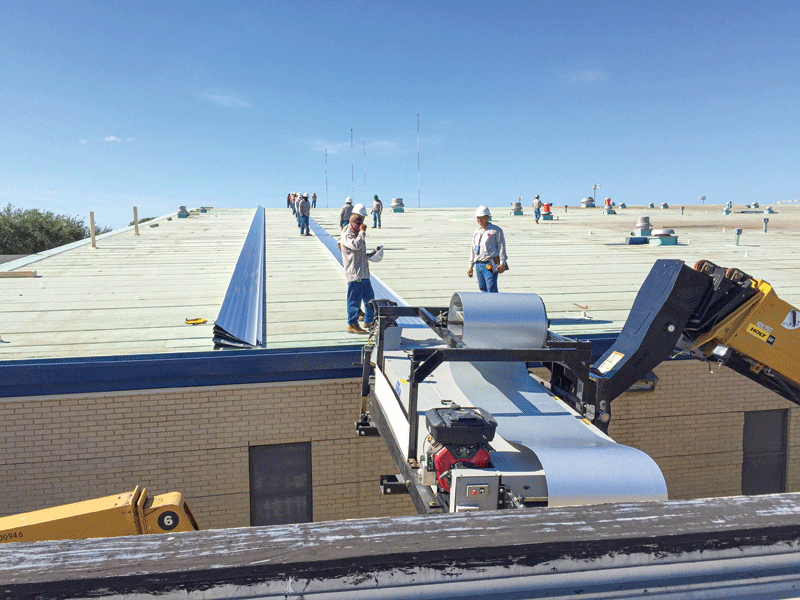
The simplest way to solve this problem is to insist on providing panels with no lap joints. In most cases, factory-formed panels can be used, but if the run length is too long to be shipped from the factory in one panel, then the roof panels should be made on the jobsite, in full length from eave to ridge. Forming long panels on-site eliminates the biggest source of leaks on a metal roof.
It is also important to consider where the panel will be fixed, or pinned. All these low-slope metal roof systems are normally installed with exposed fasteners fixing the roof panel to a 16-gauge eave plate. This creates a watertight condition at the eave. The panel expansion is then directed toward the ridge or headwall. Once the ridge-to-eave dimension exceeds 61 m (200 ft), the panel is normally fixed in the middle and allowed to float in both directions with the introduction of a floating eave plate.
Successful curb installation
Next to panel end laps, curb installs represent the second biggest challenge to weathertight metal roof installations. A typical metal roof curb installation involves a minimum of four end laps and diverting water into adjacent panels as it flows around the curb. Normally, curbs in a low-slope metal roof do not have secondary waterproofing below and rely on exposed fasteners and butyl tape sealant to provide a compression seal between the roof panels and the curb apron. Most of the time this works for long-term success, especially in new roof installations, but with curb additions to existing roofs, the stakes change—that is, unless a symmetrical panel is used to start with. With a symmetrical T-shaped panel, the roof can be disassembled and properly reassembled in shingle fashion around the new curb.
One idea that has been successfully employed with existing asymmetrical systems is to use transverse panels uphill of the curb. In simple terms, the area uphill of the curb is raised to the level of the surrounding panel ribs and new panels are installed sideways all the way from the uphill side of the curb to the ridge. The main thing that transverse panels do is raise the curb flashing out of the water plane, so the curb does not ever see any water. This is an effective method of adding a curb into an existing roof, or repairing a leaking curb. Transverse panels also provide an opportunity to explore hybrid roof systems where polyvinyl chloride- (PVC-) or thermoplastic polyolefin- (TPO-) clad metal is used to make a curb flashing with heat-welded joints.
New insulation products
 [2]
[2]The extended Galvalume warranties make a solid case for using metal roofing on low-sloped buildings, but there is more. Developments in rigid insulation products now allow for direct installation over open framing while offering a safe working surface for the remainder of the project duration.
That is a huge deal for several reasons. First, there is obvious safety and time savings. Additionally, this new breed of rigid insulation products eliminates the inefficient and time-consuming banding and multilayer fiberglass batt insulation approach typically used in open-frame metal roof construction. Instead, these high R-value rigid boards are applied directly over the purlins. They have shiplap side joints to eliminate the need for multiple layers. In addition, instead of standard lengths, the insulation is extruded in custom lengths up to 16 m (53 ft), resulting in very fast and efficient installation. Finally, the insulation thickness is consistent across the entire building, ensuring there is no thermal break where the roof panel crosses the purlin.
Using this new product technology, new construction open-frame buildings have been temporarily dried in at a rate of 1,393 m2
(15,000 sf) per day with a five-man crew. Having a 5,574-m2 (60,000-sf) building ready for inside trades in a week after steel erection can have tremendous effect on both construction schedules and overall project cost. These insulation products can help bring metal roofing into jobs where continuous insulation thickness is extremely important to interior operations. While these products come with an air barrier on both sides that provides good temporary waterproofing, it is also easy to add secondary waterproofing such as high-temperature peel-and-stick on the top for extra protection.
Solar and sustainability considerations
Low-sloped standing seam roof systems also make tremendous sense when a building owner wants to use solar panels to generate electricity. Instead of racks that penetrate the roof and attach to the structure, solar panels on a standing seam can be clamped to the panel ribs with absolutely no penetrations, completely eliminating the potential for any roof leaks related to solar mounting.
There is a trend toward the combination of solar and metal roofing. In fact, many design professionals have begun moving their HVAC and other related equipment to the ground instead of the roof to maximize solar opportunities. A 9,290-m2 (100,000-sf) roof with 90 percent solar panel coverage can produce up to 2 MW of electricity, reducing the annual cost of electricity by up to $240,000. And, of course, this reduction in cost continues to rise as the cost of generated power goes up. Between hedging future power bills and a payback in as little as five years, as well as current federal incentives, there is simply a lot to like about combining solar technology with metal roofing. Adding solar can be especially important for power-hungry data centers.
Charlie Smith, national recover manager with McElroy Metal, has been on a passionate mission to expand the use of metal roofing in non-conventional methods. Smith’s efforts have made him one of the industry’s foremost authorities on recover systems utilizing metal roofing. He holds several patents in the recover and panel design fields. He co-wrote the two-day International Institute of Building Enclosure Consultants (IIBEC) (formerly RCI Inc.) Metal Roofing course and is a frequent presenter at IIBEC and other roofing industry events. In 2018, Smith was presented with the Outstanding Educator Award from RCI in recognition of continuous delivery of exceptional educational courses.
- [Image]: https://www.metalconstructionnews.com/wp-content/uploads/2024/07/Edinburg-Site-Form-2.gif
- [Image]: https://www.metalconstructionnews.com/wp-content/uploads/2024/07/Office-Depot-3.gif
Source URL: https://www.metalconstructionnews.com/articles/using-metal-for-low-slope-roofing-has-clear-advantages/