Warehouse Conversion
by Marcy Marro | 1 July 2022 12:00 am
A renovated railroad warehouse transforms into school for young children

Legacy Early College[1] (LEC), a public charter elementary, middle and high school, opened in 2009 to help meet the needs of more than 1,700 students facing socioeconomic challenges. The school offers an educational program focused on developing college-bound scholars using a model targeting the needs of the whole child including academics, physical education, nutrition and social relationships.
LEC worked with McMillan Pazdan Smith Architecture[2]’s Greenville office to create a site plan that would expand the program to include a K4 preschool building, as well as expand their existing sports and recreation offerings to include a 24,000-square-foot multicourt gymnasium.
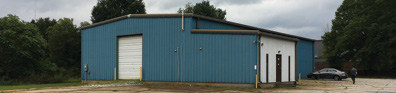
Before
The Case for Renovating
Having a K4 program was important to the school because it helps get neighborhood kids who may have financial need into school early, better preparing them for educational success, while matriculating them into future attendance at LEC.
The original thought for the project required tearing down an existing pre-engineered metal building that had served as a railroad warehouse to make room for prefabricated units to serve the K4 population.
“Using mobile units is costly for a K4 building because of the exiting requirements; you’d have to construct a sea of decks and ramps with access to every classroom,” explains Jeff Tiddy, AIA, project manager and architect at McMillan Pazdan Smith.
However, upon further discussions with William W. Brown, founder and board chair for LEC, architects found a way to use the existing building by converting it into a space that students, staff and the community could be proud of. During the six- to eight-month design phase, McMillan Pazdan Smith held weekly meetings with Brown, some of the school’s teachers, and administrators who would be leading this new program.
Once it was decided to save the original metal building, the architects performed field investigations to determine how much existing space was there. “We knew we had to create six classrooms, and a lot of support space; this required expanding the existing footprint with something that would complement the scale and mass of the existing building,” Tiddy says.
McMillan Pazdan Smith also worked with the school in rezoning the parcel from industrial to education use, and to revise a setback variance to make the site more neighborhood- and pedestrian-friendly.
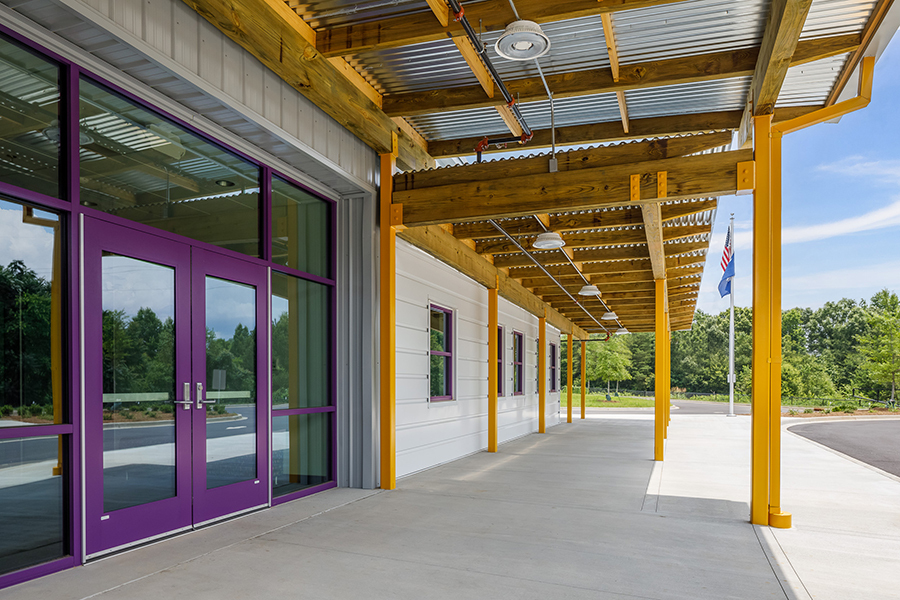
Metal Building Renovation
Along with the McMillan Pazdan Smith Community Studio, the existing PEMB was re-clad and an addition was put on to expand the space while saving the school on construction costs. One of the primary concerns was ensuring that the building was structurally suitable to accommodate the students and faculty. Since classrooms have much higher structural, fire and seismic requirements than storage facilities, several code modifications were required. “We reinforced some of the existing bracing and relocated others to place the doors and openings where we needed them,” Tiddy says.
The exterior features a unique color palette of gold and purple, the school’s colors. The columns, canopy and window frames were all painted in these colors, giving a real sense of pride. Additionally, honor roll students get to wear gold, further connecting the building to the school’s focus on academic achievement.
The project used Moon Township, Pa.-based CENTRIA’s[3] Concept Series metal wall panels, and aluminum storefront windows and entrances from Oldcastle BuildingEnvelope[4], Dallas. Premiere Roofing of the Upstate LLC[5], Easley, S.C., was the metal roofing and wall contractor, and supplied its Metal AG–Tuff Rib metal roofing panels.
To reduce the building’s industrial feeling, many of the exiting features were changed. Inside, the metal roof deck is exposed, providing a nod to this history of the structure and the intentional decision to make the building feel less like a typical school building. Missy Games, Assoc. AIA/Assoc. IIDA, project designer with McMillan Pazdan Smith, adds, “We tried to be smart and strategic about where we would have exposed areas of the ceiling to allow for more height, versus areas where a drop ceiling would be installed, and making it all transition seamlessly and smoothly.” The overall finished design accomplished having a light, airy feeling that would be welcoming to any child.
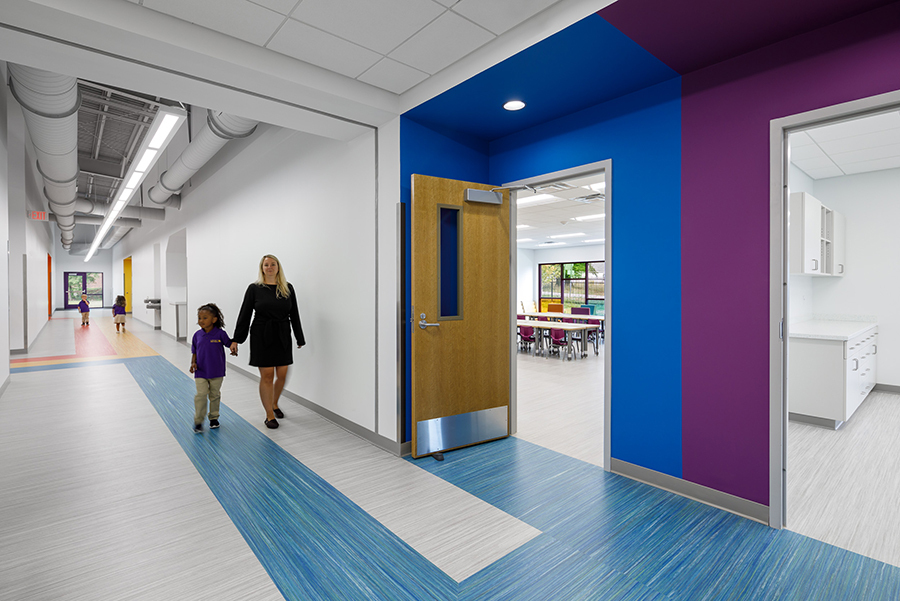
Since the new building is for young students, wayfinding played a major role in the interior design. While four-year-olds may not be able to read, they know their colors, and the design team used Forbo Marmoleum to create color-coded paths leading to the six classrooms, each a different color of the rainbow. McMillan Pazdan Smith’s design team used colors strategically and intentionally to create environments that did not feel industrial but instead felt clean, crisp and playful.
“It’s a comforting thing for young children, who may get turned around, to be able to use a corresponding color to find their classroom,” Games says. “It also makes the spaces fun, lively and exciting.”
Adds Games, “I was wearing my designer hat, but I was also wearing my mom hat, thinking about my son who is the same age, being in the building and what he would and would not like. With this school, you can tell that it’s intended to be a fun space for preschoolers when you drive up.”
- Legacy Early College: https://www.legacyearlycollege.org/
- McMillan Pazdan Smith Architecture: https://mcmillanpazdansmith.com/
- CENTRIA’s: http://www.centria.com/
- Oldcastle BuildingEnvelope: https://obe.com/
- Premiere Roofing of the Upstate LLC: http://www.premierroofingupstate.com/
- mcmillanpazdansmith.com : https://mcmillanpazdansmith.com
- www.trehel.com : https://www.trehel.com
- bluewatercivil.com : https://bluewatercivil.com
- www.carolinaengr.com : https://www.carolinaengr.com
- www.goldenstripglass.com : https://www.goldenstripglass.com%20
- www.premierroofingupstate.com : https://www.premierroofingupstate.com
- www.centria.com : https://www.centria.com
- www.obe.com : https://www.obe.com
Source URL: https://www.metalconstructionnews.com/articles/warehouse-conversion/