The value of newly signed design contracts declines further
by anthony_capkun_2 | 23 October 2026 10:30 am
 [1]
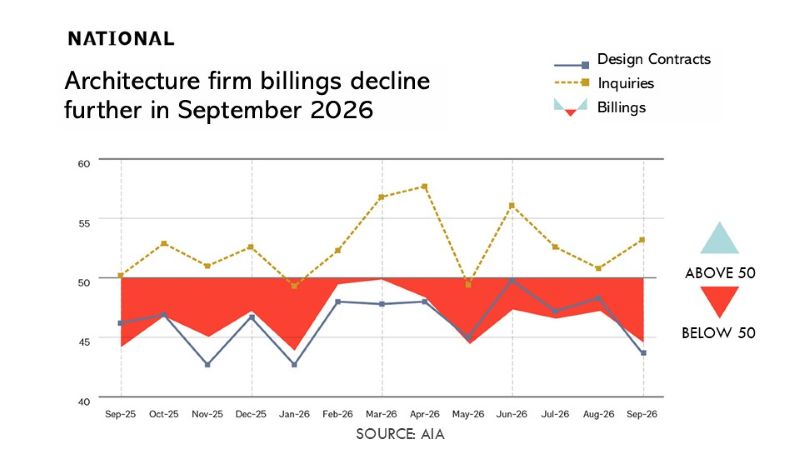
The AIA[2]/Deltek Architecture Billings Index (ABI) score for September 2026 was 44.7, showing a further weakening from August[3], and the greatest share of firms reporting declining billings since May.
The ABI is a leading monthly economic indicator based on billings at U.S. architecture firms and is used to predict nonresidential construction activity 9 to 12 months in advance.
ABI scores greater than 50 indicate growth, while scores below 50 indicate contraction.
While inquiries into new projects increased modestly, the value of newly signed design contracts declined further, after approaching growth over the summer. And while firm backlogs averaged a relatively strong 6.2 months at the end of the third quarter, they have fallen from 6.6 at the end of the first quarter.
The most noticeable decline in backlogs was at firms with a multifamily residential specialization, where backlogs have fallen from 6.2 months at the end of March to 4.8 months at the end of September.
Backlogs remained steady at 8.1 months at large firms with annual billings of $5 million or more, 8 months at firms with an institutional specialization, and up from 3.1 months to 3.8 months at small firms with annual billings of less than $250,000.
While backlogs have declined across the board from their post-pandemic peaks, most firms “still have a decent amount of work in the pipeline at this time,” says AIA.
Business conditions were mixed across the country in September. While billings remained very soft at firms located in the Northeast and continued to weaken from earlier in the year at firms located in the South, they improved at firms in other areas, with firms located in the West and Midwest both reporting flat billings.
Additionally, firms with a commercial/industrial specialization also saw slight growth in billings for the second consecutive month in September.
However, billings declined for the sixth consecutive month at firms with an institutional specialization, and for the fifth consecutive month at firms with a multifamily residential specialization, where conditions have weakened significantly since showing promise at the beginning of the year.
At the firm level
Architectural services employment added 300 positions in August (this data lags national data by one month) to reach a total of 204,500 employed in the industry. This level has generally been consistent over the last year, says AIA.
Architecture firm leaders were asked about their firm’s revenue performance this year and their expectations for 2027.
Nearly half of respondents (45%) indicated that their current estimate for net revenue at their firm this year is down in comparison to 2025, by an average of 2.9%.
However, 30% indicated that their revenue is up this year (with 13% reporting that it is up by 10% or more), while the remaining 25% indicated that this year’s revenue is on par with 2025.
Small firms with annual billings of less than $250,000 reported the greatest decline (7.2%), followed by firms located in the Northeast (5.7%). The smallest declines were at large firms with annual billings of $5 million or more (0.0%) and firms located in the Midwest (0.7%).
Overall, responding leaders were more likely to report that their current estimates for 2026 net revenue are lower than they were at the beginning of the year (47%, with 20% saying that they are significantly less than expected), with 33% indicating that they are in line with those expectations, and just 21% saying that they are more than those initial estimates.
Firms with a multifamily residential specialization were most likely to report that current estimates are less than expected (57%), while small firms are most likely to report that they are more than expected (29%).
When looking ahead to 2027, firm leaders are roughly evenly split between those expecting that net revenue will decrease (32%), stay about the same as 2026 (36%), or increase (32%).
Overall, they expect net revenue to decline by an average of 0.9% in 2027 from 2026, although that is significantly higher for small firms, where they expect a decline of 9.1%.
Firms located in the Northeast and those with a multifamily residential specialization, which are already having challenges, each expect revenue to decline by an average of 3.5% in 2027.
At firms expecting a decrease in revenue in 2027, the reasons most frequently cited as major factors were:
- Current projects winding down and fewer new ones on the horizon (70%)
- Uncertain economic conditions discouraging potential clients from pursuing projects (56%)
- Fewer opportunities/less work available in the pipeline (55%)
- Negative construction market fundamentals, including high construction costs, elevated vacancy rates, weak demand, and restrictive financing (54%).
At firms expecting an increase in revenue in 2027, the most commonly cited reason was larger project(s) proceeding, which 46% indicated as a major factor.
An improved construction financing market, being more fully staffed and able to increase billings, and increased efficiency due to AI were cited as not contributing to increased revenue by nearly two-thirds of responding firm leaders.
— With files from AIA[2]
- [Image]: https://www.metalconstructionnews.com/wp-content/uploads/2026/10/AIA-ABI-September-2026-800B.jpg
- AIA: https://www.aia.org/
- August: https://www.metalconstructionnews.com/news/increased-pessimism-among-architecture-firm-leaders-about-q4-2026-billings/
Source URL: https://www.metalconstructionnews.com/news/the-value-of-newly-signed-design-contracts-declines-further/