Intermediate School, Hot Springs, Ark.
by Jonathan McGaha | 31 March 2010 12:00 am
 The Lake Hamilton School District school once operated from a five building campus—one of six individual sites for various grade levels—across 140 acres (56 hectares). In good and inclement weather, the 620 fourth- and fifth-grade students had to walk outside to get to the cafeteria, office or other classrooms. Furthermore, there was no facility for physical education.
Current and projected enrollment dictated a new school with more logically consolidated space under roof. Funding came from state partnership money and bond levy proceeds whose combined amount required a cost-effective design and construction program, and features that would keep operating costs affordable. Additionally, the new school had to fit on the same space as the old complex and use the same parking area. The building program was made even more challenging by requiring the new school to be built at the same site while existing facilities were in use.
“Construction management was essential to making this project a success,” explained Robert Cox, project manager for Hill & Cox Corp., the builder and construction manager. “Our company teamed with the architect and owner early in the conceptual stages. This allowed everyone’s expertise to be incorporated into the design development.”
The design team quickly honed in on how to best address the district’s needs, site constraints and costs. The program called for more than two dozen classrooms, two computer labs, restrooms, full-service cafeteria, physical education facility, physical therapy and occupational therapy rooms, media center and offices.
 The new 87,000-square-foot (8,082-m2) facility features a full-height lobby in the two-story portion at the core in response to the site and logistics limitations. The portion at the heart of the school applied conventional construction with masonry load-bearing walls and bar joists framing. A large staircase facing a dramatic boxed bay window connects the second floor, as well as an elevator for special needs access. The floor plan for the two-story classroom section was kept simple with both floors consisting mainly of long corridors with classrooms arranged to allow for team teaching and easy class changing, with the upstairs carpeted to suppress noise.
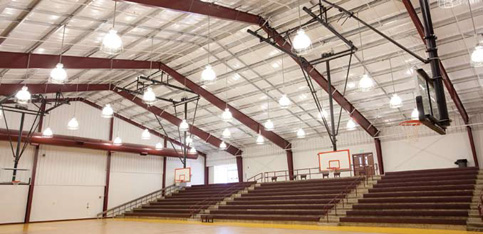
This is flanked by two single-story wings built entirely with Butler Manufacturing building systems that included its Widespan structural system, Skyline light-gauge steel truss system and factory-insulated StylWall II wall panels system with a masonry-like exterior finish. For long-term weathertightness and R-19 insulating properties, Butler’s MR-24 standing-seam roof system was used on both the metal building system and conventional construction. The roof panels were supplied in prefinished Burgundy to match the school colors. The Butler structural system used for both wings delivered flexible, column-free space for a full-size basketball court and bleacher seating for physical education classes and assemblies. The walls of both wings were made of R-19 factory insulated StylWall II flat wall panels.
The school was built in two phases to minimize class disruptions. The first phase consisted of the office portion of the left wing, the two-story central classroom section, PE wing and the front of the new school and was finished over the winter in 13 months. The demolition of existing buildings occurred during a break in the academic year and included one building that was 10 feet (3 m) from the new structure. The cleared area provided space for phase two that produced the new cafeteria wing, circular drive and parking lots.
Builder/construction manager: Hill & Cox Corp., Hot Springs
Architect: Lewis Architects & Engineers, Little Rock.
Metal building, roof and walls: Butler Manufacturing, Kansas City, Mo.
Source URL: https://www.metalconstructionnews.com/projects/intermediate-school-hot-springs-ark/