Construction job sites are dusty and dirty. Traffic from boom lifts, aerial lifts, excavating equipment and other vehicles, as well as foot traffic around the job site, send large amounts of dust particles and debris into the air. These airborne particles will often fall onto the surface of newly installed metal panels causing them to appear dull or cloudy. Metal panels can also accumulate bird droppings, mild soot, mildew, fingerprints, footprints, adhesive residue, oil, grease, excess unsightly caulking, metal filings and other visual contamination. To remove these and restore metal panel appearance and image integrity, a brisk cleaning is recommended.
Metal panels must be cleaned to restore their appearance and remove corrosive materials
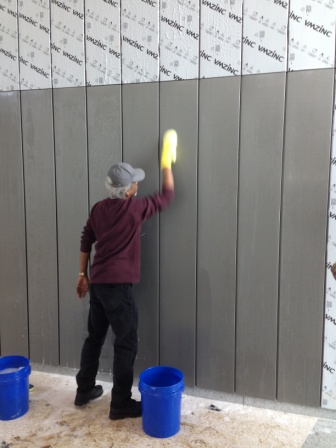
Photo courtesy of Umicore Building Products USA Inc.
“Cleaning isn’t done only because of aesthetics, it can also remove corrosive materials. Also, “During installation, panels that have been cut and fastened will often have dirt and metal fibers stick to the panels, which can cause scratches and rust to form,” says Alex Detmer, manager of field technical services at Kingspan Insulated Panels, DeLand, Fla.
Sensitivity
Certain panels are more sensitive to cleaning than others such as pre-patina copper, zinc, titanium and stainless steel. “As an example, pre-patina copper has a very thin and brittle patina top coat,” says Doug McIntyre, director of research and business development at Altech Panel Systems Inc., Cartersville, Ga. “Care must be taken during the cleaning process to ensure that the patina finish is not damaged. With all natural metal finishes, it’s important that the end user follow the cleaning procedures outlined by the manufacturer to ensure no damage occurs.”
Eric Simonsen, vice president of project management at MetalTech-USA, Peachtree City, Ga., agrees that natural metals like zinc are more sensitive to cleaning. “If cleaning is required, attention must be paid to the treatment of the surface to maintain the integrity of the natural weathering properties,” he says. “That is, after all, the primary reason to use the material in the first place: the ability to let the metal do its thing.”
Start with a Wipe Down
Installers must wipe down metal panels as they are erected and their smooth finish makes this relatively easy to do. First try to clean the surface with plain water, and a soft sponge, a clean white lint-free cotton cloth or a soft bristle brush. Apply light pressure when cleaning so as not to abrade the surface. If a stain or heavy dirt is persistent, a solution of water and a mild detergent or household cleaner (1/3 cup Tide per gallon of water) can be used. The detergent should contain less than 5 percent phosphates. Never mix dangerous chemicals, especially with compounds that contain bleach and ammonia.
“Only use neutral detergents or household cleaners to clean painted surfaces,” cautions McIntyre. “Do not use scouring powders or harsh chemicals as they will damage the surface of the material. Do not use any type of abrasive or wire brush as they have a tendency to scratch the surface of the material.” Do not use steel wool. To avoid surface damage, do not rub any metal panel excessively in one area for a long time. Rub down in the same direction of the material grain to prevent changing the grain on the panel.
Simonsen says that cleaning preweathered zinc with abrasives will result in long-term damage to the finish and will reveal the natural zinc. “Depending on the application, the natural zinc may or may not develop a patina and in time will blend back in with the surrounding area, but the time it takes to do so can vary greatly and take years,” he says.
Solutions for Cleaning
Mildew, or biological growth, may occur on metal panels in job sites subjected to high humidity. According to Detmer, to remove mildew use the following solution followed with a clear water rinse:
• 1/3 cup of detergent (Tide)
• 2/3 cup of tri-sodium phosphate (Soilex)
• 1 quart sodium hypo chlorite 5 pecent solution (Clorox)
• 3 quarts water
For non-skimming butyl caulk that may get on panels or ooze out from the joints, Detmer believes the best products for cleaning it are WD-40 lubricant or mineral spirits, and a soft rag. Extreme care must be taken when using mineral spirits to not damage the panel.
These products will also work for oil, grease, tars and wax. For these stubborn stains, McIntyre suggests using a low-alkaline cleaner such as Windex or Sharpshooter. “Extreme care must be taken with this approach so to not damage the finish of the material,” he warns. “Do not use strong organic solvents, such as MEK (Methyl Ethyl Ketone), MIBK (Methyl Iso Butyl Ketone), Triclene or paint thinner. Do not use strong alkali, strong acid or harsh cleaners. Use of these solvents and cleaners may result in the paint becoming swollen or removed.”
Sometimes detergents are not strong enough and solvents must be used. Remember that solvents can be flammable. Always use adequate ventilation and keep them away from flames, sparks, electrical motors and other ignition sources. Only apply solvents to affected areas. Many solvents are toxic; limit their working exposure. Consult maintenance professionals and label instructions for their proper handling and disposal.
Excess caulk or paint droppings can be removed with a flat razor blade but extreme care must be taken so as not to damage the finish. Aggressive cleaning can not only damage the panel coating but also void the panel warranty.
If not removed at the end of each day, metal filings-the result of drilling, grinding and cutting- can start to rust overnight. Once unsightly rust spots have appeared, they too can be removed with a nonabrasive cleaner.
Careful Cleaning
Whatever cleaner is used, test on an inconspicuous area first for colorfastness before use on a large scale. Gently wipe only the contaminated area and follow with detergent cleaning. Once all cleaners are proven effective and successfully used, thoroughly rinse the area completely with clean water to remove traces of detergent. Cold water usually works best.
Power spraying is effective in cleaning large building areas quickly. Detmer cautions against using high-power pressure washers. “If a pressure washer is used with the pressure too high, it can damage the coating causing little cracks in the embossment and may blow out the sealant in the panel joint,” he says.
If a pressure washer is used, start the process with a low-pressure sprayer at the top and work your way down. This will help carry away the dirt and debris with the water flow. It will also minimize streaking. To avoid panel damage, keep the distance of the pressure washer nozzle uniform across the surface area. Do not drive water into the seams between the metal panels.
Regardless of the technique and cleaning formula used, a thorough rinsing with clear water is critical to remove all of the cleaner residue. Cleaner residues can resemble chalk and are usually unsightly. When finished cleaning metal panels, dry them off with a squeegee. Wipe off their excess water with a damp cloth or chamois to avoid spotting and let them air dry.
Again, before cleaning, always read the panel manufacturer’s Material Safety Data Sheet and written installation instructions to avoid panel damage. Use protective clothing and goggles for worker safety.