The Backbone
A behind-the-scenes look at the role of the installer on an award-winning walls job
By Stefan Schumacher, Senior Editor
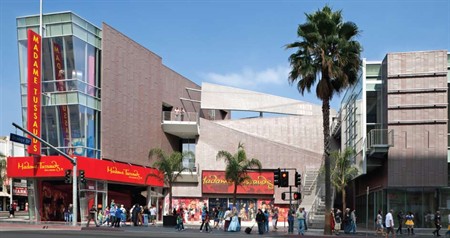
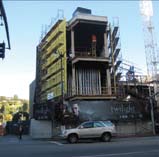
The winner of the 2010 Metal Construction News Design Award in the metal walls category was an especially unique project. The zinc panels on the Madame Tussauds Wax Museum in Los Angeles created what Design Principal Michael Rotondi of JAG/RoTo Architects, the project’s architect, calls “a scaled, articulated, sensuous building.” The panels are Umicore Building Products USA’s VMZINC Custom flat lock 0.8-mm zinc panels in PIGMENTO Red. The textured look of the organic yet modern zinc panels created an architectural landmark adjacent to the world-famous Mann’s Chinese Theater, but the installation over varying sloped walls and numerous folds was a challenge that had to be met during construction.
To learn more about how this unusual, striking and difficult wall panel application came together, MCN went behind the scenes with the installer that customized the panels.
G.E.S. Sheet Metal in Pomona, Calif. has been in business since 1972 when Glenn E. Schuske Sr., coming from a family of sheet metal fabricators in St. Joseph, Mo., moved out west. Today, 10 years after Glenn Sr.’s passing, his son Glenn Schuske-who started with the business in 1976 after a stint as a plumber-took over running the company and became CEO. He says the sheet metal shop tradition began with his grandfather, who ran a sheet metal shop from the garage behind his house.
“It’s been in our blood for many, many years,” Glenn Schuske says. “If you’re a young kid and your dad works in sheet metal, you’re usually working with him.”
Much of the work G.E.S. Sheet Metal takes on is through bids, but Schuske says because clients trust him and the quality of his work, the company hasn’t always had to come in with the lowest bid to earn a job.
“We’ve never held up a job, never slowed a job down, never stopped for not having a change order signed yet. We’ve never ever given anybody a problem,” he says.
In some ways installers like G.E.S. are the backbone of a project. When a set of drawings comes in with a concept and a set of materials, it’s the installer who has to make sure the materials aren’t too expensive and that they fit in a particular application. If not, they must make a recommendation on what will work better.
A Perfect Example
In the case of the Madame Tussauds project, the general contractor Morley Construction, had worked with G.E.S. on a project at the University of Southern California and asked them to bid on the wax museum. G.E.S. won the contract and was invited to discuss the custom design of the wall panels.
The zinc panels on were originally designed as standing seam and flushed seam. However, zinc expands and contracts. Having gone to a VMZINC training session, Schuske and his team learned that when you cut across a piece of zinc, the serration causes small hairline cracks. Those hairline cracks will grow in the material as it expands and contracts, particularly in California where the weather can go from 36 degrees in the morning to 85 degrees in the afternoon.
“Because the material wants to expand in the sun and shrink in the cold it will literally tear itself apart,” Schuske says.
Schuske recommended a flat seam, locking two seams together and allowing the panel to move vertically and horizontally at the same time. “You’re using clips. Two of the edges are turned down, two are turned up, so when you put it on the wall the two edges of the next panel will clip onto the first,” he says.
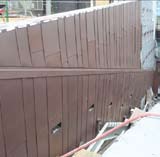
G.E.S. utilized a 16-gauge galvanize steel underneath the zinc skin to account for the multi-width flat seam panels. Any flashing that interacted with any other surface on the building was made using stainless steel with a 2b finish type 316 This was due to having to caulk where the flashing interacted with other surfaces. Caulking zinc causes it to oxidize behind the caulking, which allows water to migrate behind the caulk into the building.
Staggered Appearance
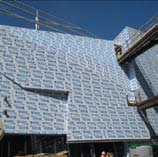
The various panel lengths gave the Madame Tussauds walls their staggered appearance, which helps make the building standout. It was the first time G.E.S. had done the staggered panel look in two directions, typically working with standard sizes.
“As far as uniqueness, I’d say Madame Tussauds is quite unique,” Schuske says. “It’s a beautiful building.”
Schuske said the company had not installed a project this large using flat seam and zinc, but he was aware of the nuances of working with zinc.
“We’ve done some zinc fascias, and that’s how we found out how much zinc moves,” he says. “With zinc you have to be very careful on how you design the job so you allow the material to move any which way it wants to, and at the same time, not fall apart.”
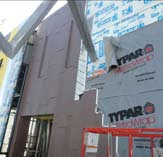
G.E.S. also used self-adhering Carlisle WIP 300Ht and Typar between the zinc as a breathable layer that stops moisture from penetrating.
The Installation
Dave McCauley of G.E.S. helped with much of the custom design aspects of the panels, and Ann Chong handled the CAD work, but when the pre-construction end had been completed, it was time for Dan Stockton and a team of 10 men to do the work in the field.
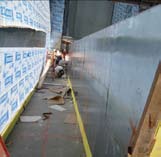
It was a challenging six-month construction that Schuske said required articulating booms to get to the ins and outs of Madame Tussauds. The work was done off of both booms and scaffolds.
Schuske says the combination of Umicore’s VMZINC material and a good working relationship with the general contractor and architect made for a very enjoyable job. “The architect was a very understanding architect who would listen.”