 Not too long ago a contractor might have read articles on “productivity” and thought: “That’s nice. I’ll try it someday, but I’m too busy right now.” Back then, “profits” just seemed to happen regardless of any project delays, call backs or weak labor pool.
The past two years have taken us “crashing and burning” into today, but a whole lot wiser. Now let’s deal with the new reality. Productivity ideas are no longer “nice to haves,” but necessities for survival! Especially now as we see things are only slightly improving in 2010. Ask yourself: “Is my company ready with the best people, practices and equipment to take full advantage of any market change?”
Make no mistake, productivity and profit are two distinct measures of your business and NOT always linked. Productivity is your measure of output based on units of input (e.g.—square feet installed per day); while Profit (hopefully) measures a dollar return for your business (e.g.—your net profit increased from $1,000 to $10,000). Too often we improve productivity in one area only to have profits eaten up by under performance in another area. Frustrating? Yes. Invisible? No, not in today’s information age and competitive market! Especially if you’re under performing areas could ADD savings to your initial improvements!
Here’s how you can do or have BOTH!
Consider any new piece of equipment that not only increases labor’s output in one area, but also could improve output in other areas as well. BUT, this can only happen if somebody tries something new! In effect you could be “multitasking” with your current labor force if you were to INNOVATE.
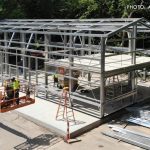
Let’s say there’s equipment out there that could speed up your job-site framing. You’d most likely want it, right? But if this equipment also makes similar gains for decking, sheathing or other tasks; you’d ask: “Where do I sign?” Unfortunately we do not always use what we have to its full potential, and savings dollars are left on the table.
Today’s market DEMANDS we try new and expanded uses for the aforementioned equipment example. If we do, we should also see cost improvement in seemingly unrelated areas. Our productivity example of cost improvement for several installations can also affect lower costs (less time) for things like scaffold and generator rentals. Better yet, shorter schedules for these several completed tasks can speed up progress payments and improve your cash flow!
Seek out the knowledge!
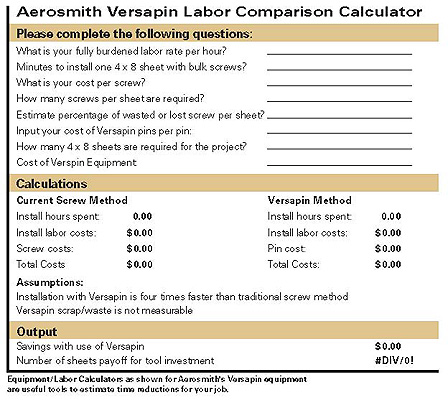
Many equipment manufacturers offer cost or “labor” calculators to measure impact on the targeted uses for their equipment. Since everyone’s project is different it is up to you to see what applications might fit your job, and then measure for yourself the positive impact on your ancillary costs. You can start with a cost calculation for the innovative equipment. Here’s just one example used by Aerosmith Fastening Systems, Indianapolis, showing cost impact of just ONE installation— plywood sheathing to cold-formed steel framing using traditional screw fastening or with the new equipment using “hardened pins.” Several more applications could be added since this equipment can also do walls, floors, roofs and track with each covering part or all of the equipment costs. As you supply your cost data you also see the differences in the times to complete each task so that you can estimate added job cost savings.
Could there be other time and money savers out there? There sure are! You can uncover more of these by adopting a change in mindset that will open up creative uses for existing equipment. Here are some simple guidelines— are you or does your organization:
Avoid complacency … stop if you hear “we’ve always done it this way.”
Keep innovating … existing equipment or methods MAY work on new stuff, get creative.
Look for new things … keep on looking and learning, don’t be afraid to look outside your industry.
Constantly look for ways to improve ALL your processes … not just the job site, but in the office too.
Use your savings wisely … use your new cost structure to compete for new work, pass some savings on to project owners … THEY WILL CALL YOU BACK!
Robert J. Shluzas is president of Aerosmith Fastening Systems, Indianapolis. Details can be found at www.aerosmithfastening.com.