Rollforming: factory-based, on-site⎯or both?
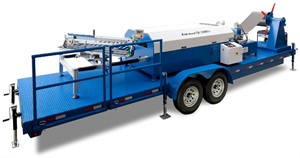 It used to be a straightforward matter. For 50 years, factory-based rollforming was the primary manufacturing solution for metal roof and wall panels. Fabricating on-site was not really a viable option.
But that’s no longer the case.Starting about 20 years ago and certainly in the last 15, that universe began to evolve to include on-site rollforming. Today, for the contractor or builder looking to decide how best to compete for jobs, the options have multiplied and the degree of control a builder can have over the production process has increased dramatically.
Investment
It’s not even an either/or decision (factory or onsite), nor is it simply a question of whether or not to invest in buying a portable rollformer. It all boils down to what kind of business you are doing, what kind of business you want to do and how much control you want to have.
Factory-based rollforming today is still a huge provider of roof and wall panels for all types of construction. Manufacturers provide a high level of quality assurance, guarantees and warranties that many builders find comforting. Many people don’t want to take responsibility for on-site production.
Also, in the past, quality assurance, in the form of Underwriters Laboratories Inc. (UL) testing and watertight guarantees, wasn’t really an option with on-site rollforming. But that changed dramatically about 14 years ago, and now those guarantees are well established for on-site rollforming. This has enabled builders inclined to use on-site rollformers to compete on jobs where UL underwriting is a requirement of the architect or building owner.
Flexibility
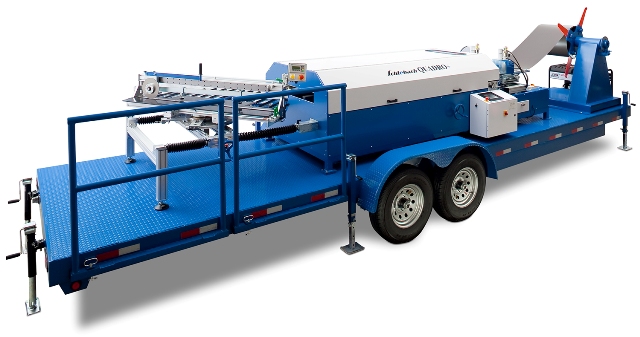
Another factor that changed the landscape is on-site profile flexibility. Residential builders who primarily do nailstrip panels probably don’t need a lot of flexibility, but for those competing for light-commercial, commercial or institutional work, as well as residential jobs, portable machines that can change profiles easily in less than 10 minutes, like the Schlebach Quadro, are now very much a part of the equation.
Typically, factory-based rollformers make panels much faster than on-site machines, but other factors, including protective packaging for the parts, transport costs and such, also need to be considered. Often, with factory-based profiles, customers will order 10 percent more panels than they need, just to be sure that if some panels are lost or damaged, they will have enough to cover without having to wait days or weeks for another shipment.
On-site rollforming, while not necessarily cheaper, is built more emphatically around the philosophy of “just-in-time” and just what you need.
Job Size
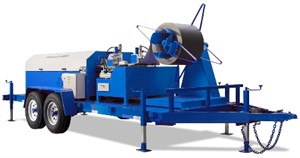 It also used to be the case that the size of a job might dictate the use of factory-based product, but today there are many builders doing huge jobs with on-site equipment. Indeed, some will bring more than one portable rollformer to a job.
But it is not an either/or decision. Many contractors continue to use factory-based partners with good success while at the same time using on-site rollformers. It depends on the job, the size of the job, the specifications, the architectural requirements, the building owner, etc. For example, when you secure factory-based metal panels, you typically can’t make them more than 50 feet long, because you can’t transport them. So, if you have longer runs on a roof, you have to make end laps and join the panels together. End laps can lead to leaks, so more and more, architects say that’s not acceptable. A portable rollformer can solve that.
Today, it’s sometimes not even a question of to buy or not to buy a portable rollformer. Some of the larger factory-based producers sometimes will bring a portable machine to the site to roll, say, 70-foot panels for their customers. The contractor doesn’t own the on-site rollformer; the factory does. In the end, it boils down to what markets you support, and what kinds of markets you want to be in.
And how important to your construction business is just-in-time control over your materials? The production side today has evolved to provide a much broader spectrum of solutions that can be tailored to meet almost any builder’s needs.
Geoff Stone is CEO of MetalForming Inc., Peachtree City, Ga., a large supplier of high-end architectural sheet metal machines in North America. To learn more, visit www.metalforming-usa.com.