Some preconceptions about moisture prevention are simply all wet
There are a myriad of challenges facing the building construction industry today. One of the biggest hurdles is the peaceful but everpresent competition between energy consciousness and inescapable environmental factors like moisture. To address this, manufacturers are striving to design and produce materials and systems to combat mold, mildew and other related issues, while increasing energy efficiency.
While the goal is to develop sustainable, durable and energy-efficient products, systems and structures, manufacturers must also (at the same time) work to ensure occupant health and safety by designing for optimum indoor air quality. To do so, they have to factor in the unpredictability of moisture management.
Those knowledgeable in the physics of buildings will contend that it takes a comprehensive approach to effectively address the aforementioned issues so we can all live and work in comfortable, healthy buildings. Air and moisture are readily addressed by understanding how the mechanics of the building work, in tandem with leveraging solutions offering the most forwardthinking properties.
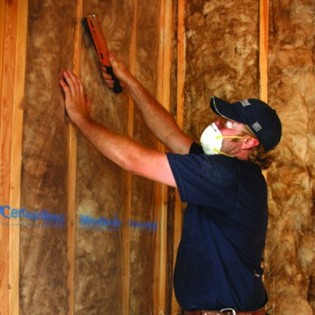 |
| Photo courtesy of CertainTeed Insulation |
Not Always Cut and Dry
All too often the industry tends to look at materials solely from an energy or moisture perspective. In truth, the joints and intersections between materials, products and/or systems often fail. One must look at the way a wall system comes together against a window. For example, in room systems it could be a joint or seam that creates potential for moisture issues.
The reality is that structures move, contract, expand, twist, turn and shift. Systems must be designed to withstand sustained periods of exposure to moisture, whether that moisture is interior or exterior in nature. A common misperception is that products and systems termed waterproof are all that is needed to keep moisture from leading to mold and mildew in check.
Adding to these factors is the advent of new business challenges. Popular cladding products hold moisture; hence the rate of building failures keeps increasing. Building codes are driving tighter construction and enhanced energy efficiency. There is also a growing shortage of skilled labor available.
Walls now tend to be wetter than we’ve ever seen. This is not because the physics have changed. It’s due in large part to new construction practices that are not allowing the moisture getting in, to get out. There is a growing need for increased R-values in building assemblies coupled with a steep reduction in air movement through the wall. While energy efficiency is being well served, this lowers the rate of drying while the rate of wetting remains the same.
No Secret Codes
Building codes, stringent regulations and requirements are ever changing. The confusion around them only continues to build with different standards and enforcement levels from the national code down to the state and even the county or local municipality. It’s dealt with so much in the construction industry that it’s easy to forget that these parameters are really representative of a baseline. They are not necessarily the best or the only ways to effectively prevent moisture from leading to mold, mildew and rot.
Many construction methodologies that are used to meet codes seek to seal a building without giving proper consideration to getting moisture out. Doing so greatly increases the chance for moisture to accumulate, or to cause issues over time as moisture finds its way into the building envelope. So we incorporate things like ventilation and other measures to allow moisture to be released from assemblies.
Consider the Implications
Proper moisture management will have an initial cost factor. However, the proper application of moisture prevention products and systems will not only prevent moisture-related issues, but also help to maintain the thermal efficiency of the building envelope. The building industry currently spends more than $9 billion annually in moisture repair and litigation. While innovations like continuous insulation are intriguing, it’s simply too new to know its long-range effectiveness.
For example, in most U.S. climates, vapor barriers (retarders) should be part of a moisture control strategy. A “smart” vapor retarder has the unique ability to be able to react to changes in relative humidity by altering its physical structure. There are many choices for products and solutions to prevent moisture. Look for those from manufacturers dedicated to advancements in its science, protecting the environment and sustainability and steer clear of preconceptions that are simply all wet.
Ted Winslow is building science, systems and technical marketing product manager, CertainTeed Insulation, Malvern, Pa. To learn more, visit www.certainteed.com or call
(800) 233-8990.