Quick tips to ensure your projects proceed without delay
 |
| Photo courtesy of R&S Manufacturing and Sales |
Roof accessories are an integral component of most metal building projects. Procuring the correct application can sometimes be overlooked, which may translate to delayed construction schedules or costly fixes. Here are a few quick tips to ensure your projects proceed without delay.
Roof Panel and Pitch
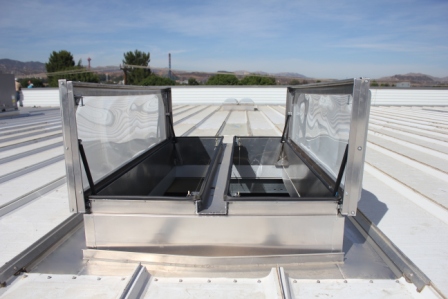
While this may seem rudimentary, there are countless scenarios whereby this basic step is overlooked. A proper curb should fit snug to the roof panel for a weathertight seal. The upslope curb flange slides under the panel while the downslope flange rests over the panel. The curb must be fabricated with precision such that the geometries line up. Most curbs require a level top for designated equipment; as such, the pitch must be confirmed with certainty in all instances.
Regional Weather Climates
Dryer climates can leverage “standard” side flanges that fasten in the flat (pan) of the roof panel secured with washered long-life self-drillers. This is a low-cost option that yields higher profits to the builder. Curbs that are to be installed in regions with inclement weather should use “seam clip” (standing seam roof systems) or “layover” (R-Panel roof systems) side flanges that extend to the next natural high. This design avoids placing fasteners in the flat which can be subject to water intrusion. Seam clip/layover curbs carry a higher cost, but drastically reduce the risk of leaking.
Inclement climates should also leverage corrosive-resistant aluminum curbs. While galvanized steel can be cost effective, it is prone to rust, particularly at weld and shear points where the galvanized coating is compromised.
Curb-mount Unit Weight
When installing curb mount units that weigh over 1,500 pounds
(general rule) on a standing seam roof, consider a two-curb system consisting of an inner weight-bearing curb and an outer flashing curb. The inner curb is typically secured directly to the structural steel. Note that two-curb systems are not required on R-Panel metal roofs.
Engineering calculations may be required to confirm that the curb system can tolerate the load. It’s important to supply your curb manufacturer with the complete mechanical schedule and roof plan for proper guidance.
Roof Warranty
Standard curb warranties are one to two years; however, building manufacturers that offer weather tightness warranties often detail specific curb requirements. Curb suppliers are generally screened and then included as an approved manufacturer so it’s important to check with the building manufacturer for a list of approved suppliers. Some specific requirements include:
• Minimum upslope and downslope flange lengths
• Inclusion of seam clip/layover side flanges
• Minimum sidewall to seam/high rib clearance
• All-aluminum construction
 |
| Photo courtesy of R&S Manufacturing and Sales |
Curb Sub-frame
Sub-framing is required to secure and seal the flanges of the curb to the roof panel. There are several ways to achieve a proper sub-frame opening which should be fabricated by an experienced supplier or metal building manufacturer.
Some curb companies offer sub-frame as an option while others include it in the final price. It’s a very good idea to be sure that your budget includes the sub frame to avoid any unexpected costs.
Uncovering Revenue Opportunity
Builders with a keen eye can often identify and pursue opportunities that increase revenue while extending the overall value proposition of a project. Roof accessories represent an excellent category to achieve this goal.
• Roof walkway systems represent one of the fastest growing categories in the roof accessory space. It is also an excellent means of increasing the overall project value with a highly complementary product. Once an installation crew becomes familiar with the basic principles associated with these systems, grating and handrail can be installed quickly and affordably. Owners will extend the life of their new building, which will reflect positively on the builder.
• Daylighting is another category that will continue to gain importance as the 2012 Energy Code sweeps the nation. Increasing demand for safe and efficient solar lighting to reduce power consumption translates to a revenue opportunity for builders. Owners will appreciate those contractors who can supply the consultative services needed to navigate this complex and changing requirement. As demand grows, builders have access to more choices to meet these demands. Roof accessory providers can act as an invaluable asset to help navigate these demands and provide the right product for the job.
• Safety products include an array of accessories that can add value to a building by reducing the likelihood of injury. Top-selling products include hand railing around roof access hatches or building edges, safety posts for ladders and fall protection for skylights.
Retail spaces or storage facilities with high-priced products should consider security bars under roof openings to prevent theft. These products are readily available and easy to install. Working with an experienced roof accessories supplier provides access to the knowledge, support and documentation needed to reduce risk and identify revenue opportunities as they arise.
Eric McClung is president at Newbury Park, Calif.-based R&S Manufacturing and Sales. For more information, visit www.RnSsales.com.