Providing a safe and comfortable environment inside buildings
 |
| Photo courtesy of Metallic Products |
The last half-century has seen countless developments and vast improvements in the metal building industry. Advancements in engineering allow for today’s metal buildings to be designed for practically any variation of wind, snow and seismic loads. Paint systems are now available with warranties that last decades. Is it any wonder metal buildings are the preferred choice for new construction in so many different sectors?
Along with the evolution of metal buildings also came the need for many different types of roof-mounted accessories. One of the first roof accessories to be developed specifically for use on metal roofs was the gravity-style roof ventilator. Metal buildings have long been the popular choice for manufacturing and warehouse facilities; proper ventilation provides a cooler, more comfortable working area and facilitates the removal of air contaminated by manufacturing processes. Proper air movement also plays an important role in the overall health of the metal building by controlling condensation.
Vent Placement and Size
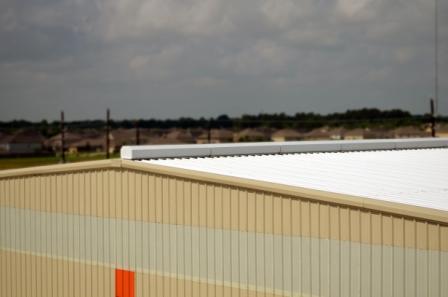
As a general rule of thumb, gravity vents perform best when placed at the ridge, thus allowing the roof slope to assist in directing the heated air to the vent opening. Spreading the vents out along the full length of the ridgeline is generally preferred because it allows for a more uniform airflow distribution by reducing any isolated hot spots. Standard ridge vents are typically 10 feet long and have a 9- or 12-inch throat, but smaller and larger throat sizes are available to address other air change requirements.
Vents arrive at the job site complete with end-skirt flashing kits that allow the vents to be installed either as a single unit or in multiples to create a continuous run. Flat skirt flashing allows the vent to be installed on any roof panel profile, including standing seam roof (SSR) systems. Die-formed skirts are also available to match the popular “R” and “M” panel profiles, therefore eliminating the need for closure strips. Operable dampers are offered with chain kits that permit the damper to be adjusted from fully open to a fully closed position.
Air flow charts and formulas are available to help determine the size, type and quantity of gravity vents required for a project. These charts take into consideration effects on natural gravity ventilation systems such as wind speed, temperature differential and stack height (the distance between the center of the intake inlet and the vent opening).
It’s important to remember, though, that gravity ventilators are normally designed to be used as exhaust vents, and they must be accompanied by adequate intake ventilation. A minimum ratio of 1:1 intake to exhaust can be used, but 1.5:1 is preferred. Wall louvers, soffit vents, intake fans and open doors are a few options that can provide the required intake ventilation.
 |
| Photo courtesy of Metallic Products |
Long-term Solution
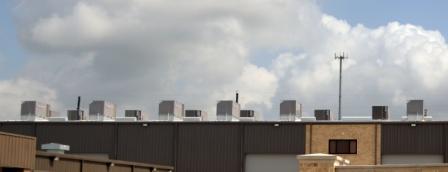
When greater air movement is required overall (or just in a particular area of the building), powered exhaust fans are also an option. Roof curbs allow the exhaust fans to be installed on the roof along with other roof-mounted accessories like skylights and HVAC equipment. Roof curbs are manufactured with metal rib caps and closures to match the panel profile, and they are built to have integral crickets that ensure proper water runoff. When they’re properly installed using sealants and fasteners as recommended by the building manufacturer, they provide a long-term solution to any roofmounted accessory.
Metal buildings will continue to be the preferred choice of construction for many projects, and the right roof accessories are essential to a safe and comfortable environment inside the structure. The proper planning, selection and installation of roof accessories will not only provide comfort and safety for personnel, but they will also contribute to the overall health of the building itself for many decades to come.
Coy Poret is president of Metallic Products, Houston. To learn more, call (800) 356-7746 or visit www.mpvent.com.