An almost limitless palette of design options at an attractive price point
Expanded metal meshes and perforated metals are continuing to find new homes in today’s modern architecture, allowing architects and designers to add a layer of visual transparency and screening characteristics. Both of these material types offer an almost limitless palette of design options at a price point many owners find attractive.
Expanded mesh has been around for more than a century and has historically been used for industrial applications such as walkways, screening, machine guards, treads and many more. The manufacturing process of expanded mesh is an efficient use of the raw materials. The slitting and stretching process in some instances allows for up to a four times yield from the raw material. This means one sheet measuring 4 feet, 6 inches wide of raw material can expand to 16 feet of expanded mesh. The expanding process creates a material that is both rigid and flexible while being lighter than the original raw material it was expanded from. The material is capable of spanning up to 5 feet, depending on the mesh style chosen, in the long way of diamond direction due to the truss-like structure created during the expanding process. Additionally, the material’s flexibility in the short way of diamond direction allows the mesh to follow undulating profiles.
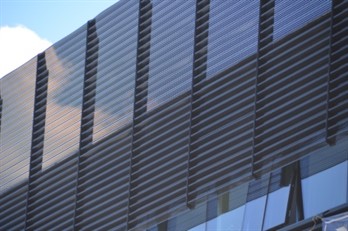 Mesh apertures range from micro-style meshes, typically used in filtration applications, up to openings large enough to fit your hand through. The angled pitch of the expanded mesh allows for great shading characteristics while still offering clear views through the material. Some expanded metal manufacturers offer fully fabricated systems complete with design engineering, shop drawings, framework, fastening clips and finishing such as powder coating, anodizing or high performance organic paint finishes. By working directly with the design and construction team, the manufacturer can recommend alternate mesh styles and manufacturing techniques to achieve the design intent.
New options
Perforated metals are offering new options in metal architecture through new manufacturing techniques such as image perforating which allows designers to create visually stunning landscapes, life forms, abstract images and text. This is achieved by using multiple diameter perforating punches in various locations. Software reads the image and then associates light and dark tones with the perforating punches. Additional surface texturizing can be achieved by way of introducing positive and negative indentations into the perforated material. Corrugated perforated metal panels are another way of introducing texture to an otherwise 2-D product. The corrugations allow the material to span greater distances and add a veil-like appearance to architectural installations.
Both expanded mesh and perforated materials can be manufactured from a wide variety of base materials, from plain steel to exotic alloys such as titanium, Zeron 100 Super Duplex Alloys, zinc and many more. It is recommended that the designer works directly with a manufacturer to ensure the combination of expanded mesh or perforated material type, thickness and panel sizes are possible. Many alloys of materials can introduce manufacturing issues such as oil canning, levelness, cracking or tolerance variances. A reputable manufacturer will work with a design team to ensure the correct combination of expanded or perforated materials and raw materials are used.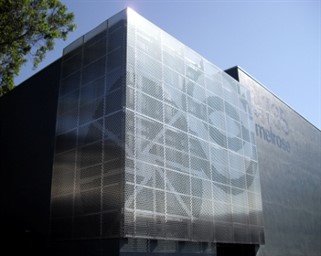
Applications for expanded metal mesh and perforated metals in architecture can be found in places such as cladding, sunshades, balustrades, ceilings, façades, room partitions, column covers and many more. Manufacturers of both products welcome designers and contractors alike to explore the many options expanded metal mesh and perforated materials bring to the architectural design process.
Phil Shevchenko is sales manager of Alabama Metal Industries Corp. (AMICO), Birmingham, Ala. For more information, go to www.amicoarch.com.