A visual enhancement and energy savings
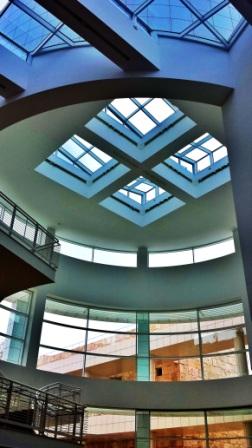
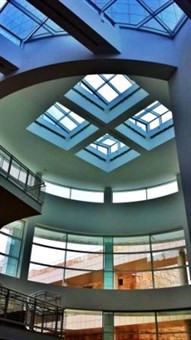
Just like the “eyes are the window to the soul” of a person, skylights provide an illumination to the activities in a building. Although open skylights were used in ancient Roman architecture such as at the famous Pantheon in Rome, many buildings today incorporate many types of shapes, sizes, colors and glazing materials to complement them.
While many structures seem to use skylights and atriums strictly as visual enhancements, it can’t be denied that a major benefit of incorporating daylighting into a space is energy savings. Skylights can be looked at as wireless light bulbs providing free energy to the user. Then, when used in conjunction with electrical lighting controls, daylighting can save thousands of dollars in energy costs.
An additional and sometimes overlooked benefit to providing free energy and optimal lighting, daylighting can contribute to productivity, health and wellness. Studies have shown that students who learn in day-lit classrooms have higher retention to math and reading, and employees who work in day-lit offices have an increase in productivity and decrease in days absent from the job.
 |
Many benefits
One example of this is a Lockheed Martin office building in Sunnyvale, Calif. It has been the subject of case studies over the years since it opened in 1983. The building design was an innovation at the time that incorporated a combination of passive solar daylighting strategies that reduce the building’s artificial lighting use by 75 percent. This resulted in a measurable savings of 50 percent in energy bills the first year of operation and an ongoing cost savings year over year. The energy savings were overshadowed, however, by an unexpected increase in employee efficiency and decrease in absenteeism. Lockheed officials attribute this reinvigoration of its workforce to the design of the building. The focus on daylighting not only reduced energy costs, it also created a pleasant, productive working environment.
The daylighting industry has come a long way in the glazings it has to offer. Not one glazing is a good fit for every project. The old traditional monolithic glazing (smooth sheet plastics) is becoming a thing of the past. The industry is shifting to new technologies such as prismatic glazing, spectrally selective glazing and those which provide higher thermal performance values than ever before.
These include:
1. Prismatic Glazing: uses thousands of tiny prisms to refract and disperse light offering the best visible light transmission
(VLT) available and providing optimal light diffusion with no glare or hot spots.
2. Spectrally Selective Glazing: utilizes a special coating on the plastic that blocks 99 percent of harmful UV rays, thus providing the lowest solar heat gain available while still providing good VLT. This type of skylight meets national energy codes.
3. Super Insulating Glazing: uses multiwall polycarbonate panels filled with silica aerogel, the same material used to insulate the Mars Rover. The use of silica aerogel provides a very low U-Factor, which is most beneficial in colder climates where buildings need to keep warm air inside. This type of glazing also acts as a great sound barrier when compared to traditional skylights.
When selecting skylights, a balance is sought between low U-factor and optimal solar heat gain coefficient (SHGC) values, while preserving enough daylight supply to minimize artificial light use. Automatic light sensing controls for electric lighting maximize energy savings. While factoring heat loss and solar heat gain adds another level of complexity to the scope of a project, conscientious architects and engineers have become accustomed to making this a consideration.
Certainly, daylighting both energy savings and a higher quality office environment at the same time. Both of these achievements due to daylighting contribute to the bottom line of corporate profits. What’s more, they contribute to a better environment and healthier employees.
James M. Fox is president of Design Components Inc., Fayetteville, Ga. To learn more, visit www.designcomponents.com.