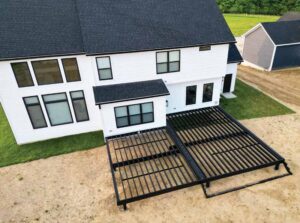
Over the last few years of high residential renovation activity, there has been a major shift in customer priorities and purchasing decisions. Many are gravitating toward wood-alternative building materials that check multiple boxes: high performance, durability, style, and sustainability. That is why so many contractors are making the switch from the time-honored choice of wood to an alternative building material like steel for deck construction. The results speak for themselves. Contractors who frame a deck with steel can create a long-lasting outdoor space that exceeds customers’ expectations.
Strength to support weight
All muscle and brawn, steel profiles are strong enough to support the added weight of today’s most in-demand outdoor amenities (think full outdoor kitchens or custom steel pergolas). Steel has an ultimate yield strength around 10 times greater than wood and even flexes with force—one of the reasons for its success on large construction projects. Steel’s ductile nature helps it withstand high winds, earthquakes, and other stressors. Its capacity for load-bearing weight has a direct correlation with its ability to provide greater spans. For example, a steel joist can span up to 6 m (20 ft) between supports. This means fewer posts are required, which frees up more usable space underneath a customer’s upper-level deck. Contractors are not handcuffed by the span limitations of wood joists, allowing for greater design flexibility to accommodate project vision.
Similarly, because contractors can frame a supersized deck with fewer pieces of material, they can conserve resources and support a more sustainable project. However, strength is only half of the equation when it comes to building a bigger and better deck structure.
Resistance to weather-related damage
With steel, contractors can have peace of mind in the long-term structural integrity of their projects. The incredibly durable building material is resistant to most tangible threats, making it possible to sideline major issues such as deterioration after long-term exposure to moisture, splitting, and warping due to extreme temperature changes. In application, steel frame profiles will remain straight and true over time. This makes for an enduring, dimensionally stable deck framing solution that keeps surface boards flat and smooth underfoot.
Steel is also a noncombustible building material, which means it can help contractors complete fire-safe projects in regions that are prone to wildfires or densely populated urban areas where fires can spread rapidly. With a fire-hardened option, framing a deck with steel can help prevent a ground fire from spreading quickly, reducing the vulnerability of a customer’s home, or building and surrounding structures.
Straightforward installation
Select outdoor building product manufacturers are leveraging the proven benefits of steel to bring comprehensive deck framing systems to market. These steel deck framing systems are typically manufactured with mild carbon steel (also referred to as low carbon), which is formed into light-gauge steel (LGS) components found in many commercial buildings. The steel is hot-dip galvanized to G60 standards of 25.5 g (0.90 oz) of zinc coating per square foot of steel sheet or higher for enhanced durability and protection from the effects of weathering.
The biggest misconception about using a steel framing system is that it requires additional tools or special industry knowledge to get the job done right. This mental roadblock may prevent some contractors from converting from lumber to steel, but when it comes to installation, these ready-to-assemble steel framing systems support a straightforward deck building process. A comprehensive framing system from a leading manufacturer will include an intuitive ledger and convenient joist lengths for an installation process that feels just like installing a traditional wood frame. Plus, going with a pre-welded assembly means there is no playing in the lumber, no grading the lumber, no taping, and no painting the end cuts. With a comprehensive steel framing system, contractors can hit the ground running and move on to their next job more quickly.
Contractors can take additional measures to ensure a safe, complete deck structure by incorporating a compatible steel deck stair system into the build. This approach sidelines serious safety concerns, like poor stringer-to-deck connections and inconsistent rises and runs. These challenges are common in traditional wood decks, as conventional stair construction requires that contractors cut pieces of lumber by hand—a recipe for miscalculations.
On the other hand, engineered stair systems from select manufacturers have fixed and adjustable stair brackets that can accommodate various rise and run options. Stringer and stair trays already include blocking every 254 mm (10 in.) on center for railing post attachment and stair tread attachment. Self-drilling screws ensure maximum strength and security at connections. This level of innovation ensures today’s supersized decks remain structurally sound, which means customers can rest easy knowing their loved ones are safe while on deck and navigating deck stairs. In addition, steel deck stair systems can be used with any type of deck surface board, including composite, polyvinyl chloride (PVC), aluminum, tile, wood, or tropical hardwoods such as teak and ipe. This makes it possible to bring design continuity to an outdoor space without compromising the structural soundness of the deck structure.
Offering unmatched strength, durability, and weather resistance, steel delivers performance advantages that make it possible for contractors to build deck structures that last. With complete, ready-to-assemble steel deck framing and stair systems available on the marketplace, there has never been a better time to put steel to the test.
Jeff Schulz is senior vice-president of sales and marketing at Fortress Building Products. A building products industry veteran, Schulz has spent the last 13-plus years at Fortress delivering proven performance and smarter solutions with the company’s steel deck framing steel stair systems, pergolas, railing, and fencing.