Motivating students and making school interesting for learners of all ages is a challenge for educators at every level. Designing new facilities or updating existing structures requires meticulous consideration of details to foster a positive learning environment. Aluminum composite material (ACM) panels can play a crucial role in creating spaces that encourage curiosity and enthusiasm for learning. Here are six educational facilities that have successfully integrated 3A Composite’s ALUCOBOND ACM panels to enhance their architecture and inspire students.
Science IV Building, Binghamton University
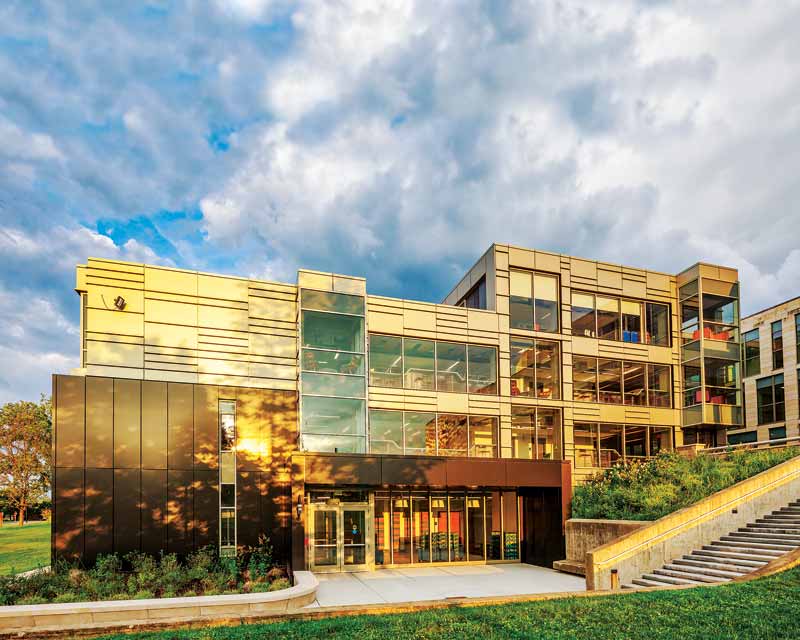
The renovation of the Science IV Building at Binghamton University in Binghamton, N.Y., transformed its original high-intensity lab environment into a welcoming space for the psychology department. The building’s central location on campus necessitated a high-profile makeover with visual impact. The use of ACM panels not only enhanced the building’s aesthetic appeal but also improved its thermal performance and efficiency.
Architects Jason Evans and Sara Berg of Ashley McGraw Architects were tasked with achieving three primary objectives: improving thermal performance, achieving greater efficiency, and enhancing the building’s appearance. Their design included the installation of a layer of spray foam insulation, a rainscreen system, and ACM panels. The ACM panels served as both the primary cladding and an accent, framing the building entrances and window banks, and adding architectural interest. The design team chose ACM panels for their durability and ease of replacement, ensuring the building’s curb appeal would remain intact.
The ribbed panels, fabricated by Gitzen Co. Inc., featured a DNA mapping pattern, with alternating panels extending 50.8 mm (2 in.) to accentuate the design. The finish was chosen for its vibrant interaction with light, shifting between champagne and silver, representing the technical work within the building.
“The Science IV Building has undergone a complete metamorphosis, and we are honored to have had a role in its stunning outcome,” says Evans. “[The use of ACM panels] made it possible for us to accomplish our unique design intent and deliver results we are proud of, and that has been recognized by our peers in the New York architect community.” For more information on this project, visit alucobondusa.com/blog/alucobond-plus-delivers-an-award-winning-performance
Purdue University Northwest Bioscience Innovation Building
The Bioscience Innovation Building at Purdue University Northwest in Hammond, Ind., serves as a striking, modern symbol of 21st-century education. The three-story, 6,317.4 m2 (68,000 sf) structure houses the College of Nursing and the department of biological sciences. The building’s facade features ACM panels combined with glass, providing a refreshing contrast to the campus’s mid-century architecture.
Architects Crafton Tull were faced with the challenge of creating a facade that complemented the existing campus buildings while providing a modern, forward-looking design. Fabricated by Shaffner Heaney, the facade panels incorporated two panel depths and alternating materials between the windows. According to Mark Haab, the company’s vice-president of operations, 1,150 panels were fabricated ranging in size and composition to coincide with the window frame width.
A total of 2,229.6 m2 (24,000 sf) of ACM panels—including 464.5 m2 (5,000 sf) with a metallic finish and 1,765 m2 (19,000 sf) of an enhanced metallic finish—was installed in a modular design on two planes with varying system depths that offset the windows. The panels were installed in a repeating pattern, mixing the two finishes within wide modules that dress the building’s facade. For more information on this project, visit alucobondusa.com/blog/new-bioscience-building-showcases-state-of-the-art-facade-design-in-alucobond-plus/.
Mt. San Antonio College Student Center
The new Student Center at Mt. San Antonio College (Mt. SAC) in Los Angeles County (Walnut, Calif.) is designed to be the heart of campus life. The 11,798.6 m2 (127,000 sf) building, designed by HPI Architecture and fabricated by Elward Systems, is adorned with ACM panels in various finishes, shapes, and sizes, reinforcing the school’s brand and generating energy on campus. The center provides a vibrant, inclusive space for students to study, relax, and socialize.
Replacing the existing center built in 1953, the new building uses ACM panels to create a visually striking appearance inside and out. The dynamic design and blend of finishes highlight the architectural possibilities of ACM panels while providing an inviting and inclusive environment for students.
Elward Systems played a crucial role in bringing the design to life. Their expertise in fabricating and installing ACM panels ensured the project’s success, delivering a high-quality finish that meets the demands of a busy campus environment.
The University of Texas (UT) Darrell K Royal-Texas Memorial Stadium
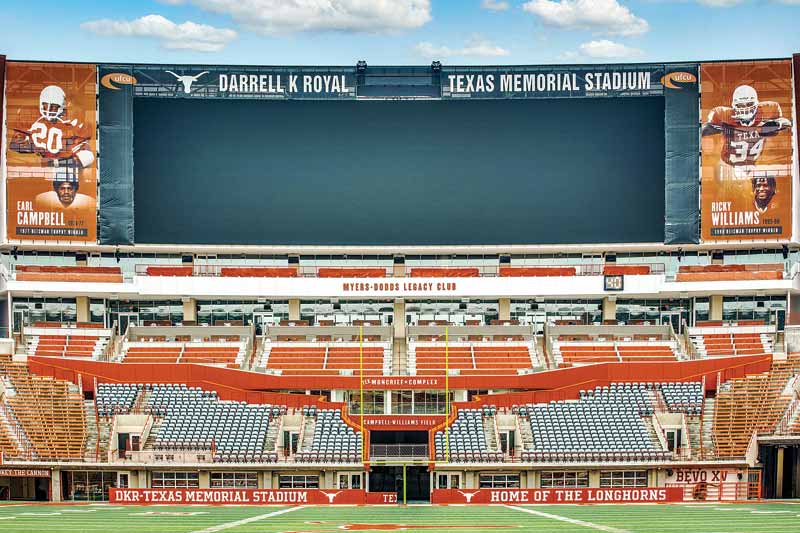
The Darrell K Royal-Texas Memorial Stadium at the University of Texas (UT) in Austin features the school’s iconic Longhorn logo integrated into the new seating bowl.
Architects Populous were tasked with ensuring the stadium’s design embodied the essence of the Longhorns’ spirit. ACM panels in custom orange and weathered metal finishes were selected to match the Longhorns’ team colors. The project included 4,478 m2 (48,200 sf) of ACM panels and 735.8 m2 (7,920 sf) of metal trim, fabricated and installed by Byrne Metals. The company fabricated and installed approximately 900 ACM panels cladding pieces and roughly 800 trim pieces—for the project.
The panels required precise color matching, ensuring the university’s iconic colors were prominently displayed throughout the facility. According to Matt Hubbell, Byrne Metals’ operations manager, the complex Longhorn silhouette seating bowl design, measuring 65.5 x 21.9 m (215 x 72 ft), demanded meticulous fabrication and installation to achieve the desired outcome.
“We spent significant time color matching the metal cladding,” says Drew Martin, executive senior associate athletics director for external affairs/intercollegiate athletics, University of Texas at Austin. “We made sure we drilled down to the exact Pantone color. The university’s iconic burnt orange and white colors are so present in the facility and are exclusive to UT.” For more information on this project, visit alucobondusa.com/blog/new-stadium-end-zone-stands-out-with-first-ever-seating-bowl-team-logo-clad-in-alucobond-plus/.
Prairie View Middle School
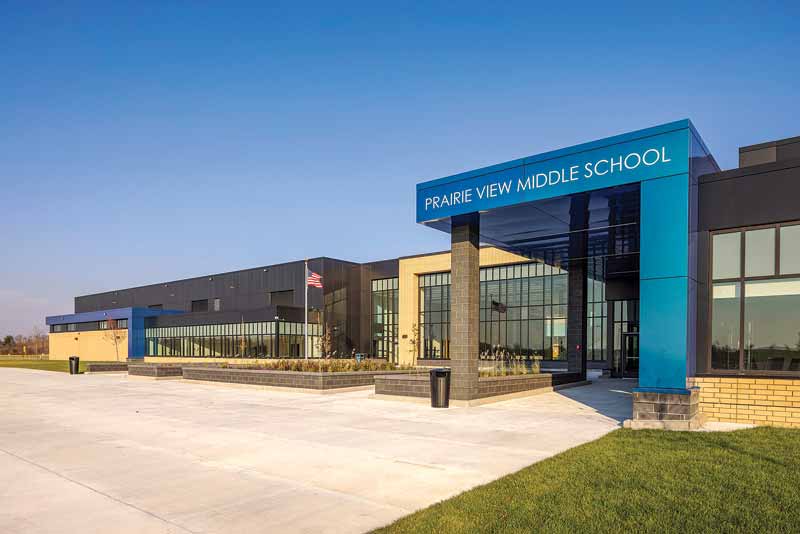
Wold Architects & Engineers designed Prairie View Middle School in Otsego, Minn. with a focus on future innovation. The school’s exterior features ACM panels in vibrant finishes, symbolizing energy and positivity. The modern architectural style, characterized by clean lines and dynamic shapes, fosters an atmosphere conducive to creativity and discovery, welcoming students into a personalized learning community.
Fabricator Innovative Building Concepts played an integral role in realizing the design, ensuring the ACM panels were precisely fabricated and installed to achieve the desired aesthetic and functional outcomes. The combination of bold finish choices was especially critical to the new school’s look, helping students cultivate a sense of excitement about being part of a personalized learning community. By incorporating the vibrant and inviting hues of ACM panels, the design fosters an atmosphere conducive to creativity and discovery.
Raymond Elementary School
The modernization and expansion of historic Raymond Elementary School in Washington, D.C., focused on sustainability and preserving the building’s legacy. STUDIOS Architecture collaborated with the Historic Preservation Office to develop a plan that included demolishing one wing and adding a 4,645 m2 (50,000 sf) addition. The new design, clad with metallic-finish ACM panels, achieved LEED Gold certification and aligned with historic design standards.
Fabricator Delray Contracting was instrumental in the project’s success, ensuring the precise fabrication and installation of the ACM panels to meet the stringent requirements of the design and historic preservation standards. The design accommodates more students and includes a gymnasium, library, and classrooms, along with an enhanced entry sequence. Clad with metallic-finish ACM panels, the building contributed to the project achieving LEED Gold certification, demonstrating the integration of urban education, historic preservation, and sustainability.
Conclusion
ACM panels play a significant role in creating educational spaces that inspire students and enhance learning environments. Their versatility, durability, and aesthetic appeal make them an ideal choice for building systems contractors, general contractors, suppliers, architects, designers, and fabricators. These case studies demonstrate how ACM panels can transform educational facilities, fostering enthusiasm for learning and contributing to thriving academic communities.