IMP installation saves both labor and installation time
When the California Department of Corrections and Rehabilitation
(CDCR) bid out the new California Health Care Facility inmate hospital to be built in Stockton, Calif., it was apparent that scheduling would be paramount to its success. The planned peak for manpower during construction would be 1,700 workers on an expansive 144-acre site. This meant that in addition to the timing, logistics and accessibility would be a major challenge. When 791,000 square feet of the facility’s planned 1.2 million square feet called for a traditional built-up architectural metal roof, Mike Harnack, sales manager for Roland Construction in Stockton, started looking into Vacaville, Calif.- based All Weather Insulated Panel’s (AWIP) standing seam roof system in hopes he might save both labor and installation time.
An alternate improvement Submitting insulated metal roof panels as an “alternate” was an improvement. Roland worked with the successful prime contracting joint venture team Clark/McCarthy, consisting of Chicago-based Clark Construction Group and St. Louis-based McCarthy Building Companies. Clark/McCarthy worked with CDCR prior to the bid date to make sure that this alternate roof system would be acceptable to the state. Not only was it deemed acceptable, it was considered an upgraded material in the final design-build package submitted for consideration. The specification was subsequently amended to include insulated metal panels for the architectural roofing before subcontractors submitted bids. When the bids were opened, Harnack’s plan was chosen. Design work began in January 2012 for the 23 buildings’ roofs. The 4-inch-thick, SR-2 standing seam insulated roof panel by AWIP was selected with a 22-guage exterior skin coated in Natural Green Kynar paint. With the excellent insulating properties of the insulated metal panel
(R-value= 32 for a 4-inch panel), the darker color could be used and still comply with the project’s LEED Silver Certification.
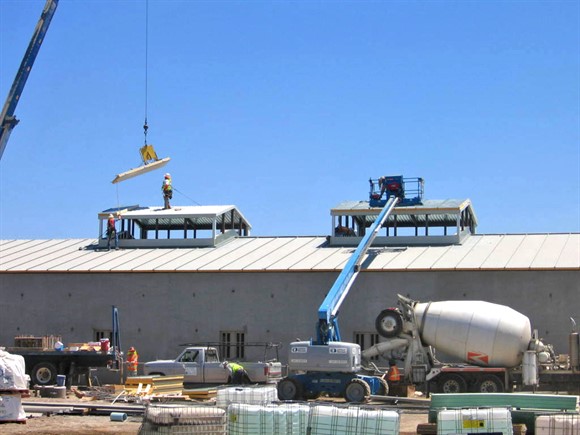
Starting in January, several mock-ups were completed, including a full-scale mock-up of the building on-site. Both the AWIP and Roland design teams devoted many hours to this project. Fifteen workers installed up to 22,950 square feet a day. Installation of the first roof panels began in May. Over the course of the next six months Roland utilized three separate installation crews, each with its own crane to erect the roof panels. At the peak of production, each five-man crew was capable of installing up to 7,650 square feet in a single day. That kind of production would have been impossible with as few people utilizing any other type of roof system. Following behind the roof paneling crews were several other crews installing the AWIP 2 1/2-inch DM40 wall panels, flashings and trims to encapsulate the 192 individual “light monitors” on the project. These are cupola-like structures located on the building roofs with windows on all sides in order to invite natural light into the buildings.
Keys to success
One of the keys to the success of the installation crews was a Wood’s Powr-Grip vacuum lifter provided by Automatic Panel Lifting System (APLS) of Auburn, Calif. They are designed to be hung from a crane or forklift, and with the proper attachment setup, are capable of raising panels up to 60-feet long and weighing approximately 600 pounds each. With the panels being able to be lifted and released in a matter of seconds, production was increased dramatically over traditional sling methods in order to meet the project’s break-neck schedule.
 |
|
It was also important for the success of the project to minimize the amount of on-site materials as much as possible. This made scheduling a key component not only to construction, but to manufacturing as well. Since there was not enough space to store 1,200 bundles of AWIP roof panels in any one space, production had to be paced with installation, and a choreographed dance of trucks, forklifts and installation crews was required to be executed in extremely compact areas.
The use of AWIP’s insulated metal roof panels for this project proved to be the decision that made this job feasible. The reduction in installation man-hours not only saved schedule time, but more than made up for the additional material cost over a more traditional built-up insulation and metal roof system. Bill Lowery, president of AWIP says: “We believe that superior customer service is ultimately what differentiates us from other IMP manufacturers. The sheer scope and aggressive construction schedule on the CHCF project provided AWIP with some unique challenges and the opportunity to support our customer, Roland Construction.”
Jim Hoagland is owner of Roland Construction, Stockton Calif. To learn more, visit www.awipanels.com and www.rolandconst.com.
.