Don’t overlook air movement, one of the most beneficial elements of occupant comfort
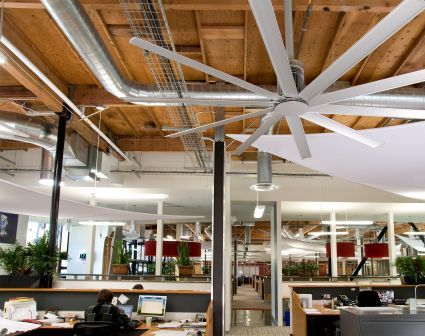
Along with making sure all the screws, bolts, beams, hinges, doors, siding, windows and roofing have been properly installed, it’s important to provide comfort within a facility. Air movement is one of the most beneficial, yet overlooked elements of occupant comfort regardless of climate or season. Operating solo, accompanying natural ventilation or specified to work alongside an HVAC system, large overhead fans, up to 24 feet in diameter, are key to supplying the necessary required thermal comfort to any building.
How they work
The effectiveness of a large-diameter, low-speed fan lies in its ability to move great volumes of air slowly and gently without disrupting the occupant’s desired atmosphere. During the cooling season, with fans operating between 60 to 100 percent of capacity, the additional air movement does not cool the air, but rather creates a cooling sensation of up to 10 F through evaporative cooling; the body’s natural cooling process.
In the winter months, in lieu of reversing the fans, large overhead fans are capable of destratifying the air within a space by simply reducing the speed to 10 to 30 percent of maximum speed, conserving heat-energy consumption by as much as 30 percent. Considering hot air naturally rises as cold air falls, these fans mix the two extremes by redirecting warm air from the ceiling to the occupant level, creating a more uniform temperature without causing a draft.
Tandem operation
In air-conditioned facilities, fans efficiently circulate the conditioned air, reducing the need for ductwork while decreasing the system’s load. At the same time, the fans are easily integrated into the mechanical system via a building automation system (BAS), increasing effectiveness by operating as part of the HVAC system.
In the cooler months, mixing the air destratifies a space, resulting in more uniform temperatures, cost savings from reduced energy consumption, and quicker warm-up times for buildings with variable occupancy. Savings accrue by slowly circulating heat trapped at the ceiling level down to the occupant/thermostat level before it is able to escape from the space. Even though the thermostat set point remains the same, the heating system does not have to run as long, or work as hard to maintain the given set point.
 |
Based on square footage, capacity and usage, there are minimum requirements for the amount of fresh air that needs to be brought into a space specified by ASHRAE Standard 62.1-2010, Ventilation for Acceptable Indoor Air Quality. With a traditional HVAC system, only about 80 percent of the fresh air brought into a space reaches the designated occupant level; given the ventilation requirements, some systems are designed to overcompensate to achieve these minimums. Large-diameter, low-speed fans assist the ventilation system by ensuring a thorough mixing of air and reducing the need to overcompensate with costly mechanical equipment.
The mechanics
Along with understanding the crucial role airflow plays in thermal comfort and energy efficiency, it’s also important to understand how these benefits are achieved mechanically. Properly engineered, large-diameter, low-speed fans take advantage of their immense size-not speed-to move a massive amount of air in spaces where traditional, high-velocity fans are rendered ineffective. When the airfoil length is doubled you’ve increased the surface area that those airfoils sweep times four. As the size gets larger, the amount of air the fan moves increases at a much faster rate than the amount of power it takes to turn. So, with all things being equal, the fan will become more efficient.
Airfoil design also plays a key role in determining the effectiveness of the fan. The shape of the foil combined with its pitch, or angle of attack, are the key parameters in determining how much air will be moved and how much energy will be required in the effort. An exaggerated pitch, airfoils with an almost vertical angle of attack, will either increase drag (and increase energy draw), while a flat, mostly horizontal airfoil will typically not move much air at all; the most efficient angle lies somewhere in between. The operational speed ranges at which a fan operates also contributes to effectiveness.
While running a given fan faster may move more air, there is a point of diminishing returns, where the increase in energy required exceeds the additional air movement and the system loses its efficiency. The optimal fan design combines the most air movement with the least amount of energy use. The key is finding the optimal combination of size, speed, airfoil shape and position to produce the most air movement with the least amount of energy.
High, low, noisy, quiet
Ceiling height, square footage and space usage are all important environmental factors that affect fan performance, and thus their ability to improve the thermal comfort, as well as the health needs of occupants. To accommodate these varying factors, overhead fans have gone through a transformation over the past few years leveling the playing field between design and technology.
While ceiling fans offer enhanced thermal comfort to the occupants, it is also important to understand that advances in engineering design and manufacturing have allowed products to become more energy efficient and operate more quietly. Direct-drive motors and high-efficiency airfoils yield maximum efficiency without disrupting ambience, making contemporary ceiling fans far more appealing than their predecessors, especially in sound-sensitive environments that benefit from elevated air speed, such as classrooms, libraries and offices.
Nina Wolgelenter is senior writer at Big Ass Fans Co., Lexington, Ky.
For more information, visit www.bigassfans.com.