Years with presidential elections are always full of uncertainty, and business owners generally act cautiously. This year the uncertainty appeared more pronounced, compounded by the looming tax rates and budget cuts that have become known as the “Fiscal Cliff.”
While housing starts seem to be a brightening arena, it is still tenuous and that is reflected in the construction employment numbers. Still, there are positive signs for the industry as it begins to dig out from a deep hole.
Value of Construction Put in Place in the United States, Seasonally Adjusted Annual Rate
(Millions of dollars. Details may not add to totals due to rounding.)
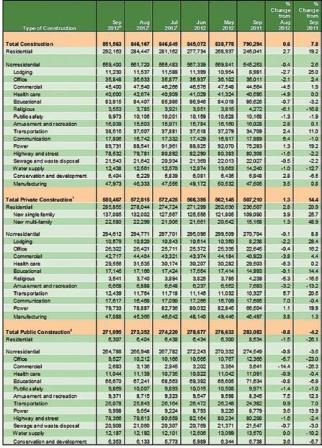
Total construction is up 7.8 percent from September 2011 to September 2012, with strong private construction increases offsetting declines in public sector construction. Most of those declines came in the office and commercial segments. Showing a relatively strong bounce has been the increase in private residential construction, reflecting the recent growth in the housing market. (Source: U.S. Census Bureau)
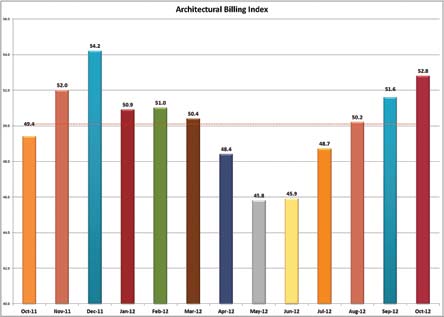
ABI Shows Increased Confidence
The American Institute of Architects produces the Architectural Billing Index on a monthly basis. It is a leading indicator that reflects the work on the books within architectural firms and can be predictive of future construction work. An index number above 50 shows a positive assessment of the market, while a number below 50 shows a negative assessment. After a spate of strongly negative sentiment earlier in the year, the ABI has reflected a strong come back, indicating a strengthening construction market. (Source: American Institute of Architects)
Housing Starts Start with Multifamily
The charts on single-family and multifamily starts show the steep decline in the new home market
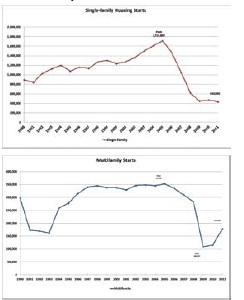
that was a key drag on the overall economy with housing in general. Pegged at about 15 percent of the Gross Domestic Product, the housing market can be a determining factor for investment in other segments and a strong influence on consumer sentiment.
The growth in multifamily building is indicative of a housing recovery, which tends to come through multifamily first, but it is more indicative of a demographic trend as the Echo Boomers enter the rental market, increasing demand for rental space. (Source: National Association of Home Builders)
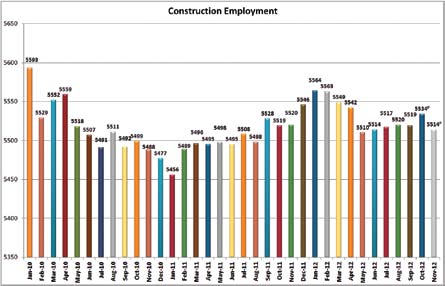
Employment Takes a Hit After Sandy
Construction companies are, understandably, reluctant to hire given the tenuous nature of the economic recovery. Thwarting recent increases was the devastation caused by Tropical Storm Sandy, which shut down millions of workers in the Northeast for a period of a couple of weeks. The bounce back from that impact should be quick, though, as well as have long-term consequences for construction employment as the region begins to rebuild. (Source: Bureau of Labor Statistics)