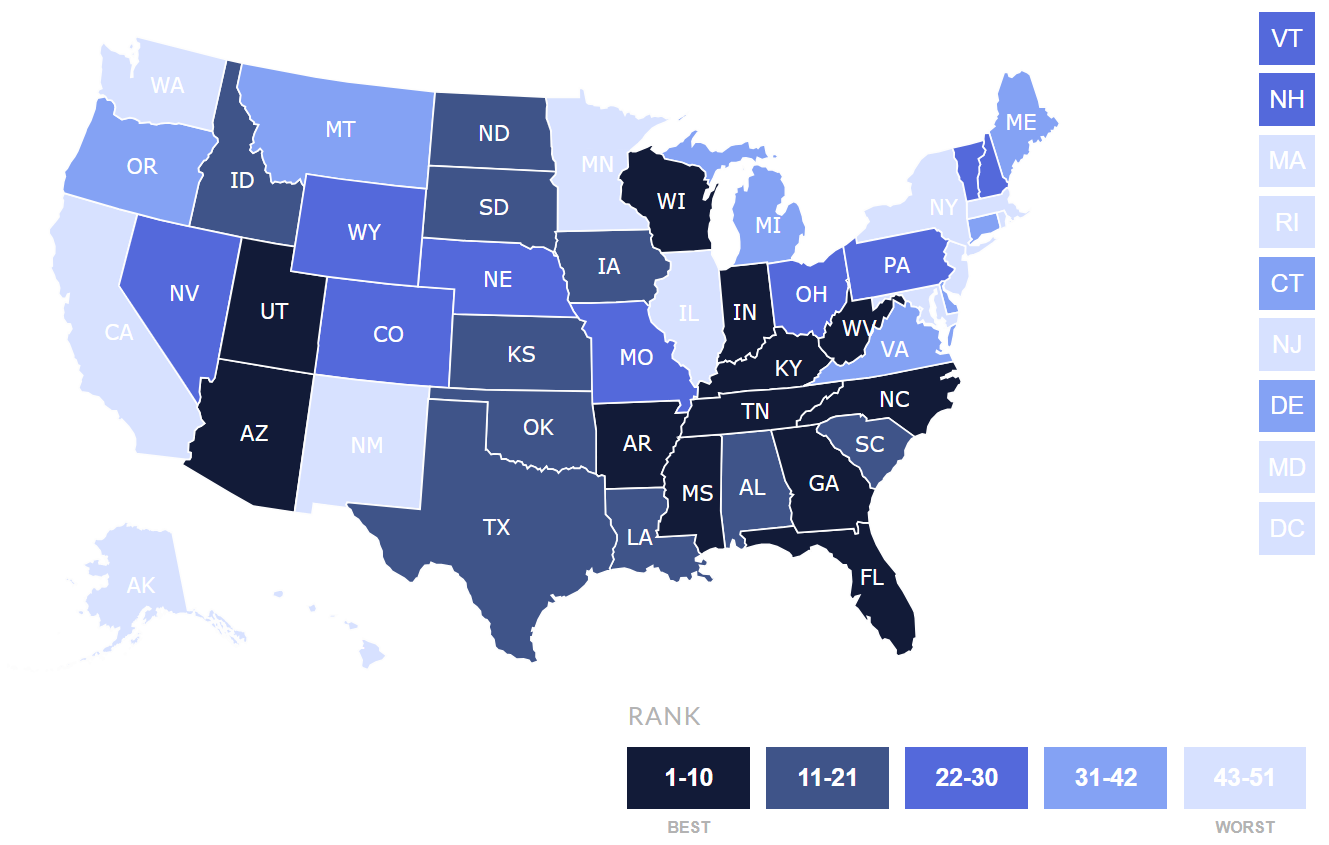
Wisconsin is the No. 1 state for construction, according to Associated Builders and Contractors’ 10th annual Merit Shop Scorecard. The scorecard, released annually since 2015, ranks all 50 states and the District of Columbia based on policies and programs that better career pathways in construction, further workforce development, and strengthen fair and open competition on taxpayer-funded construction projects. Arkansas, Kentucky, West Virginia and Florida rounded out the top five states in 2024, in ranking order.
“Policies and processes that protect free enterprise, promote economic growth, reduce regulatory burdens and expand workforce development create the conditions to welcome all of the U.S. construction industry to rebuild America’s infrastructure,” says Ben Brubeck, ABC’s vice president of regulatory, labor and state affairs. “States like Wisconsin, Arkansas, Kentucky, West Virginia and Florida set the standard in favorable conditions for the construction industry, and its workforce, to thrive. Hard-working taxpayers are best served by a regulatory environment that creates a level playing field for all contractors to build America with fewer obstacles.”
The bottom five states, in ranking order, were Washington, the District of Columbia, Illinois, New York and Hawaii, each receiving poor ratings for creating conditions and policies that allow merit shop contractors to thrive, according to ABC.
“Low-performing states maintain policies unfriendly to open shop contractors and taxpayers, such as encouraging or requiring the use of government-mandated PLAs on state and/or local projects … Policies limiting opportunity for the merit shop workforce, which makes up the majority of construction workers in these states, also lead to lower-than-desired outcomes in workforce readiness and job growth for the construction industry, whether union or merit shop,” a press release regarding the scorecard states.
The 2024 Building America: The Merit Shop Scorecard rates state laws, programs, policies and statistics in seven categories: project labor agreements, prevailing wage laws, right-to-work laws, public-private partnerships, workforce development, CTE and job growth rate.