Most business owners focus lots of their energy trying to cut their costs by being more efficient, working faster, buying cheaper, not wasting any money, keeping their crews busy, or doing all the pricing and ordering themselves. Spending all your time focused on cutting your costs won’t improve your bottom-line unless you keep some of the savings for yourself. Most contractors add up their material costs, and mark them up at the same rate.
What should you do when you get a 10 percent better price on material, or a lower bid from a subcontractor? By always passing along the entire costs savings generated by your hard work or negotiating skills, you are actually hurting your bottom line. By using the lower cost in your estimate, and then adding a 20 percent mark-up for overhead and profit, the actual gross profit and final selling price is lower than if the materials or subcontract had been ordered at the original higher price. Look at these examples:
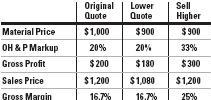
Review the three examples above. The “Original Quote” mark-up example shows the result of getting a material price of $1,000 and then selling it at $1,200. The next “Lower Quote” example shows what happens when you work hard to get a lower price and then pass all of the savings on to your customer. The “Sell Higher” example shows what happens when you get a lower price for material and then still sell the item at the market value or what the customer is willing to pay for the work. Should you always offer your customer the lowest price on every bid and purchase on the job? On the ‘Sell Higher’ example, you purchased material or subcontracted work for $ 900 and still sold it for $1,200. Your gross margin increased from 16.7 to 25 percent. A huge difference in your bottom line!
What if you buy in bulk?
When I was remodeling our home, the contract with the electrician included an allowance for the number of light switches and power outlets we anticipated. When the walls were framed, I walked the job with him and located where we wanted the switches, lights and outlets. He told me the final number was larger than the amount he had included in the contract. No problem for me. I still wanted them. He then told me he had already bought the switches and outlets included in the contract at a quantity discount and he would now have to charge me more per extra outlet because he couldn’t get the same price from his supplier.
I was thinking, on every house built there are lots of switches and power outlets. If I was an electrician, I would buy them by the case, pallet or car load to get the best price I could and store them in my warehouse. The selling price would still be the same but I would make more money by buying them at a lower price in bulk. What can you buy in bulk to save money? Wealthy drywall contractors buy their drywall and metal studs by the train car load. The same principal applies for rebar, lumber, irrigation pipe, copper pipe, and all the other materials subcontractors and contractors need on every job. When you buy small job amounts from wholesale houses, you pay 5 to 20 percent more for materials. Want to boost your bottom line? Look at your annual purchases and start buying items you use over and over in bulk. This tool should make you at least 2 to 5 percent on your bottom line.
Should you always pass the lowest cost along?
There are many instances when you work hard to get a lower price. Should your customer always get the full benefit of your efforts? What about on change orders? Should your change order cost include the cheapest price you bought the materials for, or what the market price is for the item? Should you always pass your contractor discounts along to your customers? By presenting a lump sum or a cost plus price for changes using the market versus the cheapest price for materials, you can increase your gross margins significantly.
Think about how you price work and sell your services. Bidding with the cheapest price you buy materials for is not always the best way to approach your customers. Want to make more money? Decide how you will estimate your jobs based on what your customer is buying. It is not always about being the lowest price contractor to get work or keep your customers happy.
George Hedley is a licensed professional business coach, popular professional speaker and author of “Get Your Business to Work!” available at his online bookstore. He works with contractors to build profitable growing companies. To request your free copy of “Profit 101 For Contractors,” sign up for his free monthly e-newsletter, hire Hedley to speak, be part of his ongoing BIZCOACH program, or take a class at Hardhat BIZSCHOOL online university, visit www.hardhatpresentations.com or email gh@hardhatpresentations.com.