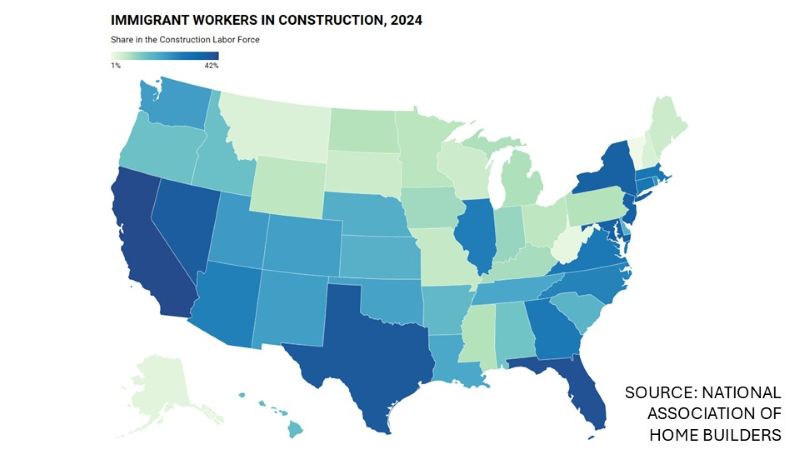
Immigrants’ share of the construction workforce reached a record high in 2024, with foreign-born workers accounting for more than a quarter of the industry’s labor force (26.3%). The share is even higher among construction trades, for which one in three craftsmen is foreign-born.
That, according to a report authored by Natalia Siniavskaia, Ph.D., the assistant vice president for housing policy research at the National Association of Home Builders (NAHB).
Her article “Which states and construction trades depend the most on immigrant workers?” also finds that reliance on foreign-born labor is especially pronounced in California and Florida (where immigrants make up more than 40% of the construction workforce), Texas (39%) and Nevada (38%).
The concentration of immigrants is particularly high in construction trades that are essential to building homes, such as roofers (53%).
The two most prevalent construction occupations, laborers and carpenters, account for more than a quarter of the industry’s labor force. Among them, 35% of carpenters and 43% of construction laborers are foreign-born.
“These trades typically require less formal education, yet such workers consistently rank among those with the most severe labor shortages,” Siniavskaia writes.
In a survey from April 2025, more than half of builders reported either some or a serious shortage of workers performing finished carpentry. Shortages are similarly widespread for other construction trades directly employed by builders, such as bricklayers and masons.
More than half (52%) of the nation’s three million immigrant construction workers reside in the four most populous states (California, Texas, Florida, New York), which comes as no surprise.
“These states are not only the largest by population but also longstanding immigrant gateways, making them particularly reliant on foreign-born construction labor,” writes Siniavskaia.
Immigrants comprise 42% of the construction workforce in California and 41% in Florida, followed by 39% in Texas and 37% in New York.
That said, reliance on foreign-born labor is expanding beyond these traditional hubs. Nevada, for example, recorded the fourth-highest share of immigrant construction workers in 2024 (38%), closely trailing Texas.
Maryland and New Jersey also reflect this broader trend, with immigrants accounting for 37% of the construction labor force in each state.
In Connecticut, Massachusetts, Georgia, Virginia, Illinois, Arizona, and North Carolina, more than one-quarter of construction workers are foreign-born.
At the other end of the spectrum, several states, including New Hampshire, Montana, Alaska, West Virginia, and Vermont, have immigrant shares below 5%.
“Because immigrant workers are disproportionately concentrated in construction trades, their presence among craftsmen exceeds their overall share of the industry in every state,” Siniavskaia notes.
In California and Texas, immigrants account for more than half of all construction tradesmen. In Florida, Maryland, and Nevada, the shares are similarly elevated, approaching 50%, while in New Jersey and New York, more than 45% of craftsmen are foreign-born.
While most states draw most of their foreign-born workers from the Americas, Hawaii relies more heavily on Asian immigrants. European immigrants are a significant source of construction labor in New York, New Jersey, and Illinois.